

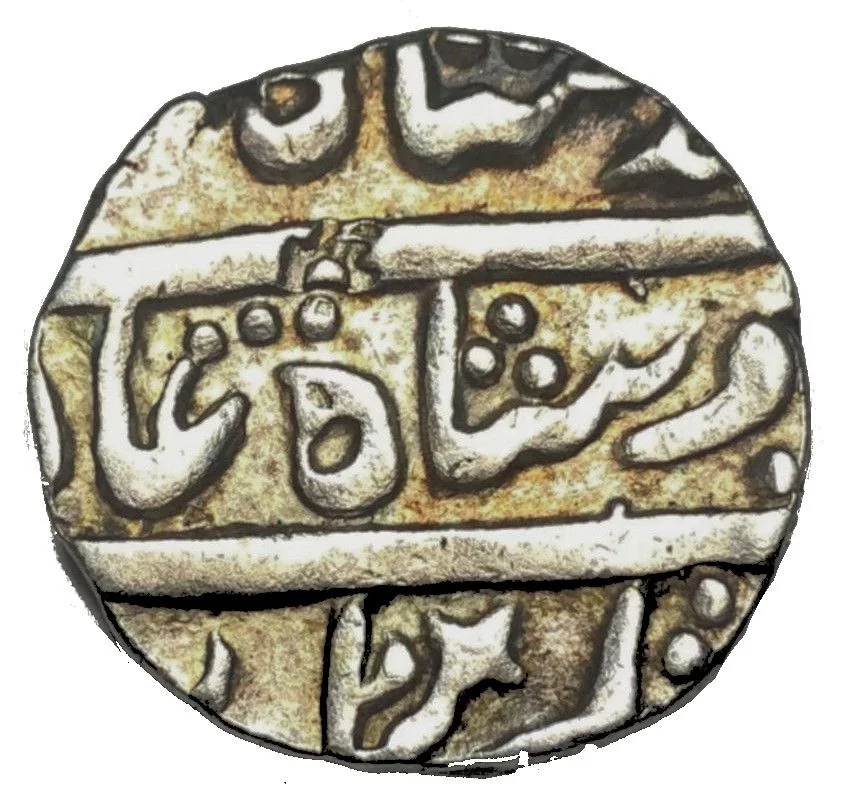
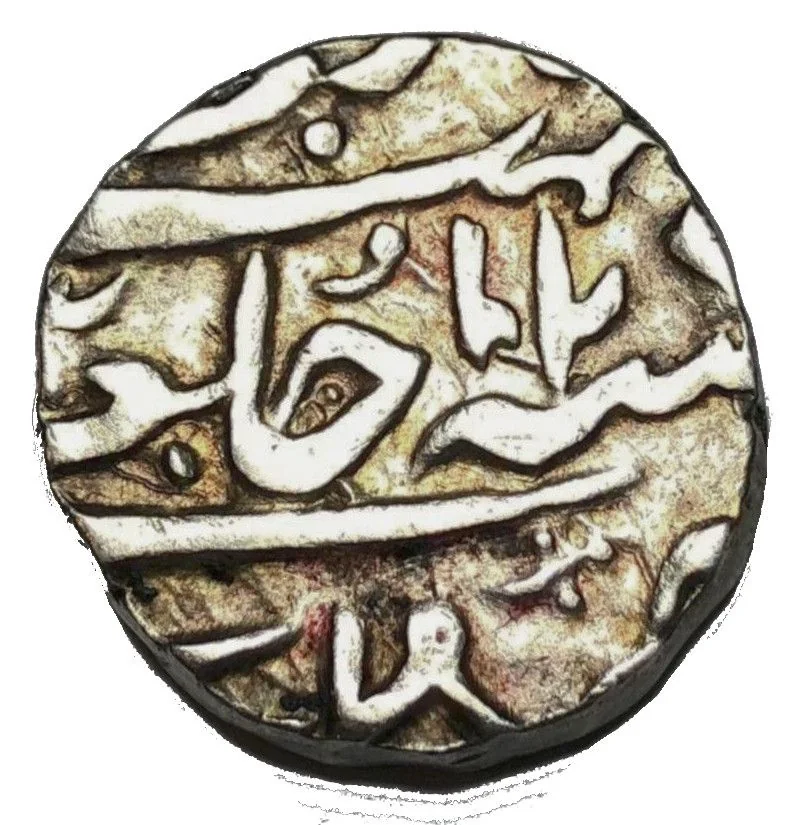
1 Rupee – Maratha Empire
India
Context

Material
Diameter: 21 mm
Weight: 10.7 g
Silver weight: 10.70 g
Thickness: 3.5 mm
Shape: Irregular round
Composition: Silver
Magnetic: No
References
KM: #Click to copy to clipboard438
Numista: #321778
Value
Bullion value: $30.62
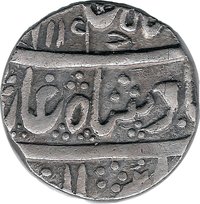
Obverse
Description:
Named for Raghoji II.
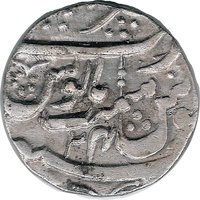
Reverse
Description:
Surat pseudo-mint, upside-down 'Ma' with dagger.
Inscription:
Persian
Edge
Lettering:Persian
Legend:
Persian
Mintings
| Year | Mint Mark | Mintage | Quality | Collection |
|---|---|---|---|---|
| — | — | — |
Historical background
By 1772, the Maratha Empire, under the nominal leadership of the Peshwa in Pune, was a vast but increasingly decentralized confederacy. This political structure was mirrored in its monetary system, which lacked a single, uniform imperial currency. Instead, the economy operated on a complex and heterogeneous mix of coins. The most prominent and widely accepted was the Chhatrapati Shivaji Maharaj hon, a gold coin, and its silver counterpart, the rupee, often minted by various Maratha sardars like the Holkars, Scindias, and Gaikwads in their own territories. These circulated alongside a plethora of older Mughal rupees, Portuguese xerafins in coastal areas, and coins from other regional powers, creating a landscape where currency value and purity depended heavily on the prestige of the minting authority.
This monetary fragmentation was exacerbated by the aftermath of the Third Battle of Panipat in 1761. The catastrophic defeat had drained the central treasury and accelerated the shift of power from the Peshwa to the major feudal lords. As these sardars grew in autonomy, so did their right of coinage (sanad), leading to inconsistencies in weight and fineness. While the Peshwa's mint in Pune attempted to maintain a standard, the system relied heavily on money changers (sarrafs) who were essential for assessing the intrinsic metal value of countless coin types and facilitating trade. This informal network, though functional, introduced transaction costs and uncertainty.
Financially, the year 1772 was particularly significant as it marked the beginning of a major crisis. The Peshwa, Madhavrao I, a capable administrator who had been stabilizing the empire, died of tuberculosis in November. His death plunged the confederacy into a succession struggle and political chaos, further undermining any prospect of monetary reform. Consequently, the currency situation remained a patchwork, reflecting the empire's political reality: a collection of powerful, semi-independent states with a weakened central authority, trying to govern an economy without a unified monetary standard.
This monetary fragmentation was exacerbated by the aftermath of the Third Battle of Panipat in 1761. The catastrophic defeat had drained the central treasury and accelerated the shift of power from the Peshwa to the major feudal lords. As these sardars grew in autonomy, so did their right of coinage (sanad), leading to inconsistencies in weight and fineness. While the Peshwa's mint in Pune attempted to maintain a standard, the system relied heavily on money changers (sarrafs) who were essential for assessing the intrinsic metal value of countless coin types and facilitating trade. This informal network, though functional, introduced transaction costs and uncertainty.
Financially, the year 1772 was particularly significant as it marked the beginning of a major crisis. The Peshwa, Madhavrao I, a capable administrator who had been stabilizing the empire, died of tuberculosis in November. His death plunged the confederacy into a succession struggle and political chaos, further undermining any prospect of monetary reform. Consequently, the currency situation remained a patchwork, reflecting the empire's political reality: a collection of powerful, semi-independent states with a weakened central authority, trying to govern an economy without a unified monetary standard.
✨ Legendary