

2 Ducats – Kingdom of Bohemia
Context
Years: 1725–1727
Country: Bohemia
Issuer: Kingdom of Bohemia
Ruler: Charles VI
Currency:
(1520—1754)
Demonetized: Yes
Material
References
KM: #Click to copy to clipboard706
Numista: #316017
Value
Bullion value: $1134.13
Obverse
Description:
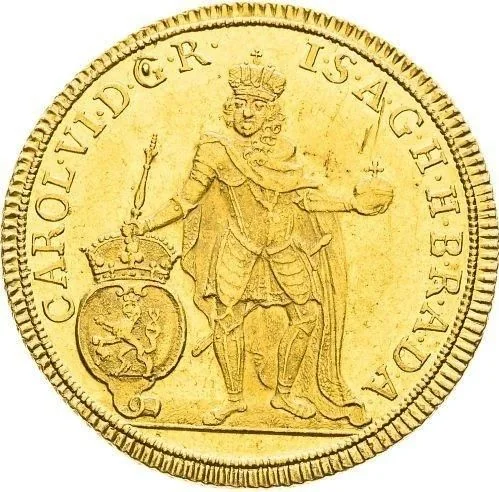
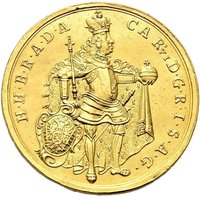
Full-length, facing right, holding orb and scepter; crowned imperial eagle shield at lower left.
Inscription:
CAROL VI D G R I S A G H H B R A D A
Script: Latin
Reverse
Description:
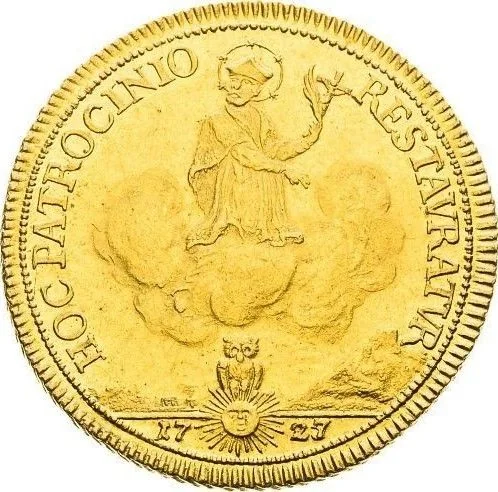
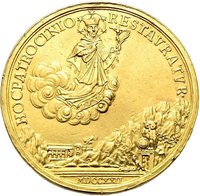
St. John above mines, owl over sun.
Inscription:
HOC PATROCINIO RESTAVRATVR
1727
1727
Script: Latin
Edge
Mints
| Name | Mark |
|---|---|
| Prague | — |
Mintings
| Year | Mint Mark | Mintage | Quality | Collection |
|---|---|---|---|---|
| 1725 | — | — | ||
| 1727 | — | — |
Historical background
In 1725, the Kingdom of Bohemia, a core crown land of the Habsburg Monarchy, operated under a complex and strained currency system. The primary circulating coin was the silver Konventionstaler, established by a 1753 convention (hence its name), but the monetary reality was dominated by the debased Wiener Kreuzer and the heavily used Groschen. A key problem was the persistence of older, lower-quality coins from previous mintings, which circulated alongside newer issues, creating confusion and facilitating clipping and counterfeiting. The state's finances, heavily burdened by the debts from the recent Wars of Spanish and Austrian Succession, placed constant pressure on the monetary system.
The authority over currency was centralized with the Habsburg state in Vienna, which dictated monetary policy for all its hereditary lands, including Bohemia. The main mint for Bohemian coins was in Prague, but its output was directed by the central treasury. A significant challenge was the discrepancy between the official Rechnungsgulden (a unit of account used for bookkeeping) and the actual value of circulating specie. Furthermore, the economy still felt the aftershocks of the great currency reform of 1700, which had attempted to stabilize the gulden but left a legacy of multiple coin types in circulation.
Consequently, everyday trade in Bohemia was characterized by practical difficulties. Merchants and the populace had to constantly evaluate the actual metal content and origin of coins, leading to localized exchange rates and distrust. While the Konventionstaler provided a standard for larger transactions and foreign trade, the small-change economy was messy and inefficient. This situation hindered commerce and was a point of contention until more comprehensive reforms, particularly those under Empress Maria Theresa decades later, sought to unify and simplify the Habsburg currency.
The authority over currency was centralized with the Habsburg state in Vienna, which dictated monetary policy for all its hereditary lands, including Bohemia. The main mint for Bohemian coins was in Prague, but its output was directed by the central treasury. A significant challenge was the discrepancy between the official Rechnungsgulden (a unit of account used for bookkeeping) and the actual value of circulating specie. Furthermore, the economy still felt the aftershocks of the great currency reform of 1700, which had attempted to stabilize the gulden but left a legacy of multiple coin types in circulation.
Consequently, everyday trade in Bohemia was characterized by practical difficulties. Merchants and the populace had to constantly evaluate the actual metal content and origin of coins, leading to localized exchange rates and distrust. While the Konventionstaler provided a standard for larger transactions and foreign trade, the small-change economy was messy and inefficient. This situation hindered commerce and was a point of contention until more comprehensive reforms, particularly those under Empress Maria Theresa decades later, sought to unify and simplify the Habsburg currency.
✨ Legendary