

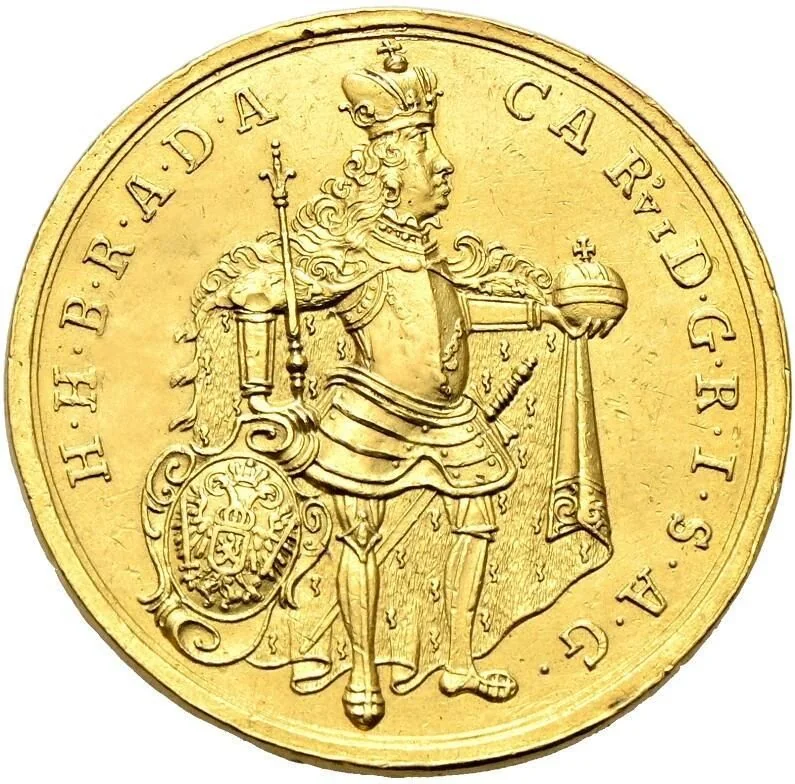
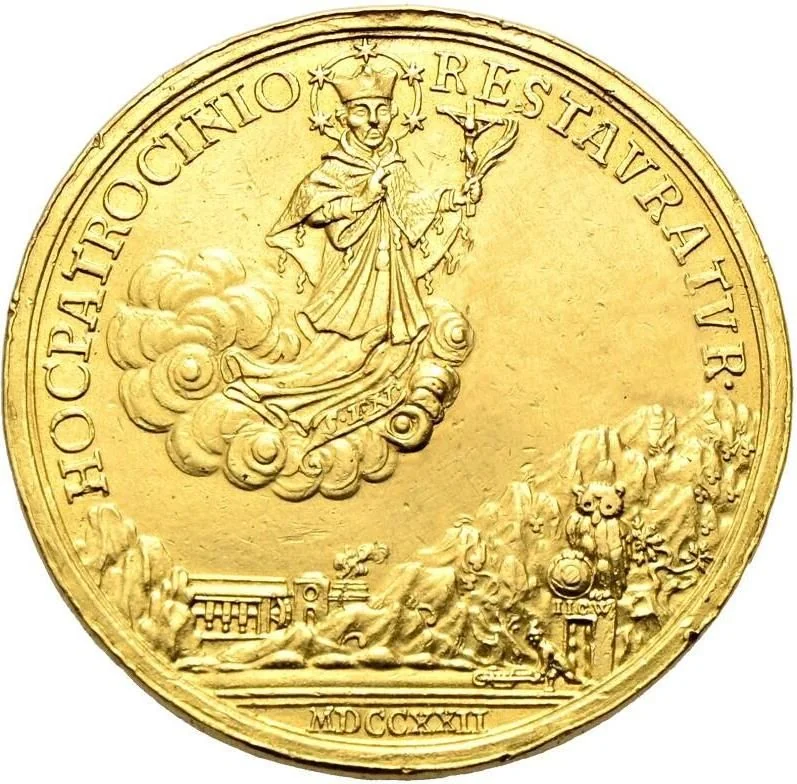
5 Ducats – Kingdom of Bohemia
Context
Year: 1722
Country: Bohemia
Issuer: Kingdom of Bohemia
Ruler: Charles VI
Currency:
(1520—1754)
Demonetized: Yes
References
KM: #Click to copy to clipboard702
Numista: #311824
Value
Bullion value: $2868.11
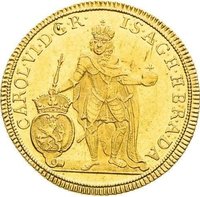
Obverse
Description:
Charles VI standing, shield at left.
Inscription:
CAR'VI D.G.R.I.S.A.G.H.H.B.R.A.D.A
Script: Latin
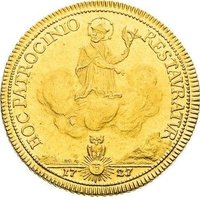
Reverse
Description:
St. John overlooking a mining scene from the clouds.
Inscription:
HOCPATROCINIO RESTAVRATVR
MDCCXXII
MDCCXXII
Script: Latin
Edge
Mints
| Name | Mark |
|---|---|
| Prague | — |
Mintings
| Year | Mint Mark | Mintage | Quality | Collection |
|---|---|---|---|---|
| 1722 | — | — |
Historical background
In 1722, the Kingdom of Bohemia, a core crown land of the Habsburg Monarchy, was navigating a period of monetary instability and transition. The region was still grappling with the aftermath of the Great Turkish War and the costly War of the Spanish Succession, which had strained imperial finances and led to repeated debasements of the coinage. The circulating medium was a complex mix, including older, debased Reichsthalers, Kreuzers, and Groschen, alongside newer coins minted under imperial authority, creating confusion in trade and public distrust.
The primary monetary framework was governed by the imperial Reichsmünzfuß (imperial minting standard), most recently revised in 1739. However, the 1720s were a precursor to this reform, characterized by efforts to stabilize and unify the currency across the Habsburg domains. In Bohemia specifically, the Prague mint was active, producing coins that were supposed to align with these imperial standards, but the simultaneous circulation of older, inferior coins from previous debasements created a persistent gap between official face value and intrinsic silver content.
This situation posed significant challenges for the Bohemian economy, which was increasingly commercialized and export-oriented, particularly in textiles and agriculture. Merchants and estates had to contend with exchange rate fluctuations and the practical difficulties of everyday transactions. The monetary confusion of 1722 was part of a longer process that would eventually lead to more centralized and stable Habsburg monetary policies, but in that year, it remained a source of economic friction and a testament to the ongoing project of financial consolidation within the empire.
The primary monetary framework was governed by the imperial Reichsmünzfuß (imperial minting standard), most recently revised in 1739. However, the 1720s were a precursor to this reform, characterized by efforts to stabilize and unify the currency across the Habsburg domains. In Bohemia specifically, the Prague mint was active, producing coins that were supposed to align with these imperial standards, but the simultaneous circulation of older, inferior coins from previous debasements created a persistent gap between official face value and intrinsic silver content.
This situation posed significant challenges for the Bohemian economy, which was increasingly commercialized and export-oriented, particularly in textiles and agriculture. Merchants and estates had to contend with exchange rate fluctuations and the practical difficulties of everyday transactions. The monetary confusion of 1722 was part of a longer process that would eventually lead to more centralized and stable Habsburg monetary policies, but in that year, it remained a source of economic friction and a testament to the ongoing project of financial consolidation within the empire.
✨ Legendary