

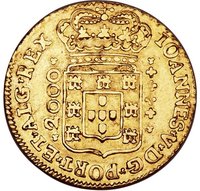
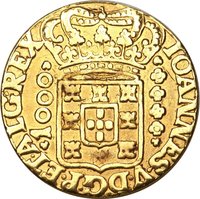
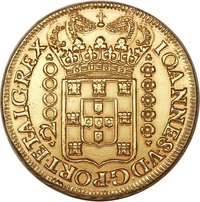
Obverse
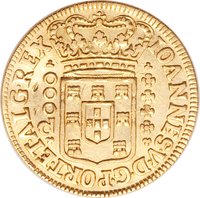
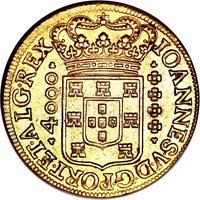
Description:
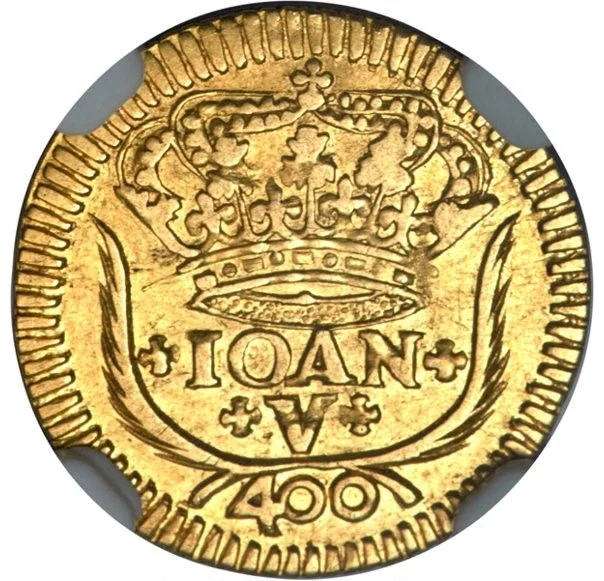
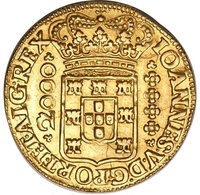
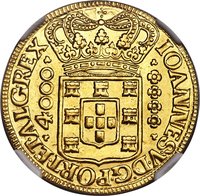
Royal crown with two intertwined wreaths, value 400.
Inscription:
+IOAN+
+V+
400
+V+
400
Script: Latin
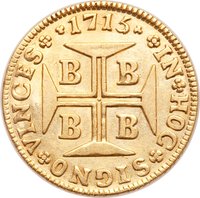
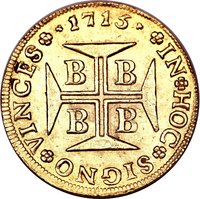
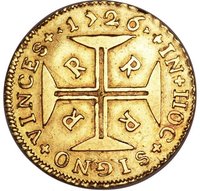
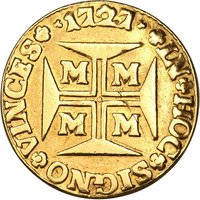
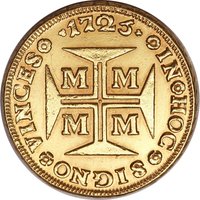
Reverse
Edge
Reeded.
Mints
| Name | Mark |
|---|---|
| Vila Rica | — |
Mintings
| Year | Mint Mark | Mintage | Quality | Collection |
|---|---|---|---|---|
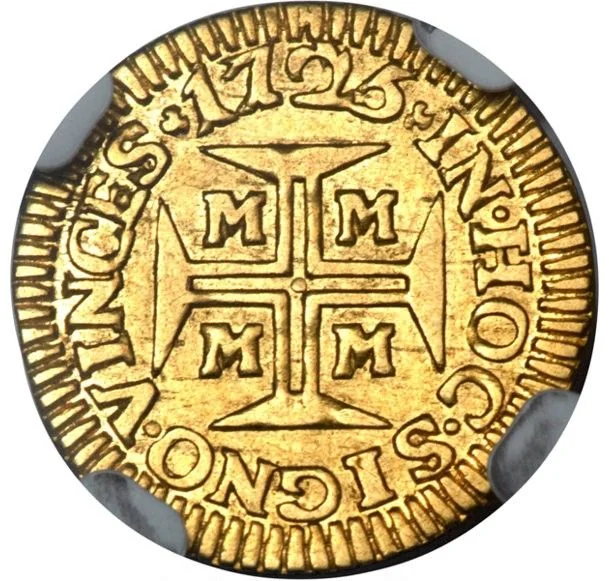
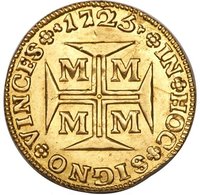
| 1724 | MMMM | — | ||
| 1725 | MMMM | — | ||
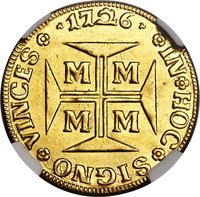
| 1726 | MMMM | — |
Historical background
In 1724, Brazil's currency situation was defined by scarcity, inconsistency, and the enduring legacy of the sugar cycle. The primary circulating medium was not a unified national coinage but a chaotic mix of Portuguese réis (in both coin and imaginary "money of account" form), Spanish-American silver pesos (particularly from Potosí), and a vast array of crude, locally minted "clipped" gold coins. The discovery of immense gold deposits in Minas Gerais in the late 1690s had shifted the colony's economic heart, but the official mint, the Casa da Moeda, had only been relocated from Salvador to Rio de Janeiro in 1703 and was struggling to meet demand. This resulted in widespread circulation of irregular gold "chips" (o ouro em pó e em pepitas), which were weighed for each transaction, leading to fraud and constant friction in commerce.
The Portuguese Crown, viewing the colony primarily as a source of wealth, exacerbated the problem through systemic extraction. Heavy taxation, particularly the royal fifth (o quinto), drained gold from the local economy. Furthermore, a severe shortage of low-denomination copper coins (moedas de baixo valor) crippled everyday market exchanges for the general population, hindering internal trade. The monetary chaos was so profound that prices were often quoted in the stable Spanish peso or even in quantities of sugar, while accounts were kept in the theoretical Portuguese réis, creating a complex and inefficient multi-tiered system.
Recognizing the disorder as a threat to both royal control and economic productivity, King João V took decisive action in 1724. He ordered the confiscation and demonetization of all the irregular, clipped gold coins, demanding they be reminted into proper, milled-edge coins at the Rio mint. This reform, while disruptive in the short term, aimed to standardize the gold currency, curb fraud, and reassert royal authority over the money supply. Thus, 1724 stands as a pivotal year of transition, marking the Crown's attempt to impose order on the wild monetary frontier of its richest colony, moving from a fragmented, commodity-based system toward a more centralized, coin-based one.
The Portuguese Crown, viewing the colony primarily as a source of wealth, exacerbated the problem through systemic extraction. Heavy taxation, particularly the royal fifth (o quinto), drained gold from the local economy. Furthermore, a severe shortage of low-denomination copper coins (moedas de baixo valor) crippled everyday market exchanges for the general population, hindering internal trade. The monetary chaos was so profound that prices were often quoted in the stable Spanish peso or even in quantities of sugar, while accounts were kept in the theoretical Portuguese réis, creating a complex and inefficient multi-tiered system.
Recognizing the disorder as a threat to both royal control and economic productivity, King João V took decisive action in 1724. He ordered the confiscation and demonetization of all the irregular, clipped gold coins, demanding they be reminted into proper, milled-edge coins at the Rio mint. This reform, while disruptive in the short term, aimed to standardize the gold currency, curb fraud, and reassert royal authority over the money supply. Thus, 1724 stands as a pivotal year of transition, marking the Crown's attempt to impose order on the wild monetary frontier of its richest colony, moving from a fragmented, commodity-based system toward a more centralized, coin-based one.
Series: Serie of Doubloons
✨ Legendary