

1 Mohur – Mughal Empire
India
Context
Year: 1624
Islamic (Hijri) Year: 1033
Country: India 
Issuer: Mughal Empire
Ruler: Jahangir I
Currency:
(1540—1842)
Demonetized: Yes
Material
References
KM: #Click to copy to clipboard180.07
Numista: #315561
Value
Bullion value: $1820.20
Obverse
Description:
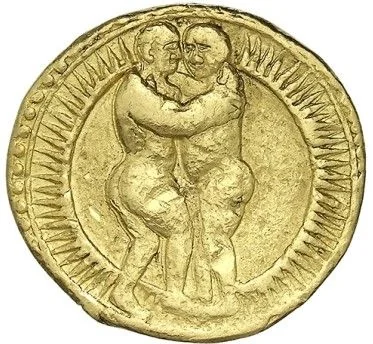
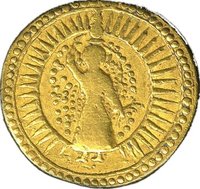
Twins with right leg up, encircled by sunbeams.
Reverse
Inscription:
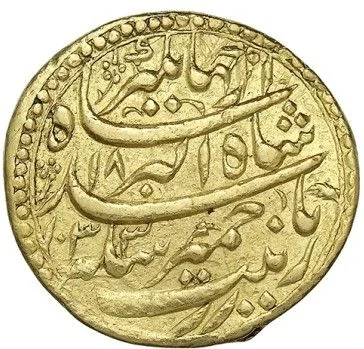
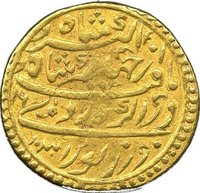
Ba Ajmer zar Zeenat shud sikka-i-Shah Jahangir [ibn] Shah Akbar
Edge
Mintings
| Year | Mint Mark | Mintage | Quality | Collection |
|---|---|---|---|---|
| 1624 | — | — |
Historical background
In 1624, the Mughal Empire's currency system was a well-established and sophisticated bimetallic standard, operating under the reign of Emperor Jahangir. The system was centrally controlled from the imperial mints (dar-ul-zarb), with the silver rupee as the primary unit of account and medium for large transactions, taxation, and state revenue. It was complemented by the gold mohur, used for high-value transactions, hoarding, and ceremonial purposes, and a variety of copper dam coins, which served as the everyday small change for the vast majority of the population. The purity and weight of these coins, particularly the rupee, were remarkably consistent across the empire, a testament to the administrative efficiency of the Mughal state.
This monetary stability, however, was undergirded by a critical external dependency: a massive and continuous inflow of silver bullion from the New World. European traders, primarily the Portuguese, Dutch, and English, imported vast quantities of American silver to purchase Indian textiles, spices, and other goods. This silver was minted into rupees, effectively fueling the Mughal economy and allowing for the expansion of the money supply to match economic growth. In 1624, this system was functioning smoothly, but it made the empire vulnerable to future shifts in global trade flows. The currency's integrity was a direct reflection of the empire's political strength; any debasement or irregularity in coinage was seen as a sign of administrative weakness.
Regionally, the situation was nuanced. While imperial coins circulated widely, local and older coins from previous reigns also remained in use, especially in more distant provinces. Furthermore, the year 1624 fell within a period of relative internal peace before the later rebellions of Jahangir's reign, meaning currency production and circulation were largely uninterrupted by major internal conflict. The system's greatest strength—its reliance on imported silver—was also its latent vulnerability, though this would not become a acute crisis until much later in the 17th century when silver inflows occasionally faltered.
This monetary stability, however, was undergirded by a critical external dependency: a massive and continuous inflow of silver bullion from the New World. European traders, primarily the Portuguese, Dutch, and English, imported vast quantities of American silver to purchase Indian textiles, spices, and other goods. This silver was minted into rupees, effectively fueling the Mughal economy and allowing for the expansion of the money supply to match economic growth. In 1624, this system was functioning smoothly, but it made the empire vulnerable to future shifts in global trade flows. The currency's integrity was a direct reflection of the empire's political strength; any debasement or irregularity in coinage was seen as a sign of administrative weakness.
Regionally, the situation was nuanced. While imperial coins circulated widely, local and older coins from previous reigns also remained in use, especially in more distant provinces. Furthermore, the year 1624 fell within a period of relative internal peace before the later rebellions of Jahangir's reign, meaning currency production and circulation were largely uninterrupted by major internal conflict. The system's greatest strength—its reliance on imported silver—was also its latent vulnerability, though this would not become a acute crisis until much later in the 17th century when silver inflows occasionally faltered.
✨ Legendary