

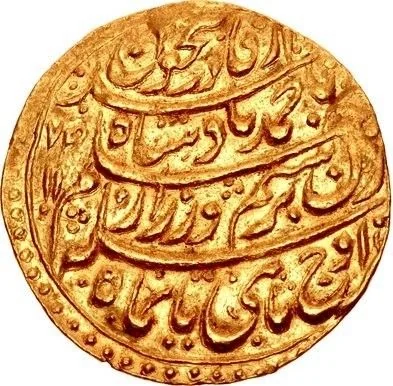
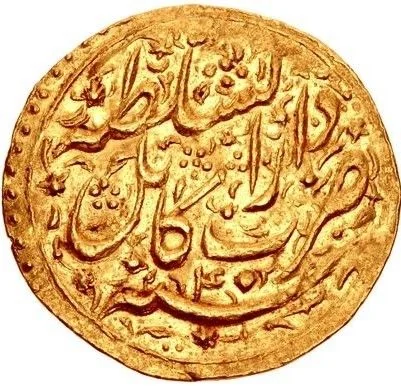
1 Mohur – Afghanistan
Afghanistan
Context
Year: 1762
Islamic (Hijri) Year: 1175
Issuer: Afghanistan 
Ruler: Ahmad Shah
Currency:
(1747—1891)
Demonetized: Yes
Material
Diameter: 33 mm
Weight: 10.94 g
Gold weight: 10.94 g
Shape: Irregular round
Composition: Gold
Magnetic: No
References
KM: #Click to copy to clipboard427
Numista: #315499
Value
Bullion value: $1822.45
Obverse
Description:
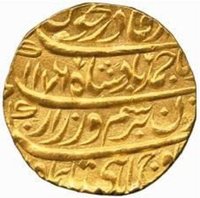
Persian couplet referencing Ahmad Shah.
Script: Arabic
Reverse
Description:
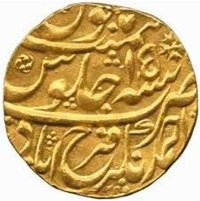
Mint RY Formula
Script: Arabic
Edge
Mints
| Name | Mark |
|---|---|
| Kabul | — |
Mintings
| Year | Mint Mark | Mintage | Quality | Collection |
|---|---|---|---|---|
| 1762 | — | — |
Historical background
In 1762, the currency situation in Afghanistan was characterized by fragmentation and transition, reflecting the region's turbulent political landscape. Following the collapse of the Hotak dynasty after the Battle of Gulnabad in 1722, and the subsequent assassination of Nader Shah Afshar in 1747, the newly founded Durrani Empire under Ahmad Shah Durrani was consolidating its power. The monetary system was not yet unified, consisting of a mix of circulating coins from previous regimes, including leftover Persian silver abbasi and lari coins, Mughal Indian rupees, and various Central Asian tillas. This created a complex and inconsistent economic environment for trade.
Ahmad Shah Durrani, recognizing the need for economic sovereignty and stability, had begun issuing his own coinage from mints in cities like Kandahar, Kabul, and Herat. The primary silver coin was the Durrani rupee, often bearing his name and titles in Persian script, which sought to establish a standard imperial currency. However, the production and reach of these new coins were still limited, and older foreign coins remained in widespread use, their value fluctuating based on weight and silver purity rather than a centralized guarantee.
This period was therefore one of monetary duality. While the Durrani state actively worked to project authority through a unified currency, the practical reality across bazaars and trade routes was one of heterogeneity. Merchants and money-changers played a crucial role in assessing and exchanging this medley of coins, facilitating both local commerce and Afghanistan's critical position in the trans-regional trade networks connecting Persia, India, and Central Asia. The currency situation in 1762 was thus a tangible indicator of an empire in the process of building its administrative and economic foundations.
Ahmad Shah Durrani, recognizing the need for economic sovereignty and stability, had begun issuing his own coinage from mints in cities like Kandahar, Kabul, and Herat. The primary silver coin was the Durrani rupee, often bearing his name and titles in Persian script, which sought to establish a standard imperial currency. However, the production and reach of these new coins were still limited, and older foreign coins remained in widespread use, their value fluctuating based on weight and silver purity rather than a centralized guarantee.
This period was therefore one of monetary duality. While the Durrani state actively worked to project authority through a unified currency, the practical reality across bazaars and trade routes was one of heterogeneity. Merchants and money-changers played a crucial role in assessing and exchanging this medley of coins, facilitating both local commerce and Afghanistan's critical position in the trans-regional trade networks connecting Persia, India, and Central Asia. The currency situation in 1762 was thus a tangible indicator of an empire in the process of building its administrative and economic foundations.
✨ Legendary