

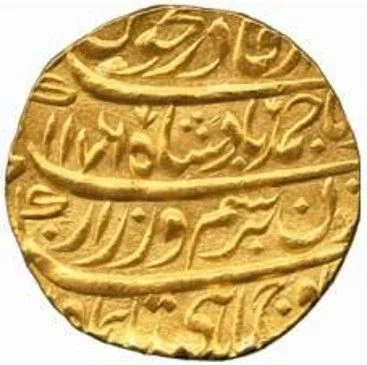
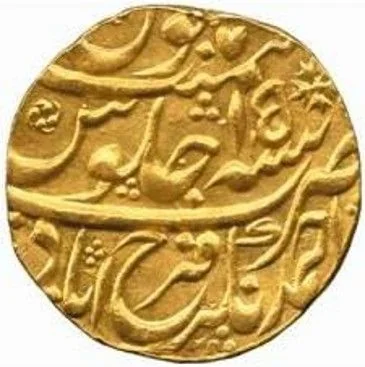
1 Mohur – Afghanistan
Afghanistan
Context
Year: 1763
Islamic (Hijri) Year: 1176
Issuer: Afghanistan 
Ruler: Ahmad Shah
Currency:
(1747—1891)
Demonetization: 1922
Material
Diameter: 28 mm
Weight: 10.9 g
Gold weight: 9.99 g
Shape: Irregular round
Composition: 91.67% Gold
Magnetic: No
References
KM: #Click to copy to clipboard105
Numista: #10473
Value
Bullion value: $1666.65
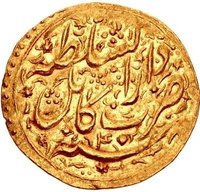
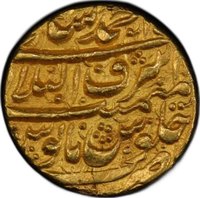
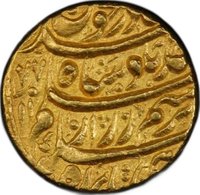
Obverse
Reverse
Edge
Mintings
| Year | Mint Mark | Mintage | Quality | Collection |
|---|---|---|---|---|
| 1763 | — | — |
Historical background
In 1763, Afghanistan was not a unified nation but a patchwork of competing principalities and tribal confederations, primarily under the Durrani Empire founded by Ahmad Shah Durrani in 1747. The currency situation reflected this decentralized political reality, though a significant standardization had been achieved. Ahmad Shah established a unified monetary system for his empire, with the silver rupee as the principal coin, minted primarily at the major capitals of Kabul and Kandahar. These coins bore his name and titles in Persian script, asserting dynastic legitimacy and facilitating trade across his vast, multi-ethnic domains, which stretched from eastern Persia to northern India.
Alongside the imperial rupee, a variety of older and regional currencies remained in circulation, particularly in more remote areas. This included residual Mughal rupees from India, Persian abbasi coins, and even older Afghan issues from before the Durrani consolidation. Furthermore, the monetary economy coexisted with systems of barter, especially in rural and mountainous regions where state control was weak. The empire's economy was heavily reliant on long-distance trade (the Silk Road and routes to India) and military conquest, with loot from campaigns in India providing a crucial influx of precious metals to mint new currency.
Therefore, the currency landscape in 1763 was one of a fragile centralization imposed over a traditionally fragmented system. The Durrani rupee provided a stable and trusted medium for imperial taxation and inter-regional commerce, symbolizing the power of the nascent state. However, the persistence of older coins and non-monetary exchange underscored the practical limits of Kabul's authority and the diverse, localized nature of economic life within the empire's borders.
Alongside the imperial rupee, a variety of older and regional currencies remained in circulation, particularly in more remote areas. This included residual Mughal rupees from India, Persian abbasi coins, and even older Afghan issues from before the Durrani consolidation. Furthermore, the monetary economy coexisted with systems of barter, especially in rural and mountainous regions where state control was weak. The empire's economy was heavily reliant on long-distance trade (the Silk Road and routes to India) and military conquest, with loot from campaigns in India providing a crucial influx of precious metals to mint new currency.
Therefore, the currency landscape in 1763 was one of a fragile centralization imposed over a traditionally fragmented system. The Durrani rupee provided a stable and trusted medium for imperial taxation and inter-regional commerce, symbolizing the power of the nascent state. However, the persistence of older coins and non-monetary exchange underscored the practical limits of Kabul's authority and the diverse, localized nature of economic life within the empire's borders.
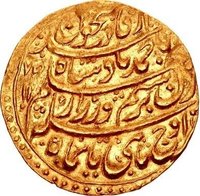
💎 Extremely Rare