

1 Schilling (Solidus / Silins) – Swedish Livonia
Context
Years: 1660–1665
Country: Livonia
Issuer: Swedish Livonia
Ruler: Charles XI
Currency:
(1629—1710)
Subdivision: 1 Schilling (Solidus / Silins) = 1⁄48 Thaler
Demonetized: Yes
Material
References
KM: #Click to copy to clipboardA5
Numista: #31470
Obverse
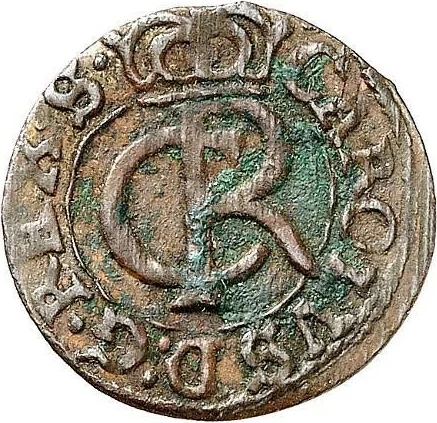
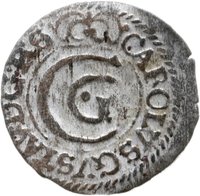
Description:
Crowned monogram encircled by legend.
Inscription:
CAROLVS · D · G · REX · S ·
CR
CR
Script: Latin
Reverse
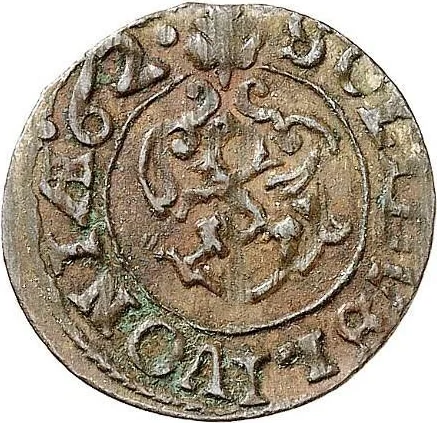
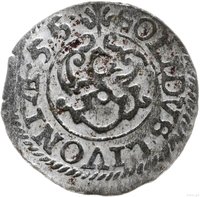
Description:
Griffin wielding dual swords with its talons, encircled by legend.
Inscription:
SOLIDVS · LIVONIÆ · 6 · 2 ·
Script: Latin
Edge
Plain
Categories
| Mythology> Fantastic animal |
| Symbols> Monogram |
Mints
| Name | Mark |
|---|---|
| Riga | — |
Mintings
| Year | Mint Mark | Mintage | Quality | Collection |
|---|---|---|---|---|
| 1660 | — | — | ||
| 1661 | — | — | ||
| 1662 | — | — | ||
| 1663 | — | — | ||
| 1664 | — | — | ||
| 1665 | — | — |
Historical background
In 1660, Swedish Livonia (encompassing much of modern-day Estonia and Latvia) was navigating a complex and challenging monetary environment, a direct legacy of its position as a contested Baltic frontier. The region had endured decades of war, most recently the Russo-Swedish War (1656-1658) and the ongoing Second Northern War, which had severely disrupted its economy. The primary circulating currency was the Polish-Lithuanian ort (or öre), a small silver coin, reflecting the territory's deep historical and economic ties to the Polish-Lithuanian Commonwealth, from which Sweden had conquered it earlier in the century.
The Swedish state, under King Charles X Gustav, struggled to impose monetary order. While attempting to integrate Livonia into the Swedish realm, Stockholm faced the practical reality that its own high-quality silver coins, like the riksdaler, were often hoarded or exported due to their superior intrinsic value, leaving the debased and worn Polish coins as the common medium of exchange. This created a classic "bad money drives out good" (Gresham's Law) scenario, hampering commerce and tax collection. Furthermore, the Swedish government was itself contributing to inflation by flooding the Baltic provinces with low-quality copper mynt (coinage) from its own strained treasury.
Consequently, the monetary situation was characterized by confusion, multiple circulating coinages (Polish, Swedish, and local issues), and a significant disparity between official exchange rates and market reality. This monetary disorder mirrored the broader administrative and demographic challenges of a war-ravaged province. The death of Charles X Gustav in early 1660 and the subsequent peace treaties would allow his regency government to begin addressing these issues, leading to eventual monetary reforms aimed at establishing a unified and stable Swedish currency system in Livonia later in the decade.
The Swedish state, under King Charles X Gustav, struggled to impose monetary order. While attempting to integrate Livonia into the Swedish realm, Stockholm faced the practical reality that its own high-quality silver coins, like the riksdaler, were often hoarded or exported due to their superior intrinsic value, leaving the debased and worn Polish coins as the common medium of exchange. This created a classic "bad money drives out good" (Gresham's Law) scenario, hampering commerce and tax collection. Furthermore, the Swedish government was itself contributing to inflation by flooding the Baltic provinces with low-quality copper mynt (coinage) from its own strained treasury.
Consequently, the monetary situation was characterized by confusion, multiple circulating coinages (Polish, Swedish, and local issues), and a significant disparity between official exchange rates and market reality. This monetary disorder mirrored the broader administrative and demographic challenges of a war-ravaged province. The death of Charles X Gustav in early 1660 and the subsequent peace treaties would allow his regency government to begin addressing these issues, leading to eventual monetary reforms aimed at establishing a unified and stable Swedish currency system in Livonia later in the decade.
🌱 Fairly Common