

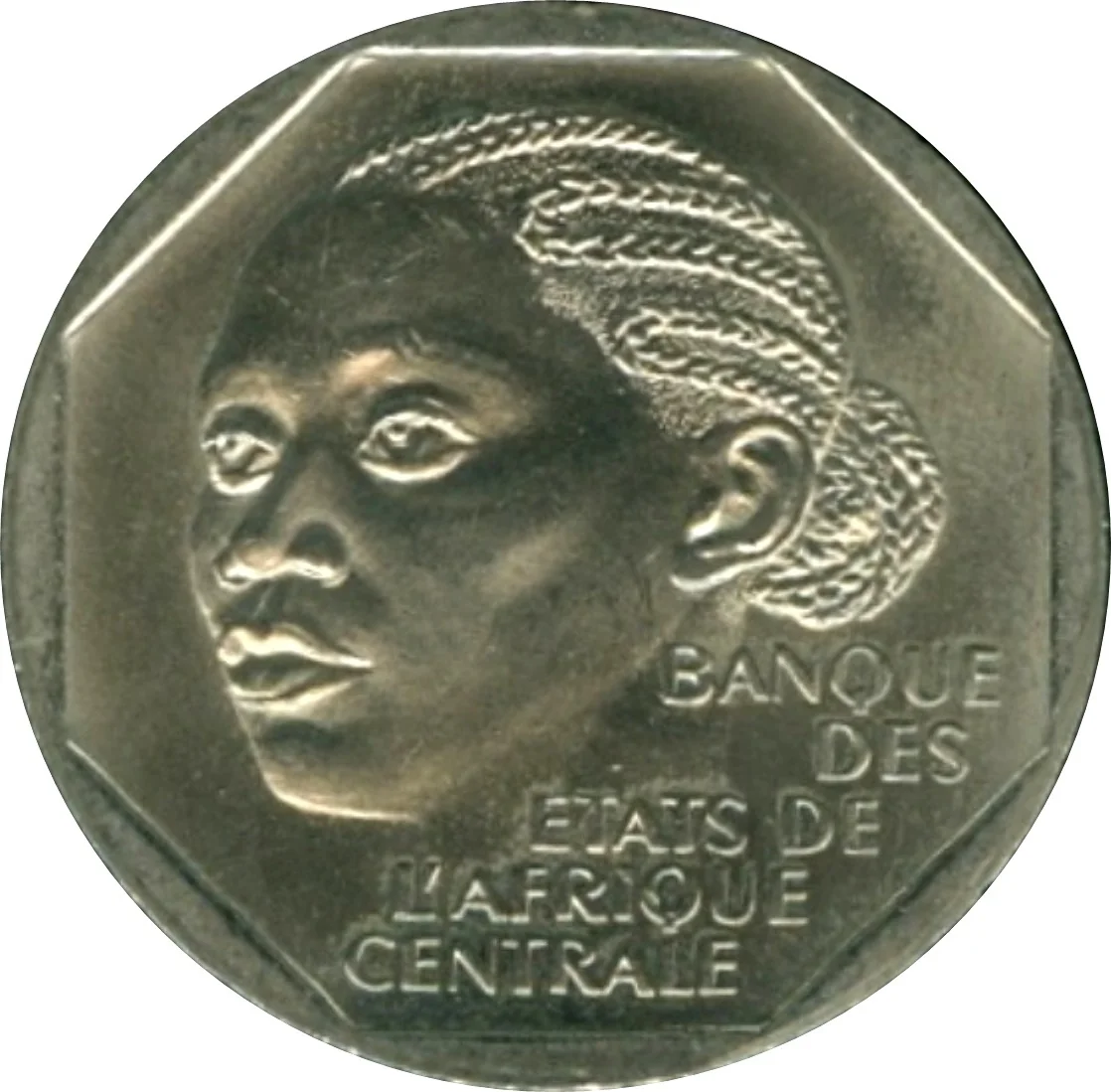
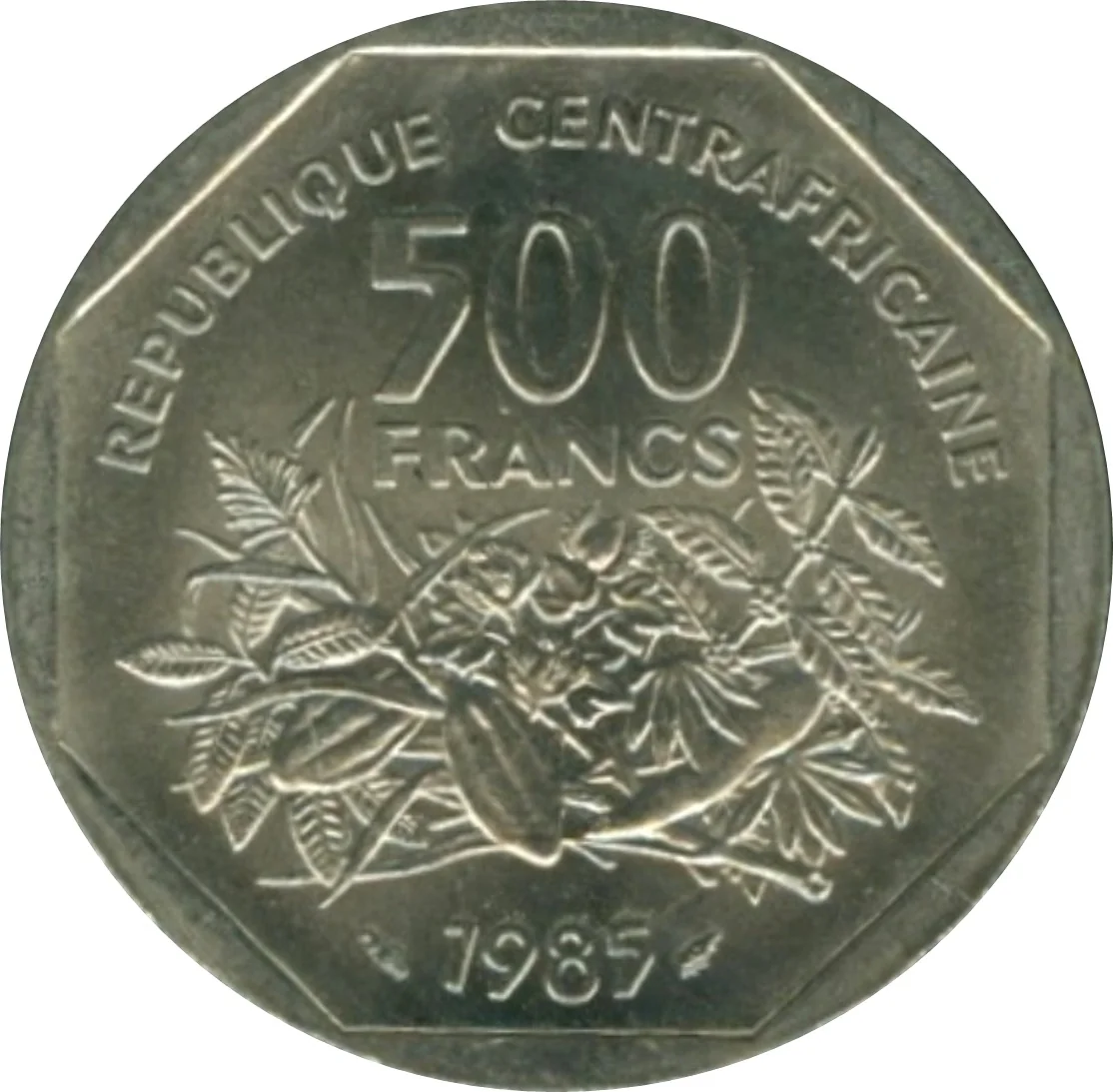
500 francs cfa – Central African Republic
Add to wishlist
Central African Republic
Context
Years: 1985–1986
Issuer: Central African Republic
Issuing organization: Bank of Central African States
Period:
(since 1979)
Currency:
(since 1973)
Total mintage: 700,000
Material
References
KM: #
Numista: #8520
Value
Exchange value: 500 XAF
Obverse
Reverse
Edge
Plain
Mints
| Name | Mark |
|---|---|
| Monnaie de Paris | — |
Mintings
| Year | Mint Mark | Mintage | Quality | Collection |
|---|---|---|---|---|
| 1985 | — | 200,000 | ||
| 1986 | — | 500,000 |
Historical background
In 1985, the Central African Republic (CAR) operated under the monetary framework of the CFA franc, specifically the BEAC franc (XAF), as a member of the Central African Economic and Monetary Community (CEMAC). This currency was, and remains, pegged to the French franc at a fixed exchange rate, guaranteed by the French Treasury through an operations account. This arrangement provided a degree of monetary stability and low inflation by tethering the CAR's currency to a stronger European one, but it also meant the country had no independent monetary policy to address its specific economic challenges.
Economically, the country was in a fragile state. The early 1980s were marked by the authoritarian rule of President André Kolingba, who took power in 1981. His regime faced significant economic stagnation, heavily reliant on declining exports of commodities like diamonds, coffee, and timber. A bloated civil service and unproductive state enterprises strained public finances. While the fixed CFA franc peg controlled hyperinflation, it could not shield the economy from structural weaknesses, falling commodity prices, and the burdens of poor governance and corruption.
Consequently, the currency's stability existed in stark contrast to the real economy. The fixed exchange rate, combined with low domestic productivity, made CAR's exports less competitive internationally. The period was characterized by **"franc fort" (strong franc) policies within the Franc Zone, which often benefited urban elites and importers but hurt rural agricultural producers and local industries. Thus, in 1985, the currency situation was one of nominal stability underpinned by the French guarantee, yet it masked deepening economic malaise, external imbalances, and a growing dependence on external aid and borrowing to finance the state's deficits.
Economically, the country was in a fragile state. The early 1980s were marked by the authoritarian rule of President André Kolingba, who took power in 1981. His regime faced significant economic stagnation, heavily reliant on declining exports of commodities like diamonds, coffee, and timber. A bloated civil service and unproductive state enterprises strained public finances. While the fixed CFA franc peg controlled hyperinflation, it could not shield the economy from structural weaknesses, falling commodity prices, and the burdens of poor governance and corruption.
Consequently, the currency's stability existed in stark contrast to the real economy. The fixed exchange rate, combined with low domestic productivity, made CAR's exports less competitive internationally. The period was characterized by **"franc fort" (strong franc) policies within the Franc Zone, which often benefited urban elites and importers but hurt rural agricultural producers and local industries. Thus, in 1985, the currency situation was one of nominal stability underpinned by the French guarantee, yet it masked deepening economic malaise, external imbalances, and a growing dependence on external aid and borrowing to finance the state's deficits.
🌟 Limited