

2 sols – France
Add to wishlist
France
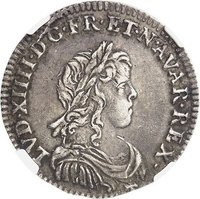
Obverse
Description:
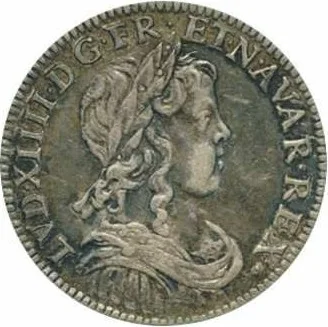
Laureate, draped, and armored bust of Louis XIV facing right.
Inscription:
LVD. XIIII. D G. FR. ET. NAVAR. REX.
Script: Latin
Engraver: Jean Warin
Reverse
Description:
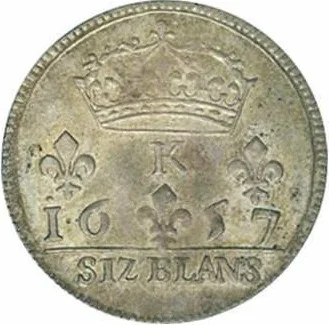
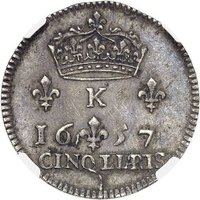
Three lilies (two over one) below a crown, with a mint letter under the crown and the date cut by the third lily. Below a line in the exergue, the face value: "six blancs" in old French.
Inscription:
K
1657
SIZ BLANS
1657
SIZ BLANS
Script: Latin
Engraver: Jean Warin
Edge
Plain
Mints
| Name | Mark |
|---|---|
| Bordeaux | K |
Mintings
| Year | Mint Mark | Mintage | Quality | Collection |
|---|---|---|---|---|
| 1657 | K | — |
Historical background
In 1657, France was in the midst of the Franco-Spanish War (1635–1659), a conflict that placed immense fiscal strain on the monarchy of the young King Louis XIV, then under the regency of his mother, Anne of Austria, and the chief ministership of Cardinal Mazarin. The primary currency situation was defined by severe monetary instability and deliberate royal manipulation. To finance the war, the Crown repeatedly engaged in the practice of augmentation—officially raising the face value of existing coins—and diminution—lowering their metal content. This created a chaotic system where the nominal value of a livre tournois (a unit of account) was drastically disconnected from the actual silver content of the physical écu coins in circulation.
This period was marked by what economists call "crying up and down the coin," leading to rampant inflation, widespread confusion in trade, and a loss of public confidence. Merchants and peasants hoarded older, purer coins, while foreign currencies and counterfeit coins flooded the market. The government's frequent edicts attempting to set exchange rates failed, as market forces consistently valued coins by their weight and fineness, not the royal decree. This monetary chaos crippled domestic commerce and made it increasingly difficult for the state to pay its armies, creating a vicious cycle of devaluation.
The situation in 1657 was a critical point in a longer crisis that underscored the weakness of royal finances. It highlighted the tension between the Crown's short-term need for war revenue and the long-term health of the economy. This instability would be a key factor leading to the monumental fiscal reforms undertaken later in Louis XIV's personal reign by his finance minister, Jean-Baptiste Colbert, who sought to stabilize the currency and centralize monetary authority, moving France toward a more reliable and state-controlled monetary system.
This period was marked by what economists call "crying up and down the coin," leading to rampant inflation, widespread confusion in trade, and a loss of public confidence. Merchants and peasants hoarded older, purer coins, while foreign currencies and counterfeit coins flooded the market. The government's frequent edicts attempting to set exchange rates failed, as market forces consistently valued coins by their weight and fineness, not the royal decree. This monetary chaos crippled domestic commerce and made it increasingly difficult for the state to pay its armies, creating a vicious cycle of devaluation.
The situation in 1657 was a critical point in a longer crisis that underscored the weakness of royal finances. It highlighted the tension between the Crown's short-term need for war revenue and the long-term health of the economy. This instability would be a key factor leading to the monumental fiscal reforms undertaken later in Louis XIV's personal reign by his finance minister, Jean-Baptiste Colbert, who sought to stabilize the currency and centralize monetary authority, moving France toward a more reliable and state-controlled monetary system.
✨ Legendary