

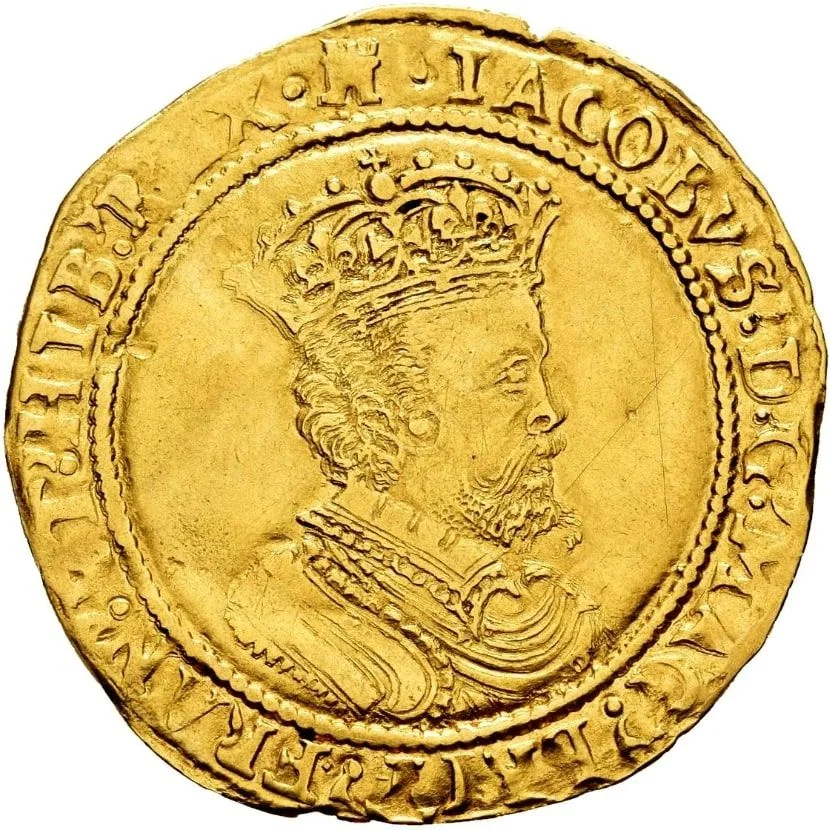
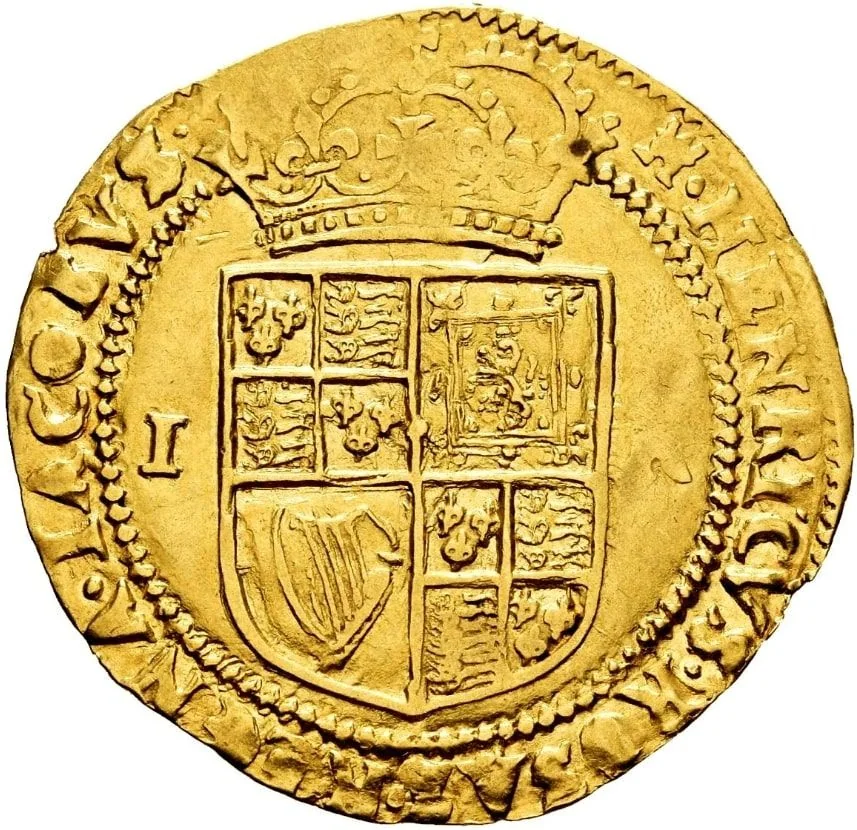
2 Crowns – England
United Kingdom
Context
Years: 1611–1619
Country: United Kingdom 
Issuer: England 
Ruler: James I
Currency:
(1158—1970)
Demonetized: Yes
Material
Diameter: 29 mm
Weight: 4.89 g
Gold weight: 4.48 g
Shape: Irregular round
Composition: 91.67% Gold
Magnetic: No
Technique: Hammered
References
KM: #Click to copy to clipboard40
Numista: #304317
Value
Bullion value: $746.75
Obverse
Description:
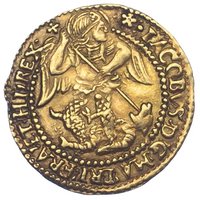
James I crowned bust right, legend around.
Inscription:
IACOBVS • D’ • G’ • MAG’ • BRIT’ • FRA’ • ET • HIB’ • REX
Script: Latin
Reverse
Description:
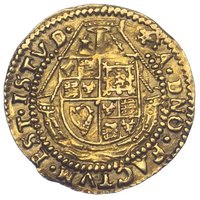
Quartered shield dividing royal cypher, legend around.
Inscription:
HENRICVS • ROSAS • REGNA • IACOBVS
I R
I R
Script: Latin
Edge
Mints
| Name | Mark |
|---|---|
| Royal Mint (Tower of London) | — |
Mintings
| Year | Mint Mark | Mintage | Quality | Collection |
|---|---|---|---|---|
| 1613 | — | — | ||
| — | — | — | ||
| 1619 | — | — |
Historical background
In 1611, England operated under a bimetallic currency system based on silver and gold, but it was a period of significant monetary instability and debasement. The primary unit was the silver pound sterling, divided into 20 shillings or 240 silver pennies. However, the realm was still grappling with the severe economic consequences of the "Great Debasement" of the mid-16th century under Henry VIII and Edward VI, which had severely eroded public trust in the coinage. While Elizabeth I had restored the silver content of coins in the 1560s, the fundamental problem of underweight and clipped coins in circulation persisted, leading to routine uncertainty in everyday transactions.
This era also saw the growing importance of gold, with the unite (worth 20 shillings) being the prominent gold coin, so named to symbolize the union of the English and Scottish crowns under James I in 1603. A critical issue was the official mint ratio between gold and silver, which often failed to match market values, causing one metal to be undervalued and subsequently exported or melted down. This, combined with a chronic shortage of small denomination coins for wage payments and market trade, created a dysfunctional monetary environment that hampered commerce and state finance.
Furthermore, 1611 fell within a period of aggressive royal fiscal expedients under James I. The crown, perennially short of funds, exploited the currency system for revenue. This included profits from minting, but also more controversial practices like arbitrarily raising the face value of certain coins or demanding loans from the City of London that were unlikely to be repaid. These actions, alongside the physical state of the coinage, contributed to inflation, market distrust, and laid the groundwork for the monetary crises that would later prompt reformers like Sir Thomas Gresham to famously observe that "bad money drives out good."
This era also saw the growing importance of gold, with the unite (worth 20 shillings) being the prominent gold coin, so named to symbolize the union of the English and Scottish crowns under James I in 1603. A critical issue was the official mint ratio between gold and silver, which often failed to match market values, causing one metal to be undervalued and subsequently exported or melted down. This, combined with a chronic shortage of small denomination coins for wage payments and market trade, created a dysfunctional monetary environment that hampered commerce and state finance.
Furthermore, 1611 fell within a period of aggressive royal fiscal expedients under James I. The crown, perennially short of funds, exploited the currency system for revenue. This included profits from minting, but also more controversial practices like arbitrarily raising the face value of certain coins or demanding loans from the City of London that were unlikely to be repaid. These actions, alongside the physical state of the coinage, contributed to inflation, market distrust, and laid the groundwork for the monetary crises that would later prompt reformers like Sir Thomas Gresham to famously observe that "bad money drives out good."
✨ Legendary