

2 Sovereigns – Spanish Netherlands
Netherlands
Context
Years: 1719–1720
Country: Netherlands 
Issuer: Spanish Netherlands
Ruler: Charles VI
Currency:
(1506—1713)
Demonetized: Yes
Material
References
KM: #Click to copy to clipboard136
Numista: #304109
Value
Bullion value: $1684.80
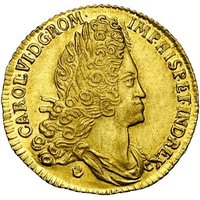
Obverse
Description:
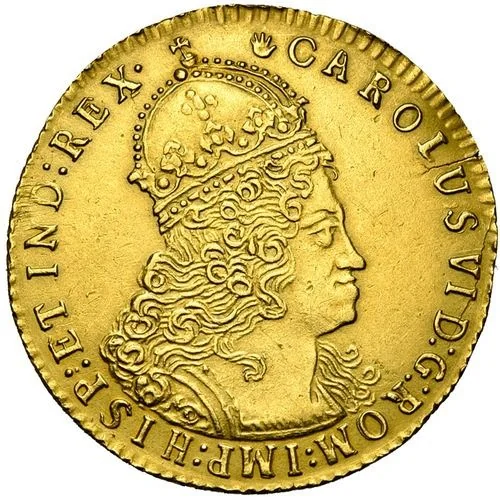
Crowned head facing right.
Inscription:
CAROLUS VI D:G: ROM: IMP: HISP: ET IND: REX.
Script: Latin
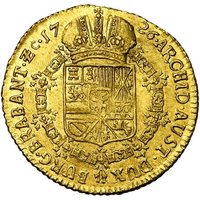
Reverse
Description:
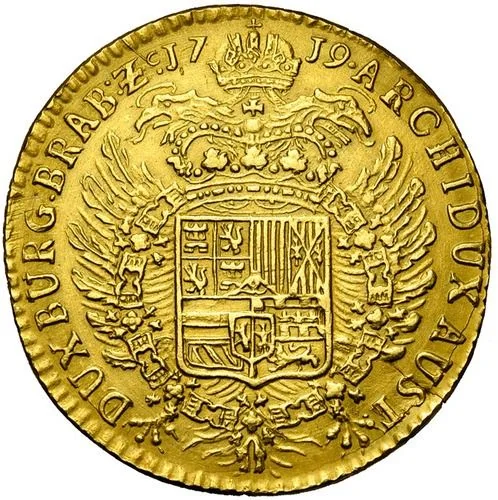
Imperial eagle with breast shield, wearing the Golden Fleece collar. Crown above divides date.
Inscription:
ARCHIDUX AUST DUX BURG: BRAB: Zc. 17 19
Script: Latin
Edge
Mints
| Name | Mark |
|---|---|
| Antwerp | — |
Mintings
| Year | Mint Mark | Mintage | Quality | Collection |
|---|---|---|---|---|
| 1719 | — | — | ||
| 1720 | — | — |
Historical background
In 1719, the Spanish Netherlands (approximately modern-day Belgium and Luxembourg) was navigating a complex monetary landscape under the rule of the Habsburg Emperor Charles VI. The region's economy was burdened by the legacy of the long War of the Spanish Succession (1701-1714), which had depleted treasuries and disrupted trade. Furthermore, the territory was now part of a broader, disjointed Habsburg monarchy, requiring its financial systems to interact with those of Austria and the Holy Roman Empire, while still feeling the residual economic influence of its former Spanish rulers.
The currency situation was characterized by significant instability and confusion. A multitude of different coins circulated simultaneously, including older Spanish issues, local Brabantian guilders, and various German and Dutch coins from neighboring states. This proliferation of currencies of varying intrinsic values and exchange rates created fertile ground for arbitrage and speculation. The most pressing issue, however, was the widespread practice of "clipping" and debasement, where coins were physically trimmed of their precious metal or governments issued new coins with reduced silver or gold content, leading to inflation and a crisis of confidence in the money itself.
In response to this chaos, the imperial authorities in Vienna initiated a major monetary reform. The goal was to standardize the coinage, stabilize the currency, and align the region's system more closely with that of the Holy Roman Empire. This involved recalling old, debased coins and minting new ones according to stricter standards. While aimed at long-term stability, the reform of 1719-1720 caused short-term dislocation, as the public was wary of exchanging old coins and the process of recalibrating prices and debts to the new standard created economic friction throughout the region.
The currency situation was characterized by significant instability and confusion. A multitude of different coins circulated simultaneously, including older Spanish issues, local Brabantian guilders, and various German and Dutch coins from neighboring states. This proliferation of currencies of varying intrinsic values and exchange rates created fertile ground for arbitrage and speculation. The most pressing issue, however, was the widespread practice of "clipping" and debasement, where coins were physically trimmed of their precious metal or governments issued new coins with reduced silver or gold content, leading to inflation and a crisis of confidence in the money itself.
In response to this chaos, the imperial authorities in Vienna initiated a major monetary reform. The goal was to standardize the coinage, stabilize the currency, and align the region's system more closely with that of the Holy Roman Empire. This involved recalling old, debased coins and minting new ones according to stricter standards. While aimed at long-term stability, the reform of 1719-1720 caused short-term dislocation, as the public was wary of exchanging old coins and the process of recalibrating prices and debts to the new standard created economic friction throughout the region.
✨ Legendary