

2 Sovereigns – Spanish Netherlands
Netherlands
Context
Years: 1724–1729
Country: Netherlands 
Issuer: Spanish Netherlands
Ruler: Charles VI
Currency:
(1506—1713)
Demonetized: Yes
Material
References
KM: #Click to copy to clipboard137
Numista: #304110
Value
Bullion value: $1684.80
Obverse
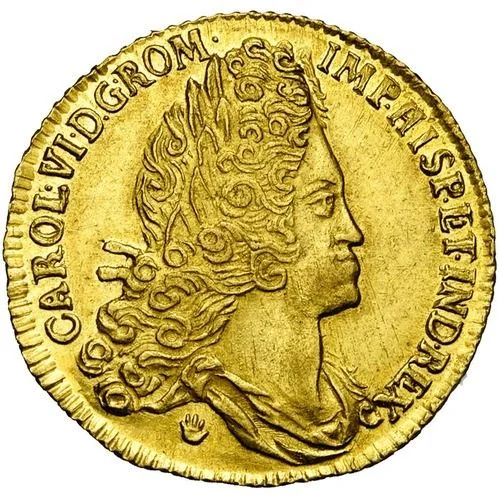
Description:
Laureate head right, mint mark beneath.
Inscription:
CAROL • VI• D • G • ROM • IMP • HISP • ET IND • REX •
Script: Latin
Reverse
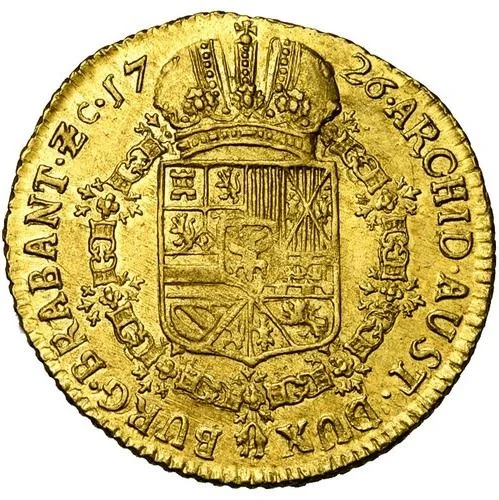
Description:
Arms with Golden Fleece collar; date split by crown above.
Inscription:
ARCHID • AUST • DUX BURG • BRABANT • Zc. 17 26
Script: Latin
Edge
Mints
| Name | Mark |
|---|---|
| Antwerp | — |
Mintings
| Year | Mint Mark | Mintage | Quality | Collection |
|---|---|---|---|---|
| 1724 | — | — | ||
| 1725 | — | — | ||
| 1726 | — | — | ||
| 1729 | — | — |
Historical background
In 1724, the currency situation in the Spanish Netherlands (roughly modern-day Belgium and Luxembourg) was one of profound instability and complexity, a lingering consequence of the War of the Spanish Succession (1701-1714). The region had recently transitioned from Spanish to Austrian Habsburg rule under the Treaty of Utrecht, with Emperor Charles VI now the sovereign. However, the monetary system remained a chaotic patchwork of old Spanish, Burgundian, and local coinages, alongside a flood of debased and counterfeit coins from neighboring states. The intrinsic value of silver in many of these coins often exceeded their face value, leading to their rapid export or melting down, which further drained the region of sound money and disrupted commerce.
This disorder was exacerbated by the policies of the previous Spanish administration, which had frequently devalued the currency to finance its wars, creating a deep-seated lack of public trust. Furthermore, the new Austrian authorities, operating through the Governor-General in Brussels, initially struggled to impose a unified monetary policy. Different provinces and cities sometimes issued their own ordinances, adding to the confusion. The circulation of overvalued foreign currency, particularly from the Dutch Republic and France, distorted local prices and exchange rates, creating a significant handicap for merchants and hindering economic recovery in the post-war period.
Recognizing the crisis, the imperial administration was actively seeking solutions. The year 1724 fell within a period of negotiation and planning that would eventually lead to the important monetary ordinance of 1725. This reform aimed to standardize the currency, define exchange rates, and prohibit the circulation of foreign and debased coins, seeking to establish a stable monetary system under the authority of the Vienna court. Thus, the situation in 1724 was a pivotal moment of transition, characterized by severe disorder but also by the first serious attempts at Habsburg-led monetary reform to stabilize the economy of the Austrian Netherlands.
This disorder was exacerbated by the policies of the previous Spanish administration, which had frequently devalued the currency to finance its wars, creating a deep-seated lack of public trust. Furthermore, the new Austrian authorities, operating through the Governor-General in Brussels, initially struggled to impose a unified monetary policy. Different provinces and cities sometimes issued their own ordinances, adding to the confusion. The circulation of overvalued foreign currency, particularly from the Dutch Republic and France, distorted local prices and exchange rates, creating a significant handicap for merchants and hindering economic recovery in the post-war period.
Recognizing the crisis, the imperial administration was actively seeking solutions. The year 1724 fell within a period of negotiation and planning that would eventually lead to the important monetary ordinance of 1725. This reform aimed to standardize the currency, define exchange rates, and prohibit the circulation of foreign and debased coins, seeking to establish a stable monetary system under the authority of the Vienna court. Thus, the situation in 1724 was a pivotal moment of transition, characterized by severe disorder but also by the first serious attempts at Habsburg-led monetary reform to stabilize the economy of the Austrian Netherlands.
✨ Legendary