

2 Sovereigns – Spanish Netherlands
Netherlands
Context
Year: 1711
Country: Netherlands 
Issuer: Spanish Netherlands
Ruler: Charles III
Currency:
(1506—1713)
Demonetized: Yes
Total mintage: 2,574
Material
References
KM: #Click to copy to clipboard135
Numista: #304108
Value
Bullion value: $1684.80
Obverse
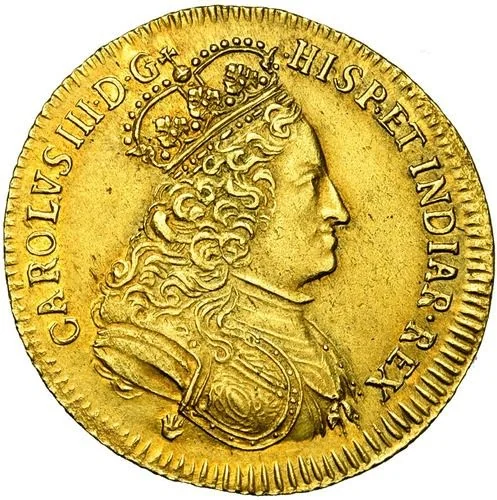
Description:
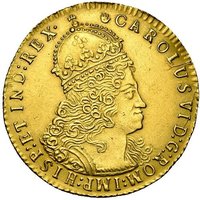
Crowned bust right, mint mark (hand) below.
Inscription:
CAROLVS III • D • G • HISP • ET INDIAR • REX •
Script: Latin
Reverse
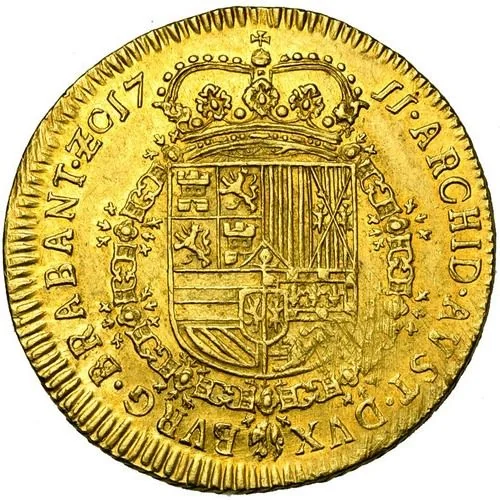
Description:
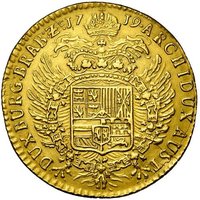
Arms with crown and Golden Fleece collar, date above.
Inscription:
ARCHID • AVST • DVX BVRG • BRABANT • Zc 17 11
Script: Latin
Edge
Mints
| Name | Mark |
|---|---|
| Antwerp | — |
Mintings
| Year | Mint Mark | Mintage | Quality | Collection |
|---|---|---|---|---|
| 1711 | — | 2,574 |
Historical background
By 1711, the Spanish Netherlands was in the throes of a severe and protracted monetary crisis, a direct consequence of the War of the Spanish Succession. The region, a battleground for over a decade, was financially exhausted from supporting occupying armies—primarily those of the Allied powers (Britain and the Dutch Republic) who administered it on behalf of the Habsburg claimant, Archduke Charles. To fund the war effort, these authorities, alongside the Spanish crown-in-exile, repeatedly debased the coinage by reducing the precious metal content, leading to a flood of low-value moneda de vellón (billon coins) and a sharp decline in the value of higher-quality full-weight coins, which were either hoarded or exported.
This situation created a chaotic "bad money drives out good" (Gresham's Law) environment. Multiple currencies circulated simultaneously: heavily debased local coins, older full-weight coins traded at a premium, and various foreign currencies from neighbouring states. The lack of a uniform, trusted medium of exchange crippled commerce and daily life, as prices became unstable and unpredictable. Merchants and the public struggled with complex and fluctuating exchange rates, which stifled economic activity and bred widespread uncertainty and hardship among the population.
Ultimately, the monetary disarray of 1711 was a stark symptom of the region's political limbo. With no sovereign power possessing both the authority and the will to implement a comprehensive recoinage and enforce monetary stability, the crisis persisted. The resolution would only begin to materialize after the war's conclusion with the Treaty of Utrecht (1713-1714), which transferred the territory to Austrian Habsburg rule, allowing the new administration to eventually undertake the necessary and arduous process of monetary reform.
This situation created a chaotic "bad money drives out good" (Gresham's Law) environment. Multiple currencies circulated simultaneously: heavily debased local coins, older full-weight coins traded at a premium, and various foreign currencies from neighbouring states. The lack of a uniform, trusted medium of exchange crippled commerce and daily life, as prices became unstable and unpredictable. Merchants and the public struggled with complex and fluctuating exchange rates, which stifled economic activity and bred widespread uncertainty and hardship among the population.
Ultimately, the monetary disarray of 1711 was a stark symptom of the region's political limbo. With no sovereign power possessing both the authority and the will to implement a comprehensive recoinage and enforce monetary stability, the crisis persisted. The resolution would only begin to materialize after the war's conclusion with the Treaty of Utrecht (1713-1714), which transferred the territory to Austrian Habsburg rule, allowing the new administration to eventually undertake the necessary and arduous process of monetary reform.
✨ Legendary