

1 Ducat – Brunswick-Lüneburg-Celle
Germany
Context
Years: 1684–1687
Country: Germany 
Issuer: Brunswick-Lüneburg-Celle
Ruler: George William
Currency:
Demonetized: Yes
References
KM: #Click to copy to clipboard310
Numista: #297565
Value
Bullion value: $574.73
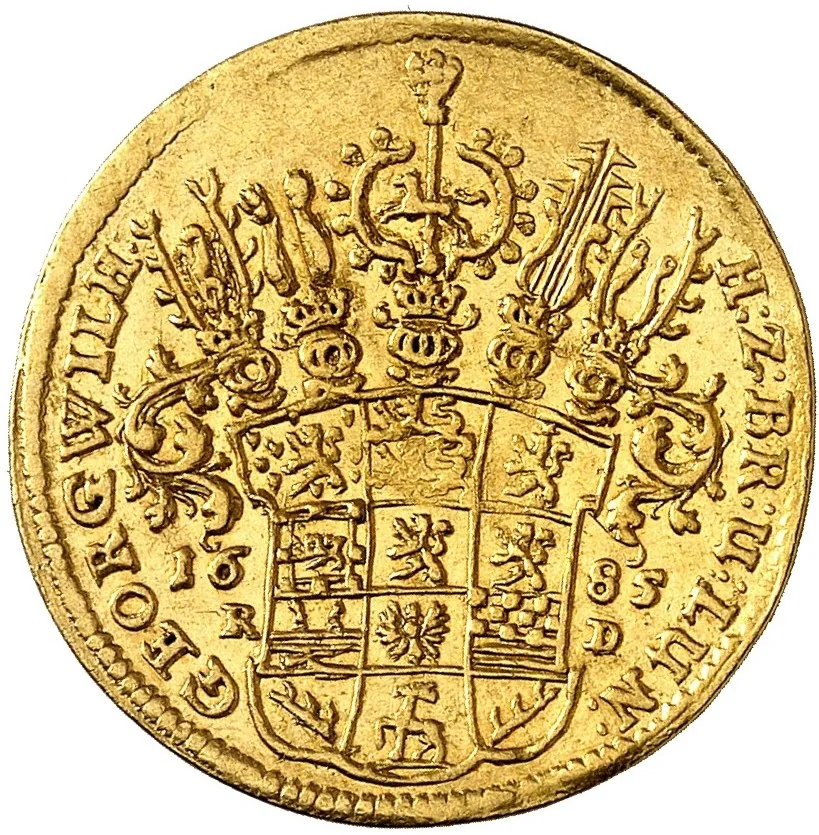
Obverse
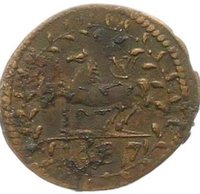
Description:
Helmeted figure with 12 arms, dated.
Inscription:
GEORGWILH. H:Z:BR:U:LUN:
16 85
R D
16 85
R D
Script: Latin
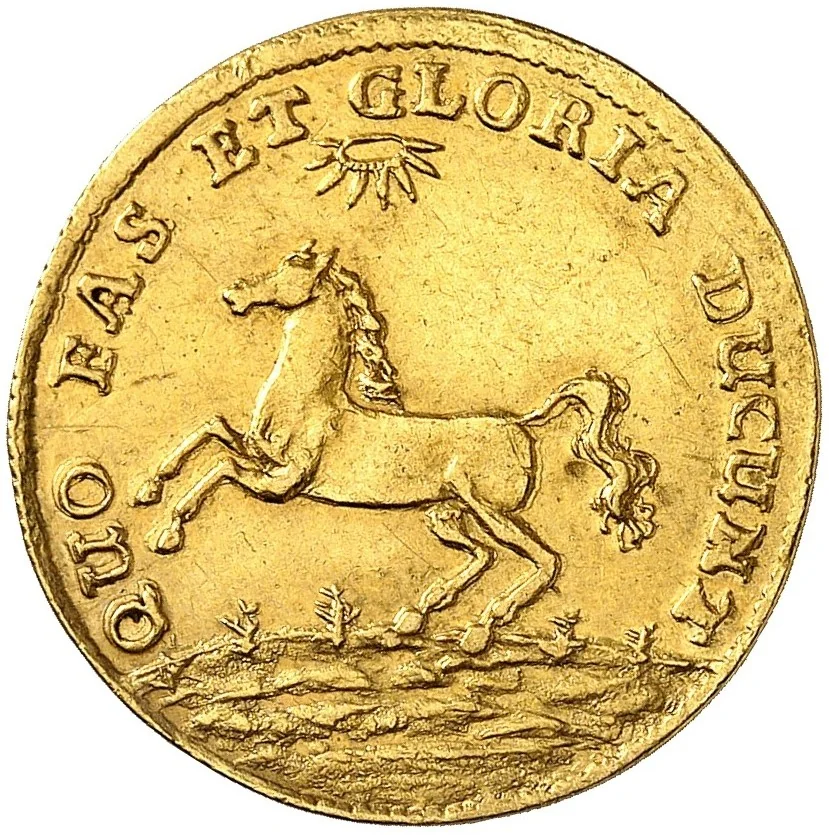
Reverse
Edge
Mints
| Name | Mark |
|---|---|
| Celle | — |
Mintings
| Year | Mint Mark | Mintage | Quality | Collection |
|---|---|---|---|---|
| 1684 | — | — | ||
| 1685 | — | — | ||
| 1687 | — | — |
Historical background
In 1684, the Duchy of Brunswick-Lüneburg, specifically the Principality of Celle under Duke George William, was entangled in the complex monetary fragmentation of the Holy Roman Empire. The region operated within a web of competing currency systems, where the official Reichsthaler (Imperial Thaler) coexisted with a plethora of circulating coins from neighboring states and older domestic issues. This created chronic instability, as the value and silver content of coins varied widely, facilitating clipping and counterfeiting and causing significant difficulties for daily trade and state finances.
Duke George William's administration actively sought to combat this disorder through monetary ordinances. The key objective was to standardize the currency within his territories by defining and enforcing the values of acceptable coins in relation to the Reichsthaler. These regulations aimed to drive out debased foreign coins and stabilize the local monetary environment, which was crucial for Celle’s economic health and its ability to fund the duke’s considerable military expenditures.
This situation was further complicated by Celle's political context. As a constituent part of the broader Welf family holdings, its monetary policies needed some coordination with other Brunswick-Lüneburg principalities, like Hanover. Furthermore, the duchy's economic life was heavily influenced by its proximity to the major trade hubs of Hamburg and the Lower Saxon Circle, whose monetary policies it could not control. Thus, the currency situation in 1684 was a continuous struggle between sovereign regulatory ambition and the practical realities of imperial decentralization and regional economic interdependence.
Duke George William's administration actively sought to combat this disorder through monetary ordinances. The key objective was to standardize the currency within his territories by defining and enforcing the values of acceptable coins in relation to the Reichsthaler. These regulations aimed to drive out debased foreign coins and stabilize the local monetary environment, which was crucial for Celle’s economic health and its ability to fund the duke’s considerable military expenditures.
This situation was further complicated by Celle's political context. As a constituent part of the broader Welf family holdings, its monetary policies needed some coordination with other Brunswick-Lüneburg principalities, like Hanover. Furthermore, the duchy's economic life was heavily influenced by its proximity to the major trade hubs of Hamburg and the Lower Saxon Circle, whose monetary policies it could not control. Thus, the currency situation in 1684 was a continuous struggle between sovereign regulatory ambition and the practical realities of imperial decentralization and regional economic interdependence.
✨ Legendary