

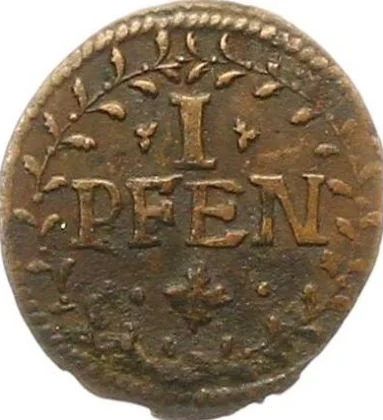
1 Pfennig – Brunswick-Lüneburg-Celle
Germany
Context
Years: 1686–1687
Country: Germany 
Issuer: Brunswick-Lüneburg-Celle
Ruler: George William
Currency:
Demonetized: Yes
Material
References
KM: #Click to copy to clipboard318
Numista: #451578
Obverse
Description:
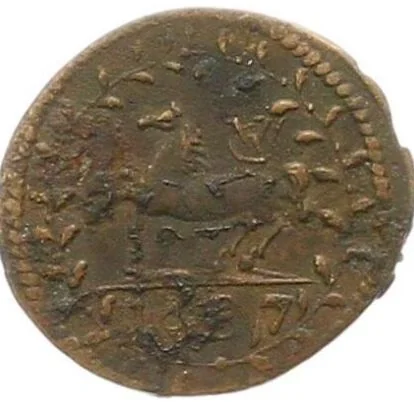
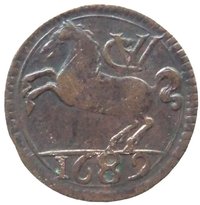
Wreath encircling left-rearing horse, date beneath.
Inscription:
1687
Reverse
Edge
Mintings
| Year | Mint Mark | Mintage | Quality | Collection |
|---|---|---|---|---|
| 1686 | — | — | ||
| 1687 | — | — |
Historical background
In 1686, the Duchy of Brunswick-Lüneburg, specifically the Principality of Celle under Duke George William, was entangled in the complex and debilitating monetary fragmentation that characterized the Holy Roman Empire. The region suffered from a proliferation of different coins issued not only by neighboring German states but also by countless local lords and cities, leading to chronic confusion, debasement, and a severe loss of public trust in the currency. This "Kipper- und Wipperzeit" crisis, though its peak had passed decades earlier, left a lasting legacy of monetary instability, where the intrinsic metal value of coins was often far below their face value, hampering trade and economic predictability.
Duke George William recognized that this chaotic situation weakened princely authority and state finances. Consequently, his administration in Celle was actively engaged in efforts to assert monetary sovereignty and stabilize the currency. This involved negotiations within the broader Brunswick-Lüneburg family and with neighboring principalities to establish binding minting treaties (Münzverträge). The goal of such agreements was to standardize coin weights, fineness, and values across territories, thereby controlling the money supply, curbing the influx of debased foreign coins, and securing seigniorage revenue for the ducal treasury.
Therefore, the currency situation in 1686 was one of transition and attempted reform. While still plagued by the inherited problems of a fragmented system, the principality was actively working toward greater monetary control and uniformity. These efforts were part of a broader trend among German territorial states to consolidate princely power through economic regulation, laying necessary groundwork for the more centralized financial systems of the future. The success of these measures, however, remained limited by the enduring political fragmentation of the Empire.
Duke George William recognized that this chaotic situation weakened princely authority and state finances. Consequently, his administration in Celle was actively engaged in efforts to assert monetary sovereignty and stabilize the currency. This involved negotiations within the broader Brunswick-Lüneburg family and with neighboring principalities to establish binding minting treaties (Münzverträge). The goal of such agreements was to standardize coin weights, fineness, and values across territories, thereby controlling the money supply, curbing the influx of debased foreign coins, and securing seigniorage revenue for the ducal treasury.
Therefore, the currency situation in 1686 was one of transition and attempted reform. While still plagued by the inherited problems of a fragmented system, the principality was actively working toward greater monetary control and uniformity. These efforts were part of a broader trend among German territorial states to consolidate princely power through economic regulation, laying necessary groundwork for the more centralized financial systems of the future. The success of these measures, however, remained limited by the enduring political fragmentation of the Empire.
✨ Legendary