

1 Mariengroschen – Brunswick-Lüneburg-Celle
Germany
Context
Years: 1677–1680
Country: Germany 
Issuer: Brunswick-Lüneburg-Celle
Ruler: George William
Currency:
Demonetized: Yes
Material
References
KM: #Click to copy to clipboard304
Numista: #241197
Value
Bullion value: $2.27
Obverse
Description:
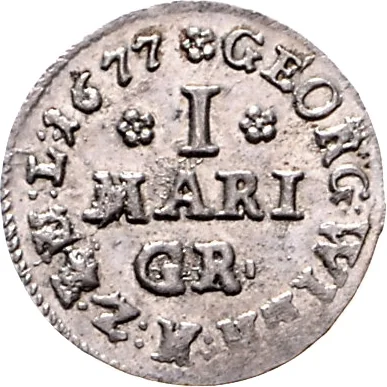
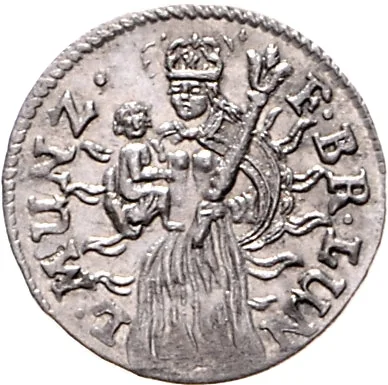
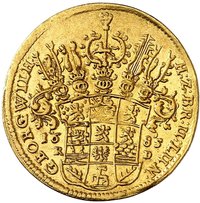
Denomination and date in surrounding legend.
Inscription:
GEORG:WILH:H:Z:B:U:L:1677
Script: Latin
Reverse
Edge
Mintings
| Year | Mint Mark | Mintage | Quality | Collection |
|---|---|---|---|---|
| 1677 | — | — | ||
| 1680 | — | — |
Historical background
In 1677, the Duchy of Brunswick-Lüneburg, specifically the Principality of Celle under Duke George William, was entangled in the complex and debilitating monetary chaos common across the Holy Roman Empire. The core problem was the proliferation of debased coinage. Numerous states within the Empire, including various Brunswick-Lüneburg lineages, were engaging in Kipper- und Wipperzeit practices, issuing lightweight, low-silver coins for profit while hoarding good silver. This created a flood of unstable currency, causing rampant inflation, a collapse in public trust, and severe disruption to trade and daily commerce.
Duke George William of Celle was actively attempting to combat this crisis through regional agreements. Most importantly, he was a leading member of the Braunschweig-Lüneburg Coinage Convention, an alliance formed with neighbouring principalities like Hanover and Wolfenbüttel. The convention's goal was to standardize coinage by agreeing on uniform weights, silver purity, and exchange rates for specific coins, such as the Reichsthaler and Gute Groschen. Their efforts in 1677 were part of a protracted struggle to restore monetary order by limiting the sovereign right of coinage—a key princely privilege—for the sake of economic stability.
Despite these concerted efforts, the situation in 1677 remained precarious. Enforcement of the convention's rules was inconsistent, and the temptation for individual mints to debase coins for short-term fiscal gain persisted. Furthermore, the monetary disorder was not confined to the region, as bad coins from elsewhere in the Empire continued to circulate. Thus, while Duke George William's administration was a proactive force for reform, the currency system in Brunswick-Lüneburg-Celle remained fragile, caught between the cooperative aim of standardization and the entrenched realities of political fragmentation and fiscal expediency.
Duke George William of Celle was actively attempting to combat this crisis through regional agreements. Most importantly, he was a leading member of the Braunschweig-Lüneburg Coinage Convention, an alliance formed with neighbouring principalities like Hanover and Wolfenbüttel. The convention's goal was to standardize coinage by agreeing on uniform weights, silver purity, and exchange rates for specific coins, such as the Reichsthaler and Gute Groschen. Their efforts in 1677 were part of a protracted struggle to restore monetary order by limiting the sovereign right of coinage—a key princely privilege—for the sake of economic stability.
Despite these concerted efforts, the situation in 1677 remained precarious. Enforcement of the convention's rules was inconsistent, and the temptation for individual mints to debase coins for short-term fiscal gain persisted. Furthermore, the monetary disorder was not confined to the region, as bad coins from elsewhere in the Empire continued to circulate. Thus, while Duke George William's administration was a proactive force for reform, the currency system in Brunswick-Lüneburg-Celle remained fragile, caught between the cooperative aim of standardization and the entrenched realities of political fragmentation and fiscal expediency.
✨ Legendary