

4 Tari – Malta
Malta
Obverse
Description:
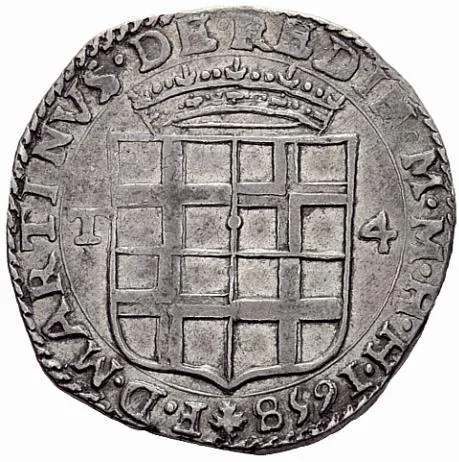
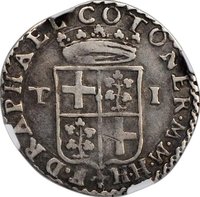
De Redin crowned arms flank value.
Inscription:
☩ F • D • MARTINVS • DE • REDIN • M • M • H • H • 1658
T 4
T 4
Script: Latin
Reverse
Description:
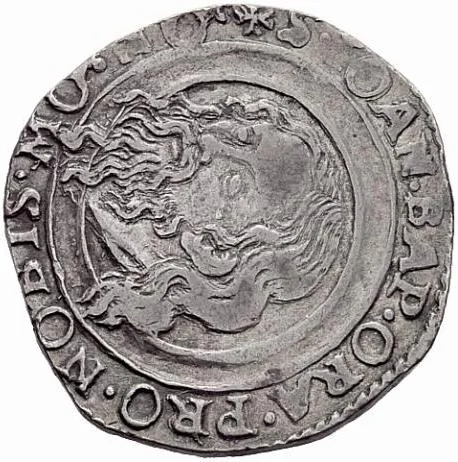
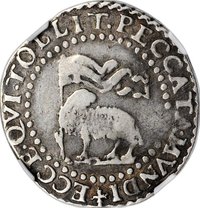
John the Baptist's severed head.
Inscription:
☩ S • IOAN • BAP • ORA • PRO • NOBIS • MO • N
Script: Latin
Edge
Mintings
| Year | Mint Mark | Mintage | Quality | Collection |
|---|---|---|---|---|
| 1658 | — | — |
Historical background
In 1658, Malta's currency situation was complex and challenging, reflecting its strategic position and the economic policies of its rulers, the Knights Hospitaller of the Order of St. John. The primary circulating coinage was a mixture of foreign silver, particularly Spanish pieces of eight (reales) and their fractional parts, alongside a variety of Italian, French, and Ottoman coins brought by trade. However, the Order itself minted very little precious metal coinage, primarily limited to high-value gold scudi and silver scudi and tari, which were insufficient for daily commerce. This reliance on foreign coinage created instability, as the value of these currencies fluctuated with international markets and their physical quality degraded through clipping and wear.
The core of the monetary problem was a severe shortage of small-denomination coinage for everyday transactions among the populace. To address this, the Order frequently issued low-value copper tokens, known as grani and piccioli, which were intended for local use only. However, these were easily counterfeited and often over-issued, leading to inflation and a loss of public confidence. Furthermore, the Knights struggled to prevent the export of full-weight silver coins, which were hoarded or melted down, leaving only poorer-quality coins in circulation—a classic example of Gresham's Law, where "bad money drives out good."
Consequently, the monetary system in 1658 was fragmented and inefficient. Prices were often quoted in a notional system of scudi, tari, and grani, but actual payment required complex calculations based on the fluctuating metallic worth of the mixed foreign coins in hand. This environment hindered trade and created economic friction, a situation the Order's treasury sought to manage through periodic edicts that attempted to fix exchange rates, often with limited success. Thus, Malta's currency landscape was one of pragmatic adaptation amidst scarcity, reliant on an international bazaar of coins and vulnerable to local inflationary pressures.
The core of the monetary problem was a severe shortage of small-denomination coinage for everyday transactions among the populace. To address this, the Order frequently issued low-value copper tokens, known as grani and piccioli, which were intended for local use only. However, these were easily counterfeited and often over-issued, leading to inflation and a loss of public confidence. Furthermore, the Knights struggled to prevent the export of full-weight silver coins, which were hoarded or melted down, leaving only poorer-quality coins in circulation—a classic example of Gresham's Law, where "bad money drives out good."
Consequently, the monetary system in 1658 was fragmented and inefficient. Prices were often quoted in a notional system of scudi, tari, and grani, but actual payment required complex calculations based on the fluctuating metallic worth of the mixed foreign coins in hand. This environment hindered trade and created economic friction, a situation the Order's treasury sought to manage through periodic edicts that attempted to fix exchange rates, often with limited success. Thus, Malta's currency landscape was one of pragmatic adaptation amidst scarcity, reliant on an international bazaar of coins and vulnerable to local inflationary pressures.
✨ Legendary