

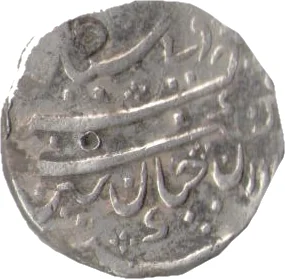
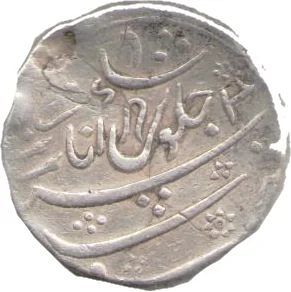
1 Rupee – Bombay Presidency
India

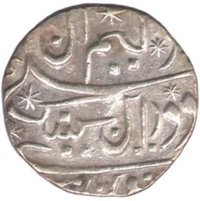
Obverse
Description:
Persian legend.
Script: Persian (nastaliq)
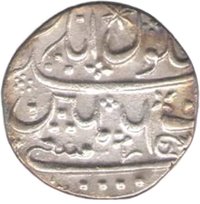
Reverse
Description:
Persian legend.
Script: Persian (nastaliq)
Edge
Plain
Mintings
| Year | Mint Mark | Mintage | Quality | Collection |
|---|---|---|---|---|
| 1686 | — | — | ||
| 1687 | — | — |
Historical background
In 1686, the currency situation within the Bombay Presidency was a complex and turbulent reflection of its transitional political status. The presidency, under the control of the English East India Company, was navigating a precarious position between the declining Mughal Empire and rising regional powers like the Marathas. Officially, the Mughal silver rupee remained the dominant and most trusted currency for large transactions and external trade, its wide acceptance underpinning commerce. However, the Company's authority to mint its own coins was extremely limited, creating a chronic shortage of reliable specie for local use and salaries.
This scarcity led to a chaotic circulation of various coins, including older Portuguese tangas and reis, as well as a flood of debased and counterfeit rupees from regional mints. The problem was exacerbated by the Anglo-Mughal War (1686–1690), which had just begun. This conflict severely disrupted trade routes and bullion supplies, while also politically alienating the Company from the Mughal monetary system. The war effort itself drained the Company's treasury, forcing it to use whatever currency was at hand, further degrading the monetary environment.
Consequently, the Presidency operated in a state of monetary crisis. The lack of a standardized, authoritative coinage hampered daily commerce and administration, forcing the Company to constantly assay and discount suspect coins. This unstable situation would become a primary catalyst for the Company's later, relentless efforts to obtain the right to mint its own rupees from the Mughal authorities after the war's conclusion, seeking to establish both financial autonomy and economic control over its territories.
This scarcity led to a chaotic circulation of various coins, including older Portuguese tangas and reis, as well as a flood of debased and counterfeit rupees from regional mints. The problem was exacerbated by the Anglo-Mughal War (1686–1690), which had just begun. This conflict severely disrupted trade routes and bullion supplies, while also politically alienating the Company from the Mughal monetary system. The war effort itself drained the Company's treasury, forcing it to use whatever currency was at hand, further degrading the monetary environment.
Consequently, the Presidency operated in a state of monetary crisis. The lack of a standardized, authoritative coinage hampered daily commerce and administration, forcing the Company to constantly assay and discount suspect coins. This unstable situation would become a primary catalyst for the Company's later, relentless efforts to obtain the right to mint its own rupees from the Mughal authorities after the war's conclusion, seeking to establish both financial autonomy and economic control over its territories.
✨ Legendary