

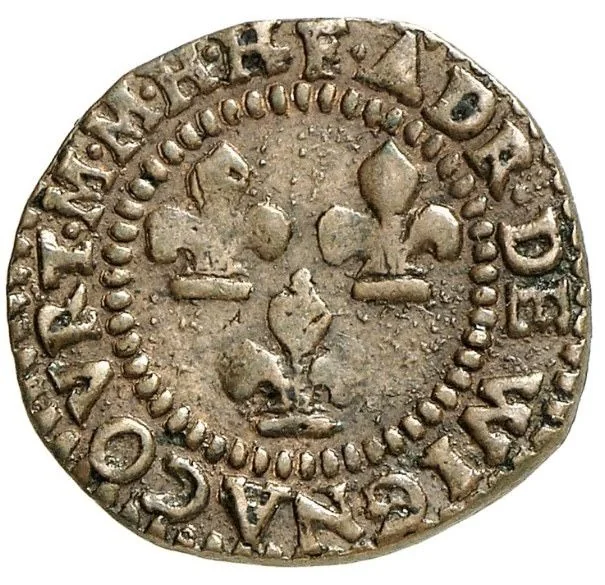
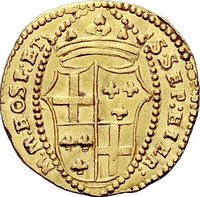
Obverse
Description:
Adrien Wignacourt's circular arms.
Inscription:
F · ADR : DE WIGNACOVRT · M · M · H · H ·
Script: Latin
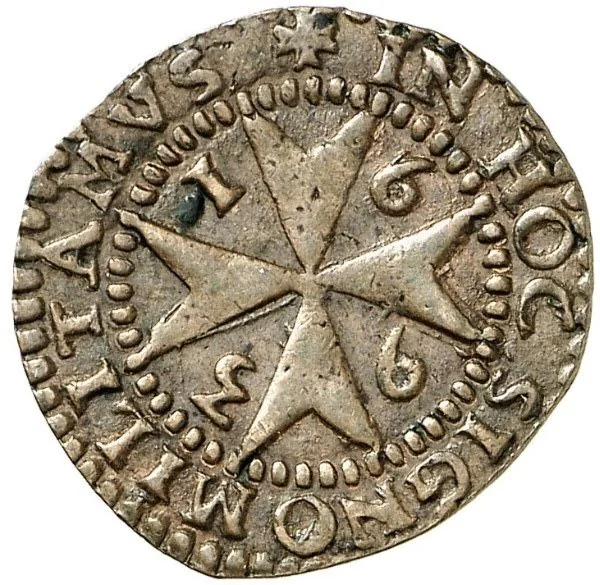
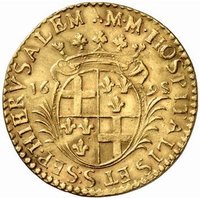
Reverse
Description:
Maltese cross with date in its angles.
Inscription:
☩ IN HOC SIGNO MILITAMVS
Script: Latin
Edge
Mintings
| Year | Mint Mark | Mintage | Quality | Collection |
|---|---|---|---|---|
| 1692 | — | — | ||
| 1693 | — | — | ||
| 1694 | — | — | ||
| 1695 | — | — |
Historical background
In 1692, Malta was under the rule of the Knights of Saint John, a period defined by the island's strategic role in the Mediterranean and its bustling, cosmopolitan port of Valletta. The currency situation was complex and reflected this international character. The official currency was the Scudo, subdivided into 12 Tari, each of 20 Grani. However, a multitude of foreign coins circulated freely alongside it, including Spanish pieces of eight, Venetian sequins, French écus, and Ottoman piastres. This created a de facto multi-currency system where merchants and officials needed a deep understanding of exchange rates and metal purity.
The Knights struggled to maintain monetary stability. A primary challenge was the chronic shortage of small-denomination coinage for everyday transactions, which hampered local trade. Furthermore, the fluctuating value and frequent clipping or debasement of the many foreign coins in circulation led to confusion and potential fraud. While the Order periodically minted its own copper grani and silver scudi at the Zecca (mint), these issues were often insufficient in volume to dominate the money supply or drive out worn and suspect foreign coins.
Consequently, the economy operated on a bullion standard, where the intrinsic silver or gold content of a coin was often more important than its face value. The Treasury of the Order and the Università (municipal government) published official bando (edicts) attempting to fix exchange rates between the various coins, but these were frequently updated, indicating the dynamic and sometimes chaotic reality. Thus, in 1692, Malta's currency landscape was a practical but unstable hybrid system, balancing local needs against the influx of Mediterranean trade wealth, with the Knights' authority over it being more aspirational than absolute.
The Knights struggled to maintain monetary stability. A primary challenge was the chronic shortage of small-denomination coinage for everyday transactions, which hampered local trade. Furthermore, the fluctuating value and frequent clipping or debasement of the many foreign coins in circulation led to confusion and potential fraud. While the Order periodically minted its own copper grani and silver scudi at the Zecca (mint), these issues were often insufficient in volume to dominate the money supply or drive out worn and suspect foreign coins.
Consequently, the economy operated on a bullion standard, where the intrinsic silver or gold content of a coin was often more important than its face value. The Treasury of the Order and the Università (municipal government) published official bando (edicts) attempting to fix exchange rates between the various coins, but these were frequently updated, indicating the dynamic and sometimes chaotic reality. Thus, in 1692, Malta's currency landscape was a practical but unstable hybrid system, balancing local needs against the influx of Mediterranean trade wealth, with the Knights' authority over it being more aspirational than absolute.
✨ Legendary