

4 Zecchini – Malta
Malta
Context
References
KM: #Click to copy to clipboard126
Numista: #129585
Value
Bullion value: $2265.26
Obverse
Description:
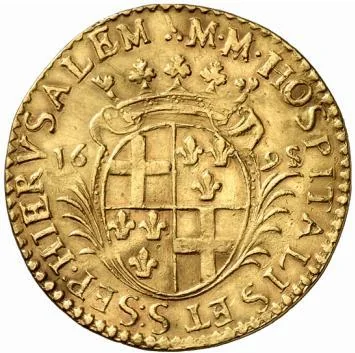
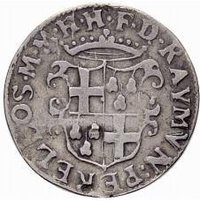
Grand Master's crowned arms.
Inscription:
M·M·HOSPITALIS ET S:SEP:HIERVSALEM
16 9S
16 9S
Script: Latin
Reverse
Description:
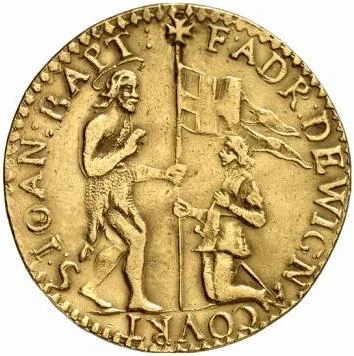
St. John gives flag to kneeling Grand Master.
Inscription:
F·ADR:WIGNA COVRT S:IOAN:BAPT:
Script: Latin
Edge
Mintings
| Year | Mint Mark | Mintage | Quality | Collection |
|---|---|---|---|---|
| 1695 | — | — |
Historical background
In 1695, Malta’s currency situation was complex and problematic, characterised by a severe shortage of official coinage and a chaotic circulation of diverse foreign coins. The islands, ruled by the Knights of St. John, lacked a mint of their own and relied heavily on imported currency, primarily Spanish and Sicilian silver coins like reali and scudi. However, decades of clipping, debasement, and the hoarding of good-quality specie had led to a degraded and unreliable monetary stock, disrupting trade and daily transactions.
The Knights attempted to impose order by issuing official tariffs, fixing the value of the myriad foreign coins in circulation, such as French écus, Venetian ducats, and Ottoman zecchini. These proclamations, however, were largely ineffective. The fundamental issue was that the official rates often failed to reflect the coins’ true metallic value, leading to Gresham’s Law in practice: "bad" debased money drove "good" full-weight coinage out of circulation, as people exported or hoarded the latter. This created a chronic shortage of sound money, with the economy relying on a patchwork of underweight and worn pieces.
Consequently, daily commerce was fraught with difficulty. Merchants and the public faced uncertainty and disputes over exchange rates, while the government struggled to collect revenues effectively. This unstable environment highlighted the urgent need for a sovereign Maltese mint, a project that would only come to fruition over two decades later with Grand Master Perellos’s establishment of the Zecca in 1698, aiming to produce standardized coinage and finally bring monetary order to the islands.
The Knights attempted to impose order by issuing official tariffs, fixing the value of the myriad foreign coins in circulation, such as French écus, Venetian ducats, and Ottoman zecchini. These proclamations, however, were largely ineffective. The fundamental issue was that the official rates often failed to reflect the coins’ true metallic value, leading to Gresham’s Law in practice: "bad" debased money drove "good" full-weight coinage out of circulation, as people exported or hoarded the latter. This created a chronic shortage of sound money, with the economy relying on a patchwork of underweight and worn pieces.
Consequently, daily commerce was fraught with difficulty. Merchants and the public faced uncertainty and disputes over exchange rates, while the government struggled to collect revenues effectively. This unstable environment highlighted the urgent need for a sovereign Maltese mint, a project that would only come to fruition over two decades later with Grand Master Perellos’s establishment of the Zecca in 1698, aiming to produce standardized coinage and finally bring monetary order to the islands.
✨ Legendary