

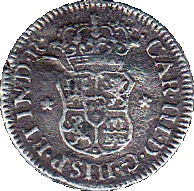

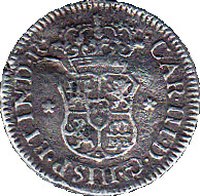
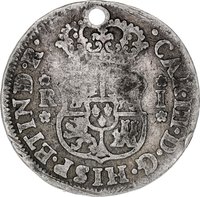
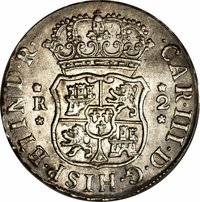
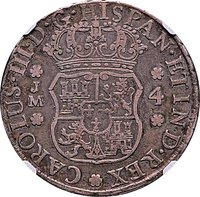
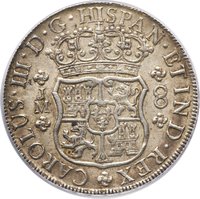
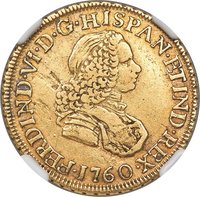
Obverse
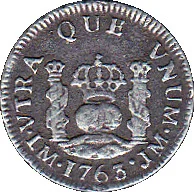
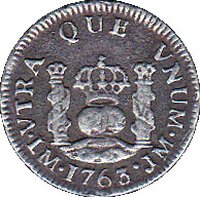
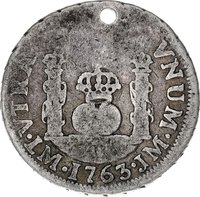
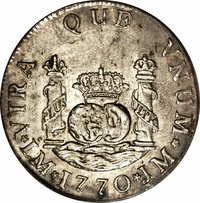
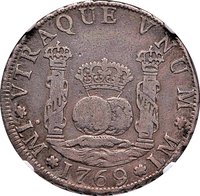
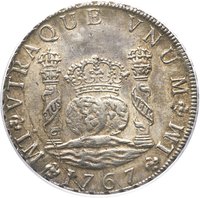
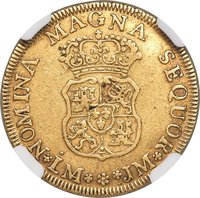
Reverse
Description:
Pillars of Hercules crowned, flanked by ribbons.
Inscription:
VTRA QUE VNUM
LM.1763.JM
LM.1763.JM
Script: Latin
Edge
Mintings
| Year | Mint Mark | Mintage | Quality | Collection |
|---|---|---|---|---|
| 1760 | LIMAE | — | ||
| 1761 | LIMAE | — | ||
| 1762 | LIMAE | — | ||
| 1763 | LIMAE | — | ||
| 1764 | LIMAE | — | ||
| 1765 | LIMAE | — | ||
| 1766 | LIMAE | — | ||
| 1767 | LIMAE | — | ||
| 1768 | LIMAE | — | ||
| 1769 | LIMAE | — | ||
| 1770 | LIMAE | — | ||
| 1771 | LIMAE | — | ||
| 1772 | LIMAE | — |
Historical background
In 1760, the Viceroyalty of Peru operated under a complex and strained monetary system inherited from Spanish colonial policy. The official currency was based on silver, primarily minted at the famed Casa de la Moneda in Potosí (in present-day Bolivia), which produced silver reales and the larger 8-real coin, known as the "Spanish dollar" or peso. This coin was a cornerstone of global trade. However, the system was fundamentally bimetallic, with gold escudos minted in Lima also in circulation, though in smaller quantities. The fixed exchange rate between gold and silver, set by the Spanish Crown, often failed to reflect market realities, creating persistent economic friction.
A critical issue was a severe shortage of fractional currency, or moneda menuda (small change), needed for everyday transactions. This scarcity, caused by the Crown's focus on exporting high-value bullion and the impracticality of cutting silver coins, crippled local markets and small-scale trade. To compensate, a widespread informal economy emerged where commodities like cacao beans, jerga (coarse cloth), and even pasta (unminted silver) were used as de facto currency, particularly among Indigenous and mestizo populations. This practice, while pragmatic, highlighted the Crown's failure to provide a functional monetary system for all levels of society.
Furthermore, the entire system was plagued by fraud and debasement. Counterfeiting was rampant, both through the clipping and shaving of official coins and the production of crude forgeries. Perhaps more damaging was the official debasement under Viceroy Manuel de Amat y Junyent (who took office in 1761), who authorized the minting of low-quality, copper-alloy moneda de molina to address the small change crisis. These coins were deeply unpopular, widely rejected by the public, and further eroded trust in the colonial government's monetary authority, setting the stage for the more sweeping Bourbon reforms that would later attempt to overhaul Peru's fiscal administration.
A critical issue was a severe shortage of fractional currency, or moneda menuda (small change), needed for everyday transactions. This scarcity, caused by the Crown's focus on exporting high-value bullion and the impracticality of cutting silver coins, crippled local markets and small-scale trade. To compensate, a widespread informal economy emerged where commodities like cacao beans, jerga (coarse cloth), and even pasta (unminted silver) were used as de facto currency, particularly among Indigenous and mestizo populations. This practice, while pragmatic, highlighted the Crown's failure to provide a functional monetary system for all levels of society.
Furthermore, the entire system was plagued by fraud and debasement. Counterfeiting was rampant, both through the clipping and shaving of official coins and the production of crude forgeries. Perhaps more damaging was the official debasement under Viceroy Manuel de Amat y Junyent (who took office in 1761), who authorized the minting of low-quality, copper-alloy moneda de molina to address the small change crisis. These coins were deeply unpopular, widely rejected by the public, and further eroded trust in the colonial government's monetary authority, setting the stage for the more sweeping Bourbon reforms that would later attempt to overhaul Peru's fiscal administration.
Series: 1760 Peru circulation coins
💎 Very Rare