

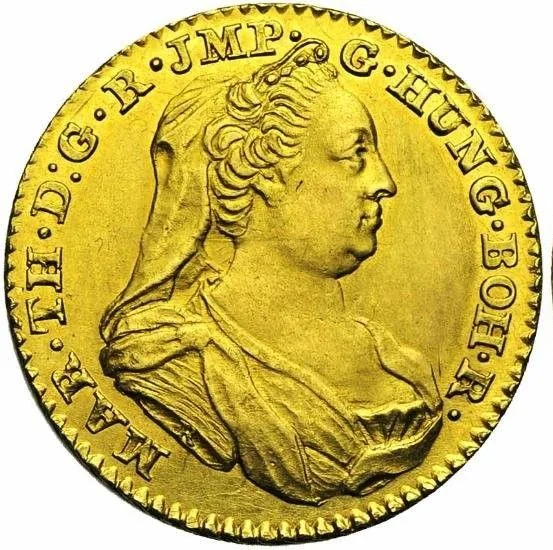
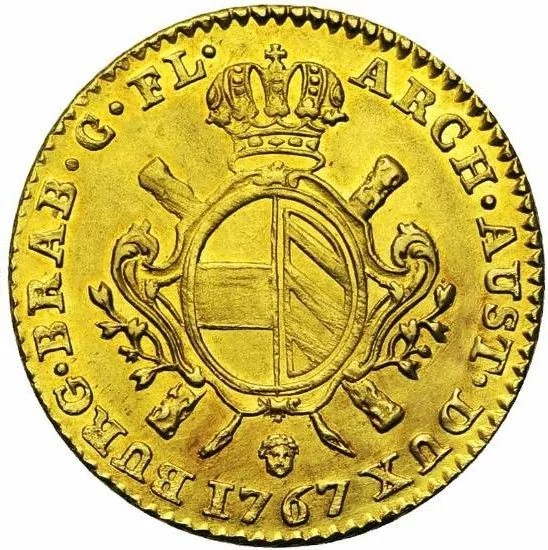
2 Souverains – Austrian Netherlands
Belgium
Context
Years: 1767–1780
Country: Belgium 
Issuer: Austrian Netherlands
Ruler: Maria Theresa
Currency:
(1744—1798)
Demonetized: Yes
Total mintage: 227,115
Material
References
KM: #Click to copy to clipboard25
Numista: #28208
Value
Bullion value: $1703.79
Obverse
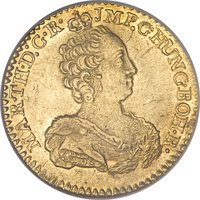
Description:
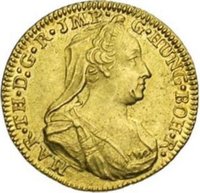
Veiled head right.
Inscription:
MAR · TH · D : G · R · IMP · G · HUNG · BOH · R ·
Script: Latin
Engraver: Jacques Roëttiers
Reverse
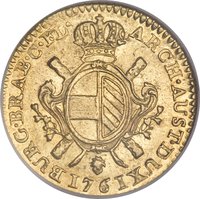
Description:
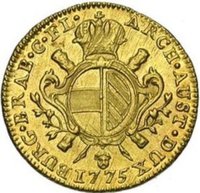
Crowned oval shield with Austria-Burgundy arms on a Burgundian cross, mint mark below, date in legend.
Inscription:
ARCH · AUST · DUX · BURG · BRAB · C · FL ·
1778
1778
Script: Latin
Engraver: Jacques Roëttiers
Edge
Twisted
Mints
| Name | Mark |
|---|---|
| Royal Mint of Belgium | — |
Mintings
| Year | Mint Mark | Mintage | Quality | Collection |
|---|---|---|---|---|
| 1767 | — | 22,110 | ||
| 1768 | — | 12,507 | ||
| 1769 | — | 8,981 | ||
| 1771 | — | 9,765 | ||
| 1772 | — | 6,541 | ||
| 1773 | — | 3,171 | ||
| 1778 | — | 83,236 | ||
| 1779 | — | 77,341 | ||
| 1780 | — | 3,463 |
Historical background
In 1767, the Austrian Netherlands (approximately modern-day Belgium and Luxembourg) grappled with a complex and debilitating currency crisis, a direct legacy of its history as a contested borderland. The region was not a monetary sovereign; it operated under the 1755 "Convention of Brussels," a treaty that attempted to standardize the numerous coins in circulation by fixing their values relative to the Brabant guilder. However, the system was inherently unstable, as it legally tied the value of over 50 different domestic and foreign coins—including Dutch guilders, French louis d'or, and Austrian kronenthalers—to a single, unrealistic standard.
The core problem was a chronic shortage of small-denomination coins for everyday trade, exacerbated by the illegal export and hoarding of full-weight silver coins. This led to a proliferation of debased, lightweight, and counterfeit coins, creating a "bad money drives out good" (Gresham's Law) scenario. Merchants and the public faced daily confusion and loss, as the official convention rates bore little relation to the actual market value of this chaotic mix of specie. The monetary disorder stifled commerce, bred public distrust, and caused frequent price fluctuations that harmed both consumers and businesses.
Empress Maria Theresa's government in Vienna was aware of the issue but approached reform cautiously. The year 1767 fell within a period of administrative study and growing pressure from the Estates of Brabant and Flanders for a practical solution. The crisis highlighted the tension between Vienna's centralizing authority and the provinces' traditional privileges, setting the stage for the more decisive—though ultimately problematic—monetary reorganisation that would be attempted with the "Imperial Ordinance" of 1774.
The core problem was a chronic shortage of small-denomination coins for everyday trade, exacerbated by the illegal export and hoarding of full-weight silver coins. This led to a proliferation of debased, lightweight, and counterfeit coins, creating a "bad money drives out good" (Gresham's Law) scenario. Merchants and the public faced daily confusion and loss, as the official convention rates bore little relation to the actual market value of this chaotic mix of specie. The monetary disorder stifled commerce, bred public distrust, and caused frequent price fluctuations that harmed both consumers and businesses.
Empress Maria Theresa's government in Vienna was aware of the issue but approached reform cautiously. The year 1767 fell within a period of administrative study and growing pressure from the Estates of Brabant and Flanders for a practical solution. The crisis highlighted the tension between Vienna's centralizing authority and the provinces' traditional privileges, setting the stage for the more decisive—though ultimately problematic—monetary reorganisation that would be attempted with the "Imperial Ordinance" of 1774.
✨ Legendary