

1 Souverain – Austrian Netherlands
Belgium
Context
Years: 1770–1777
Country: Belgium 
Issuer: Austrian Netherlands
Ruler: Maria Theresa
Currency:
(1744—1798)
Demonetized: Yes
Total mintage: 138,471
Material
References
KM: #Click to copy to clipboard26
Numista: #28202
Value
Bullion value: $842.40
Obverse
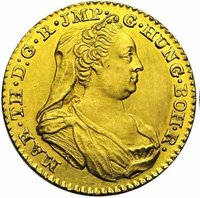
Description:
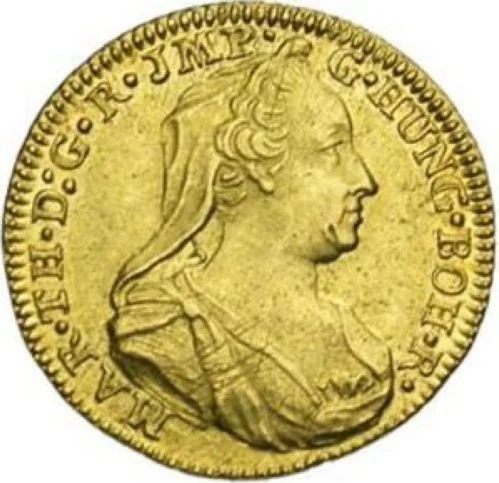
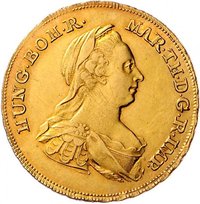
Veiled head right.
Inscription:
MAR · TH · D : G · R · IMP · G · HUNG · BOH · R ·
Script: Latin
Engraver: Jacques Roëttiers
Reverse
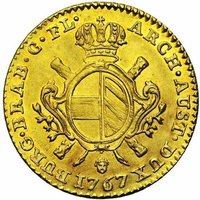
Description:
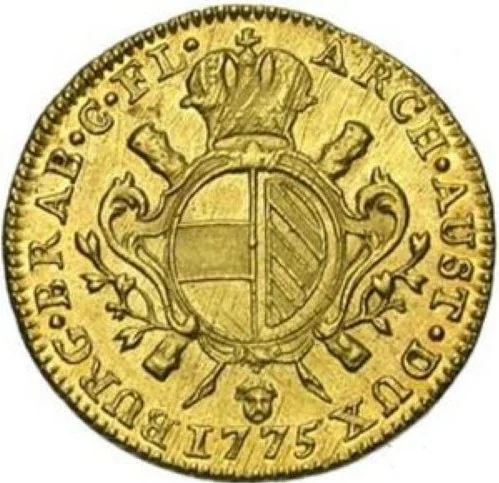
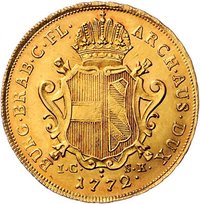
Crowned oval shield with Austria-Burgundy arms on a Burgundian cross, mint mark below, date in legend.
Inscription:
ARCH · AUS · DUX BURG · BRAB · C · FL ·
1775
1775
Script: Latin
Engraver: Jacques Roëttiers
Edge
Twisted
Mints
| Name | Mark |
|---|---|
| Royal Mint of Belgium | — |
Mintings
| Year | Mint Mark | Mintage | Quality | Collection |
|---|---|---|---|---|
| 1770 | — | 13,067 | ||
| 1773 | — | 18,451 | ||
| 1773 | W | — | ||
| 1774 | — | 37,383 | ||
| 1775 | — | 27,976 | ||
| 1776 | — | 24,032 | ||
| 1777 | — | 17,562 |
Historical background
In the Austrian Netherlands of 1770, the currency situation was a complex and persistent source of economic friction, largely inherited from the region's history under Spanish rule. The monetary system was not unified, operating on a bimetallic standard of both gold and silver coins. However, the circulating medium was a chaotic mix of over 200 different coin types from neighbouring states like France, the Dutch Republic, and the German principalities, alongside older Spanish and domestic issues. This proliferation of foreign coins, each with fluctuating values, created a bewildering and unstable environment for trade and daily transactions.
The core of the problem lay in the official agio, or exchange rate, set by the monetary ordinances between the patagon (a silver coin) and the florin (the unit of account). The government persistently overvalued the patagon in an attempt to attract precious metal and finance state expenditures. This official rate consistently diverged from the higher, market-driven rate, leading to a classic instance of Gresham's Law: "bad money drives out good." Undervalued full-weight coins were either hoarded, melted down for bullion, or exported, leaving the economy flooded with worn, clipped, and inferior foreign coins, further eroding trust and complicating commerce.
Despite repeated ordinances from the Habsburg authorities in Brussels and Vienna aimed at fixing values and recalling debased coinage, these measures provided only temporary relief. The fundamental disconnect between government decree and market reality, combined with the region's position as a commercial crossroads, made effective reform nearly impossible. This monetary instability acted as a drag on the economy, frustrating merchants and contributing to broader grievances against the Habsburg administration, which was often seen as distant and ineffective in managing local economic affairs.
The core of the problem lay in the official agio, or exchange rate, set by the monetary ordinances between the patagon (a silver coin) and the florin (the unit of account). The government persistently overvalued the patagon in an attempt to attract precious metal and finance state expenditures. This official rate consistently diverged from the higher, market-driven rate, leading to a classic instance of Gresham's Law: "bad money drives out good." Undervalued full-weight coins were either hoarded, melted down for bullion, or exported, leaving the economy flooded with worn, clipped, and inferior foreign coins, further eroding trust and complicating commerce.
Despite repeated ordinances from the Habsburg authorities in Brussels and Vienna aimed at fixing values and recalling debased coinage, these measures provided only temporary relief. The fundamental disconnect between government decree and market reality, combined with the region's position as a commercial crossroads, made effective reform nearly impossible. This monetary instability acted as a drag on the economy, frustrating merchants and contributing to broader grievances against the Habsburg administration, which was often seen as distant and ineffective in managing local economic affairs.
✨ Legendary