

1 Silver Ecu – France
France

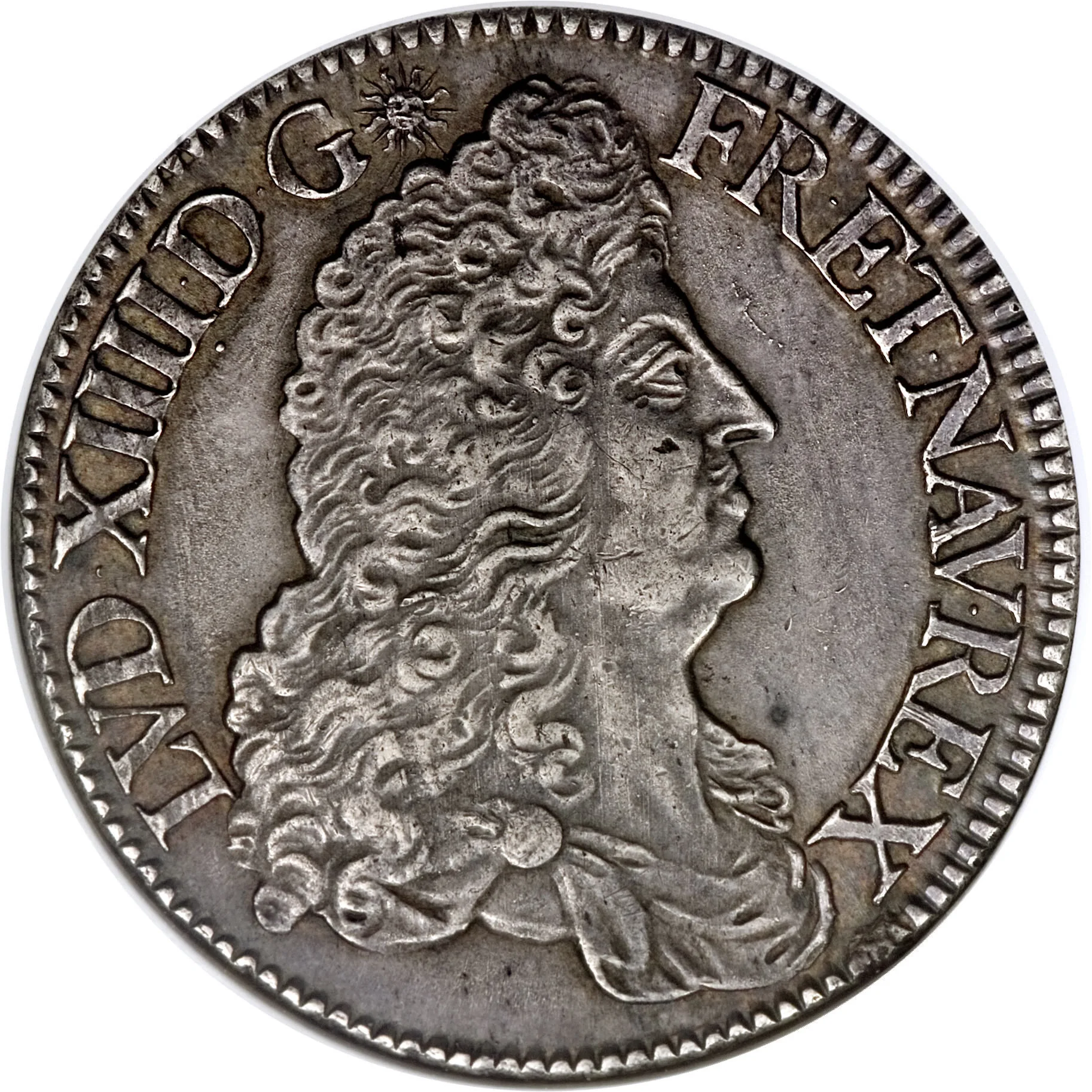
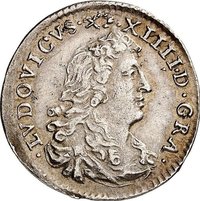
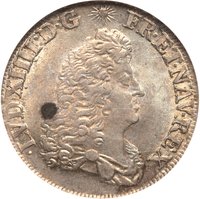
Obverse
Description:
Right bust of Louis XIV in wig and antique drapery. Caption from 7 o'clock.
Inscription:
LVD• XIIII• D• G• FR• ET• NAV• REX
Script: Latin
Engraver: Joseph Roëttiers
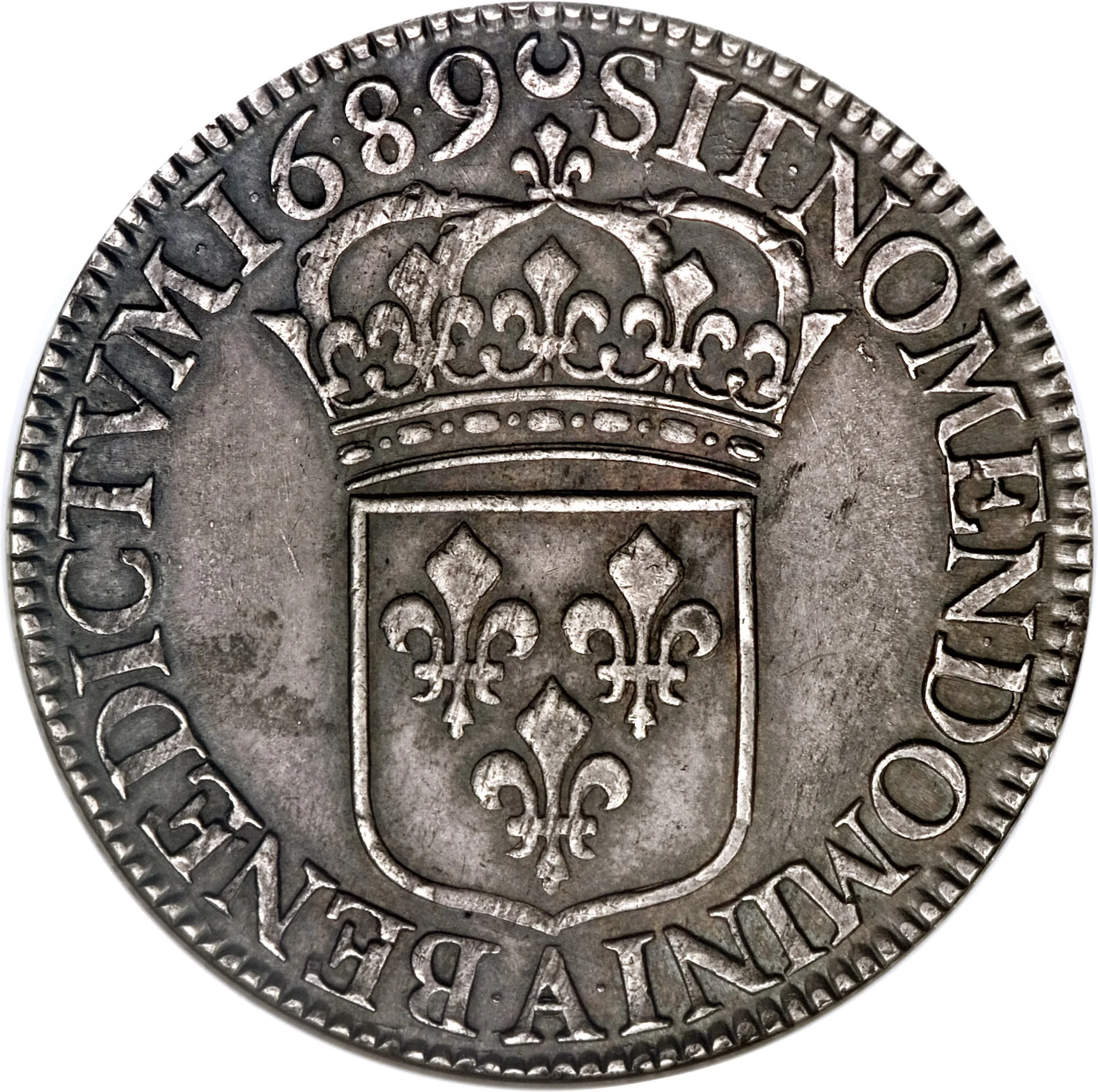
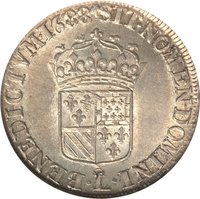
Reverse
Description:
French royal shield. Different workshop noted below.
Inscription:
SIT• NOMEN• DOMINI•BENEDICTVM•1689
Script: Latin
Engraver: Joseph Roëttiers
Edge
Inscription in relief.
Legend:
DOMINE SALVUM FAC REGEM
Mintings
| Year | Mint Mark | Mintage | Quality | Collection |
|---|---|---|---|---|
| 1684 | A | 26,962 | ||
| 1685 | 9 | — | ||
| 1685 | A | 52,136 | ||
| 1685 | K | 40,997 | ||
| 1685 | L | 190,018 | ||
| 1685 | X | 6,382 | ||
| 1686 | & | 16,170 | ||
| 1686 | 9 | 141,871 | ||
| 1686 | A | 595,152 | ||
| 1686 | K | 22,269 | ||
| 1686 | L | 188,736 | ||
| 1687 | & | 43,120 | ||
| 1687 | 9 | 478,287 | ||
| 1687 | A | 102,307 | ||
| 1687 | K | 16,292 | ||
| 1687 | L | 131,817 | ||
| 1688 | & | 22,015 | ||
| 1688 | 9 | 32,371 | ||
| 1688 | A | 6,699 | ||
| 1688 | K | 18,668 | ||
| 1688 | L | 32,736 | ||
| 1689 | L | 120,309 | ||
| 1689 | 9 | 164,340 | ||
| 1689 | A | 208,365 | ||
| 1689 | D | 79,129 | ||
| 1689 | & | 169,695 |
Historical background
In 1684, France operated under a complex and often precarious monetary system, a legacy of medieval practices modernized under Louis XIV’s absolutist rule. The official currency was the livre tournois (l.t.), a unit of account, but actual commerce relied on a physical circulation of multiple coin types: gold louis d’or, silver écus, and a plethora of copper liards and sous. Critically, the face value of these coins was not fixed to their metal content but was set by royal decree, allowing the Crown to manipulate their worth. This system created a constant tension between the official livre and the market value of the metal in the coins, leading to frequent instability.
This year fell within a period of relative monetary calm engineered by Finance Minister Jean-Baptiste Colbert, who had prioritized stability after the chaotic manipulations of earlier decades. His policy aimed to maintain a strong, reliable currency to foster commerce and state credibility. However, the immense costs of Louis XIV’s wars, palace building at Versailles, and lavish court were a constant pressure. While not in a crisis in 1684, the system was under strain; the recent conclusion of the War of the Reunions (1683-1684) had drained the treasury, and the state’s financial maneuvers often involved anticipating future tax revenues and manipulating currency values to create short-term liquidity.
Consequently, the monetary situation was one of managed fragility. The official valuations held, but merchants and money changers remained wary of devaluations, which were a traditional royal tool for raising funds. The system’s health was entirely dependent on the Crown's ability to avoid further major war expenses—a precarious balance that would soon be shattered with the outbreak of the Nine Years' War in 1688. Thus, 1684 represents a brief plateau of stability in Louis XIV’s reign, underpinned by Colbert’s discipline but inherently vulnerable to the Sun King’s expansive ambitions.
This year fell within a period of relative monetary calm engineered by Finance Minister Jean-Baptiste Colbert, who had prioritized stability after the chaotic manipulations of earlier decades. His policy aimed to maintain a strong, reliable currency to foster commerce and state credibility. However, the immense costs of Louis XIV’s wars, palace building at Versailles, and lavish court were a constant pressure. While not in a crisis in 1684, the system was under strain; the recent conclusion of the War of the Reunions (1683-1684) had drained the treasury, and the state’s financial maneuvers often involved anticipating future tax revenues and manipulating currency values to create short-term liquidity.
Consequently, the monetary situation was one of managed fragility. The official valuations held, but merchants and money changers remained wary of devaluations, which were a traditional royal tool for raising funds. The system’s health was entirely dependent on the Crown's ability to avoid further major war expenses—a precarious balance that would soon be shattered with the outbreak of the Nine Years' War in 1688. Thus, 1684 represents a brief plateau of stability in Louis XIV’s reign, underpinned by Colbert’s discipline but inherently vulnerable to the Sun King’s expansive ambitions.
✨ Legendary