

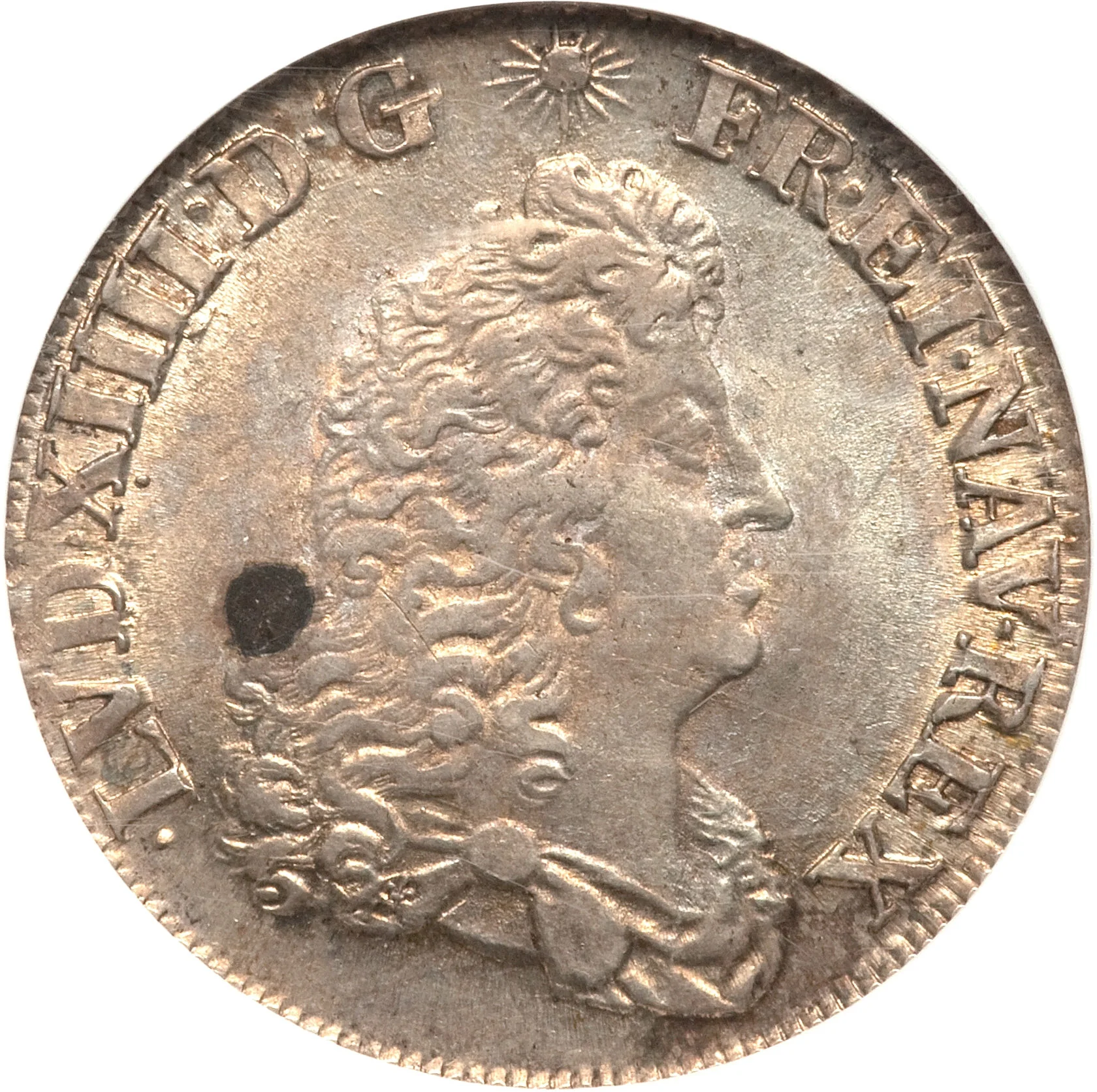
¼ silver ecu – France
Add to wishlist
France
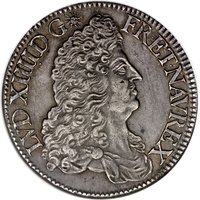
Obverse
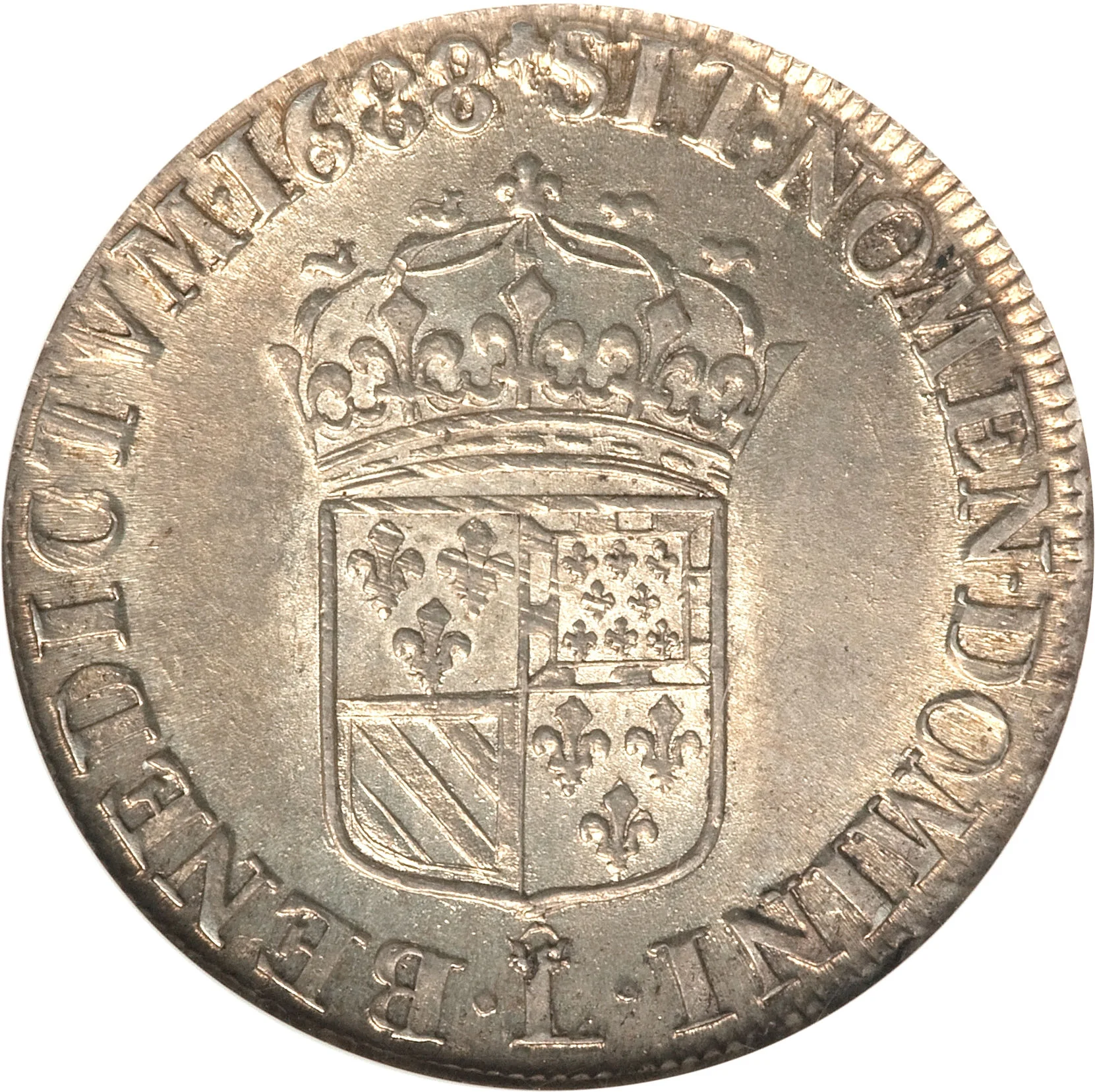
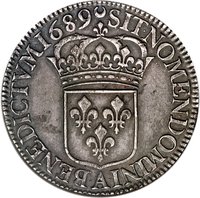
Reverse
Description:
Shield quartered with the arms of France and Old and New Burgundy.
Inscription:
SIT.NOMEN.DOMINI. BENEDICTVM. 1688
Script: Latin
Edge
Embossed inscription.
Legend:
DOMINE SALVUM FAC REGEM CHRISTIANISSIMVM
Categories
| Object> Armour |
| Symbol> Crown |
| Person> Monarch |
| Symbols> Coat of Arms |
| Symbol> Fleur-de-lis |
Mintings
| Year | Mint Mark | Mintage | Quality | Collection |
|---|---|---|---|---|
| 1686 | IL | 373,000 | ||
| 1686 | L | — | ||
| 1687 | L | 751,000 | ||
| 1688 | L | 139,000 |
Historical background
In 1686, France operated under a complex and often unstable monetary system, a legacy of medieval practices that were straining under the ambitions of Louis XIV’s absolute monarchy. The primary unit of account was the livre tournois, a theoretical value used for bookkeeping, but the physical currency in circulation was a bewildering array of gold coins (like the louis d'or), silver coins (écus and sous), and billon (debased silver) coins. The king held the sovereign right to arbitrarily alter the official value (the marc) of these coins by royal edict, a practice used to manipulate state finances but which caused widespread confusion and economic distortion.
This period was marked by a significant policy of currency manipulation orchestrated by Finance Minister Claude Le Peletier and the king. Facing the immense costs of the War of the League of Augsburg (begun in 1688 but with prior military buildup) and the lavish expenses of Versailles, the crown repeatedly engaged in augmentations (raising the official face value of coins) to extract more tax revenue in nominal terms, followed by diminutions (lowering the value) to reduce the royal debt. A major re-coinage in 1686 aimed to standardize and profit from this process, but it effectively acted as a forced loan from the populace, as old coins were called in and re-minted at a new value unfavorable to holders.
Consequently, the monetary situation was one of profound uncertainty and hardship. Merchants, peasants, and creditors never knew the real value of their money from one year to the next, which stifled commerce and long-term investment. Widespread hoarding of older, purer coins and the circulation of foreign currencies further undermined the system. This instability sowed deep discontent and was a key factor in the severe economic crises that would mark the latter part of Louis XIV's reign, highlighting the fundamental weakness of financing a modernizing state through predatory, pre-modern fiscal tools.
This period was marked by a significant policy of currency manipulation orchestrated by Finance Minister Claude Le Peletier and the king. Facing the immense costs of the War of the League of Augsburg (begun in 1688 but with prior military buildup) and the lavish expenses of Versailles, the crown repeatedly engaged in augmentations (raising the official face value of coins) to extract more tax revenue in nominal terms, followed by diminutions (lowering the value) to reduce the royal debt. A major re-coinage in 1686 aimed to standardize and profit from this process, but it effectively acted as a forced loan from the populace, as old coins were called in and re-minted at a new value unfavorable to holders.
Consequently, the monetary situation was one of profound uncertainty and hardship. Merchants, peasants, and creditors never knew the real value of their money from one year to the next, which stifled commerce and long-term investment. Widespread hoarding of older, purer coins and the circulation of foreign currencies further undermined the system. This instability sowed deep discontent and was a key factor in the severe economic crises that would mark the latter part of Louis XIV's reign, highlighting the fundamental weakness of financing a modernizing state through predatory, pre-modern fiscal tools.
✨ Legendary