

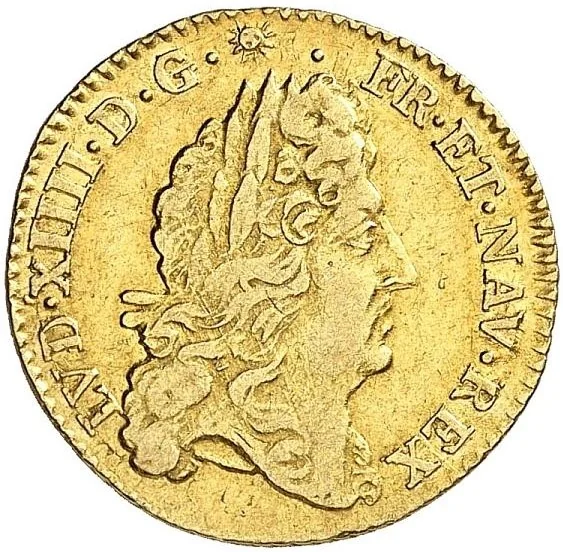
½ gold louis – France
Add to wishlist
France
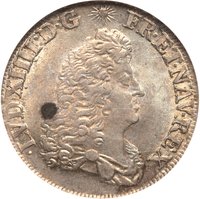
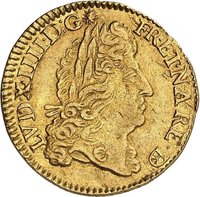
Obverse
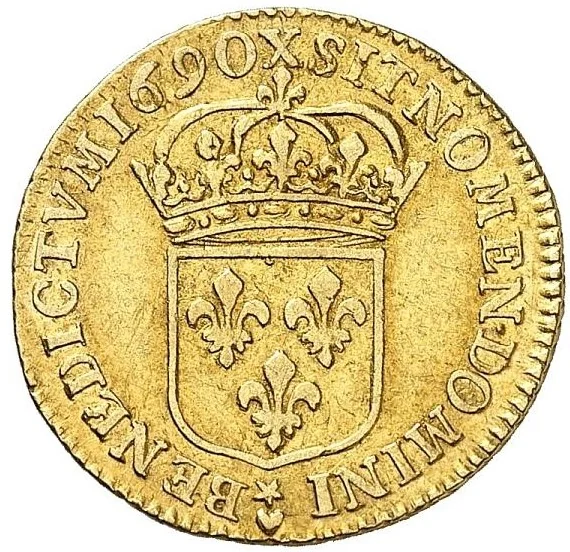
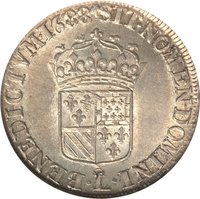
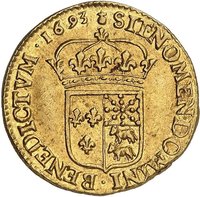
Reverse
Description:
Crowned arms, mint mark above, date in legend.
Inscription:
SIT NOMEN DOMINI BENEDICTVM 1690 X
Script: Latin
Edge
Categories
| Symbols> Coat of Arms |
| Person> Monarch |
Mints
| Name | Mark |
|---|---|
| Aix-en-Provence | & |
| Lille | ♕L |
| Rennes | 9 |
| Monnaie de Paris | A |
| Rouen | B |
| Lyon | D |
| Tours | E |
| Poitiers | G |
| La Rochelle | H |
| Limoges | I |
| Bordeaux | K |
| Bayonne | L |
| Toulouse | M |
| Montpellier | N |
| Riom | O |
| Dijon | P |
| Amiens | X |
| Bourges | Y |
Mintings
| Year | Mint Mark | Mintage | Quality | Collection |
|---|---|---|---|---|
| 1690 | & | — | ||
| 1690 | ♕L | — | ||
| 1690 | 9 | — | ||
| 1690 | A | — | ||
| 1690 | B | — | ||
| 1690 | D | — | ||
| 1690 | G | — | ||
| 1690 | I | — | ||
| 1690 | K | — | ||
| 1690 | L | — | ||
| 1690 | M | — | ||
| 1690 | N | — | ||
| 1690 | P | — | ||
| 1691 | ♕L | — | ||
| 1691 | 9 | — | ||
| 1691 | A | — | ||
| 1691 | B | — | ||
| 1691 | D | — | ||
| 1691 | E | — | ||
| 1691 | G | — | ||
| 1691 | I | — | ||
| 1691 | L | — | ||
| 1691 | M | — | ||
| 1691 | N | — | ||
| 1691 | O | — | ||
| 1691 | P | — | ||
| 1691 | X | — | ||
| 1691 | Y | — | ||
| 1692 | & | — | ||
| 1692 | ♕L | — | ||
| 1692 | B | — | ||
| 1692 | D | — | ||
| 1692 | E | — | ||
| 1692 | G | — | ||
| 1692 | I | — | ||
| 1692 | P | — | ||
| 1692 | Y | — | ||
| 1693 | E | — | ||
| 1693 | H | — | ||
| 1693 | O | — | ||
| 1693 | P | — | ||
| 1693 | A | — |
Historical background
In 1690, France under Louis XIV was embroiled in the Nine Years' War (1688-1697), a costly conflict against a grand coalition of European powers. The financial strain was immense, as the Sun King's ambitions for military glory and territorial expansion drained the royal treasury. To meet these extraordinary expenses, the government, led by Finance Minister Louis Phélypeaux de Pontchartrain, resorted to a series of desperate and disruptive monetary manipulations that severely destabilized the French currency.
The primary tactic was a deliberate augmentation—the official raising of the face value of existing silver and gold coins by royal decree. For example, a louis d'or nominally worth 10 livres might be declared worth 14 livres overnight. This created the illusion of more money in the royal coffers to pay armies and suppliers, but it triggered rapid inflation, as prices adjusted upward to reflect the coin's reduced intrinsic value. The government would later attempt a diminution, lowering the official value, to try to draw bullion back to the mints, creating a chaotic cycle of re-evaluations that destroyed public trust.
This policy devastated the economy. Merchants and peasants hoarded old coins for their metal content, creditors were repaid in devalued currency, and foreign trade suffered as French coin became untrustworthy. The manipulations amounted to a brutal, hidden tax on the population, particularly those on fixed incomes. While providing short-term war funding, the currency chaos of the 1690s exacerbated widespread poverty, contributed to the famine of 1693-94, and laid bare the structural weaknesses of the French financial system, weaknesses that would culminate in the crisis of the French Revolution a century later.
The primary tactic was a deliberate augmentation—the official raising of the face value of existing silver and gold coins by royal decree. For example, a louis d'or nominally worth 10 livres might be declared worth 14 livres overnight. This created the illusion of more money in the royal coffers to pay armies and suppliers, but it triggered rapid inflation, as prices adjusted upward to reflect the coin's reduced intrinsic value. The government would later attempt a diminution, lowering the official value, to try to draw bullion back to the mints, creating a chaotic cycle of re-evaluations that destroyed public trust.
This policy devastated the economy. Merchants and peasants hoarded old coins for their metal content, creditors were repaid in devalued currency, and foreign trade suffered as French coin became untrustworthy. The manipulations amounted to a brutal, hidden tax on the population, particularly those on fixed incomes. While providing short-term war funding, the currency chaos of the 1690s exacerbated widespread poverty, contributed to the famine of 1693-94, and laid bare the structural weaknesses of the French financial system, weaknesses that would culminate in the crisis of the French Revolution a century later.
✨ Legendary