

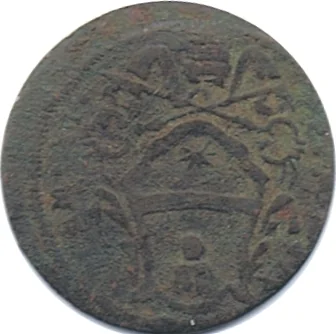
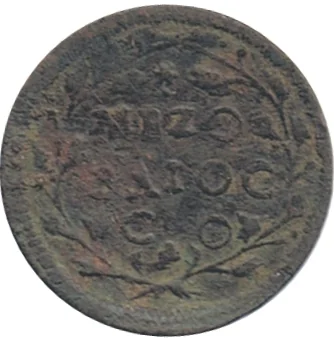
½ baiocco – Gubbio
Add to wishlist
Italy
Context
Years: 1703–1718
Country: Italy
Issuer: Gubbio
Ruler: Clement XI
Currency:
(1534—1835)
Demonetized: Yes
Material
References
KM: #
Numista: #27634
Obverse
Reverse
Edge
Mints
| Name | Mark |
|---|---|
| Gubbio | — |
Mintings
| Year | Mint Mark | Mintage | Quality | Collection |
|---|---|---|---|---|
| 1703 | — | — | ||
| 1704 | — | — | ||
| 1705 | — | — | ||
| 1706 | — | — | ||
| 1707 | — | — | ||
| 1708 | — | — | ||
| 1710 | — | — | ||
| 1711 | — | — | ||
| 1712 | — | — | ||
| 1713 | — | — | ||
| 1714 | — | — | ||
| 1715 | — | — | ||
| 1716 | — | — | ||
| 1717 | — | — | ||
| 1718 | — | — |
Historical background
In 1703, the Italian city-state of Gubbio, like much of central Italy, operated under a complex and fragmented monetary system. Officially, it was part of the Papal States, and the primary unit of account was the Papal scudo, a silver coin. However, the actual circulating medium was a chaotic mix of physical coins from various Italian and European mints, including Spanish reales, Tuscan fiorini, and local feudal issues. This proliferation of coins of varying weight, purity, and value created significant challenges for daily commerce, requiring constant reference to exchange lists and the expertise of money-changers.
The situation was further strained by the wider European context of the War of the Spanish Succession (1701-1714). Military campaigns crisscrossed the Italian peninsula, and the presence of occupying armies, whether French or Imperial, placed heavy fiscal demands on Gubbio. These forces often imposed requisitions and demanded payments, potentially introducing even more foreign coinage or, conversely, causing a shortage of good silver money as it was hoarded or taken away. This period was marked by monetary instability, where the intrinsic metal value of a coin could diverge sharply from its official face value.
Consequently, the economic life of Gubbio in 1703 was characterized by uncertainty and inflationary pressures. Merchants and citizens faced the practical difficulties of assessing and trusting a multitude of coins, while the governing authorities struggled to maintain a stable standard of value. The monetary confusion reflected the broader political fragility of the era, where a small city-state was subject to the fiscal needs of the Papacy and the disruptive currents of a continental war, all mediated through a precarious and inconsistent currency system.
The situation was further strained by the wider European context of the War of the Spanish Succession (1701-1714). Military campaigns crisscrossed the Italian peninsula, and the presence of occupying armies, whether French or Imperial, placed heavy fiscal demands on Gubbio. These forces often imposed requisitions and demanded payments, potentially introducing even more foreign coinage or, conversely, causing a shortage of good silver money as it was hoarded or taken away. This period was marked by monetary instability, where the intrinsic metal value of a coin could diverge sharply from its official face value.
Consequently, the economic life of Gubbio in 1703 was characterized by uncertainty and inflationary pressures. Merchants and citizens faced the practical difficulties of assessing and trusting a multitude of coins, while the governing authorities struggled to maintain a stable standard of value. The monetary confusion reflected the broader political fragility of the era, where a small city-state was subject to the fiscal needs of the Papacy and the disruptive currents of a continental war, all mediated through a precarious and inconsistent currency system.
💎 Extremely Rare