

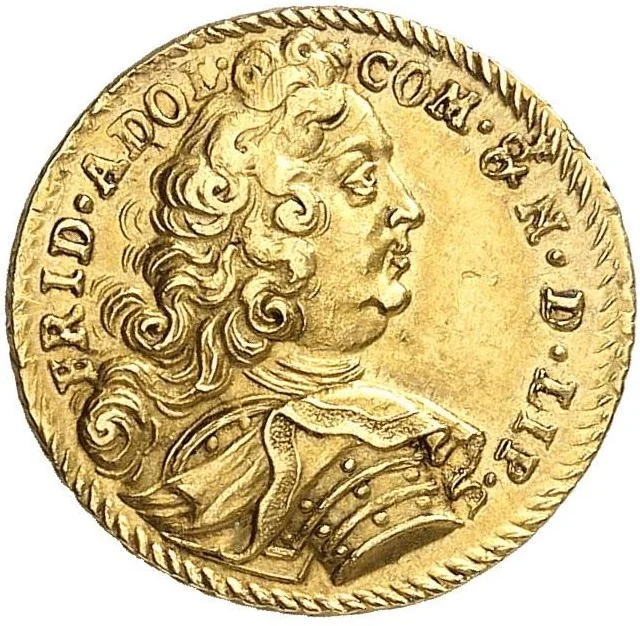
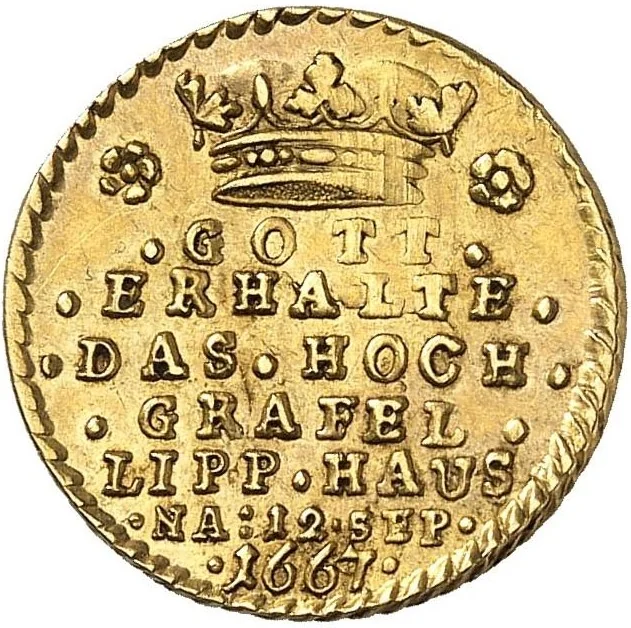
1 Ducat (Birthday) – County of Lippe-Detmold
Circulating commemorative coins
Commemoration: 47th Birthday
Context
Material
References
KM: #Click to copy to clipboard142
Numista: #276142
Value
Bullion value: $594.16
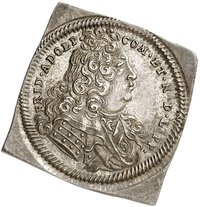
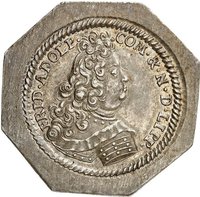
Obverse
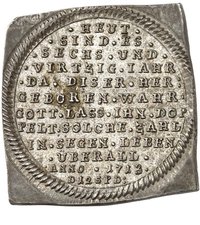
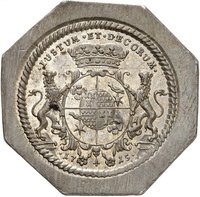
Reverse
Description:
Inscription beneath crown.
Inscription:
GOTT
ERHALTE
DAS HOCH
GRAFEL
LIPP HAUS
NA 12 SEP
1667
ERHALTE
DAS HOCH
GRAFEL
LIPP HAUS
NA 12 SEP
1667
Script: Latin
Edge
Mintings
| Year | Mint Mark | Mintage | Quality | Collection |
|---|---|---|---|---|
| 1714 | — | — |
Historical background
In 1714, the County of Lippe-Detmold, a small principality within the Holy Roman Empire, operated within a complex and fragmented monetary system. Like most German territories of the era, it did not possess the sovereign right to mint its own high-value specie coins (like thalers or gold guilders). Instead, it relied on the imperial currency framework established by the Reichsmünzordnung (Imperial Coinage Ordinance), which designated the large silver Reichsthaler as a standard. However, the county's rulers did exercise the right to mint lower-denomination Scheidemünzen (small change), such as Gute Groschen, Mariengroschen, and Pfennige, for local use. This created a dual circulation of high-value "imperial" coins and low-value "local" coins.
The practical currency situation was one of significant disorder and fluctuation. The value and metal content of the locally minted small change were frequently debased to generate seigniorage revenue for the count's treasury, especially to finance military obligations or court expenses. This led to chronic instability, as the overproduction of inferior coins drove better-quality imperial and foreign coins out of circulation (Gresham's Law). Consequently, merchants and the populace faced constant uncertainty regarding the real value of the mixed coinage in their purses, complicating trade and taxation.
Furthermore, Lippe-Detmold's economy was deeply affected by the monetary policies of its larger and more powerful neighbors, particularly Brunswick-Lüneburg and Brandenburg-Prussia, whose coins circulated widely within its borders. The year 1714 itself fell within a period of recovery from the widespread economic devastation of the Thirty Years' War and more recent conflicts like the War of the Spanish Succession, which had further disrupted regional trade and specie flows. Therefore, the county's currency landscape was characterized by a lack of uniform standard, competitive debasement, and dependence on external monetary forces, reflecting the broader political fragmentation of the Holy Roman Empire.
The practical currency situation was one of significant disorder and fluctuation. The value and metal content of the locally minted small change were frequently debased to generate seigniorage revenue for the count's treasury, especially to finance military obligations or court expenses. This led to chronic instability, as the overproduction of inferior coins drove better-quality imperial and foreign coins out of circulation (Gresham's Law). Consequently, merchants and the populace faced constant uncertainty regarding the real value of the mixed coinage in their purses, complicating trade and taxation.
Furthermore, Lippe-Detmold's economy was deeply affected by the monetary policies of its larger and more powerful neighbors, particularly Brunswick-Lüneburg and Brandenburg-Prussia, whose coins circulated widely within its borders. The year 1714 itself fell within a period of recovery from the widespread economic devastation of the Thirty Years' War and more recent conflicts like the War of the Spanish Succession, which had further disrupted regional trade and specie flows. Therefore, the county's currency landscape was characterized by a lack of uniform standard, competitive debasement, and dependence on external monetary forces, reflecting the broader political fragmentation of the Holy Roman Empire.
✨ Legendary