

1 maravedi – Spain
Add to wishlist
Spain
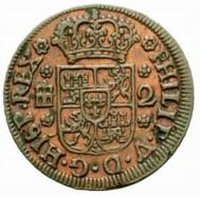
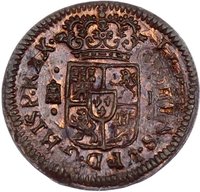
Obverse
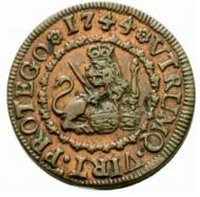
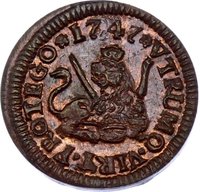
Reverse
Description:
Crowned lion holding a scepter and saber, with two globes at its feet.
Inscription:
VTRVMQ. VIRT. PROTEGO.
1745
1745
Script: Latin
Edge
Mints
| Name | Mark |
|---|---|
| Royal Mint of Madrid | (M) |
Mintings
| Year | Mint Mark | Mintage | Quality | Collection |
|---|---|---|---|---|
| 1745 | M | — |
Historical background
In 1745, Spain operated under a complex and strained monetary system, a legacy of the Habsburg era that was struggling to support the global ambitions of the Bourbon monarchy under King Philip V. The core of the system was the real de vellón, a billon coin (copper with a small silver content) that served as the primary unit of account for domestic transactions. However, the most important and prestigious coins were the silver real de a ocho (piece of eight) and the gold escudo, which were essential for Spain's vast international trade, military expenditures, and its American colonies. The system was not unified, with different regions like Catalonia using their own accounting systems, creating internal friction.
The financial situation was severely pressured by Spain's involvement in the War of the Austrian Succession (1740-1748), which placed enormous demands on the royal treasury. To fund the war, the crown repeatedly resorted to debasement and the issuance of low-quality vellón coinage, leading to inflation and a loss of public confidence. This practice caused a classic manifestation of Gresham's Law, where "bad money drives out good": high-quality silver and gold coins were hoarded or exported, leaving the economy to function on a flood of depreciating copper, which hampered commerce and state finances.
Furthermore, the monetary chaos was exacerbated by the influx of precious metals from the Americas, which, while substantial, was unpredictable and often intercepted by enemies or delayed. The royal government attempted reforms, such as the 1737 decree that tried to stabilize the relationship between gold, silver, and vellón, but these measures were largely ineffective in the face of ongoing wartime fiscal demands. Consequently, the currency situation in 1745 was one of instability, inflationary pressure, and ad-hoc management, reflecting the broader challenges of maintaining imperial power while financing prolonged European conflict.
The financial situation was severely pressured by Spain's involvement in the War of the Austrian Succession (1740-1748), which placed enormous demands on the royal treasury. To fund the war, the crown repeatedly resorted to debasement and the issuance of low-quality vellón coinage, leading to inflation and a loss of public confidence. This practice caused a classic manifestation of Gresham's Law, where "bad money drives out good": high-quality silver and gold coins were hoarded or exported, leaving the economy to function on a flood of depreciating copper, which hampered commerce and state finances.
Furthermore, the monetary chaos was exacerbated by the influx of precious metals from the Americas, which, while substantial, was unpredictable and often intercepted by enemies or delayed. The royal government attempted reforms, such as the 1737 decree that tried to stabilize the relationship between gold, silver, and vellón, but these measures were largely ineffective in the face of ongoing wartime fiscal demands. Consequently, the currency situation in 1745 was one of instability, inflationary pressure, and ad-hoc management, reflecting the broader challenges of maintaining imperial power while financing prolonged European conflict.
✨ Legendary