

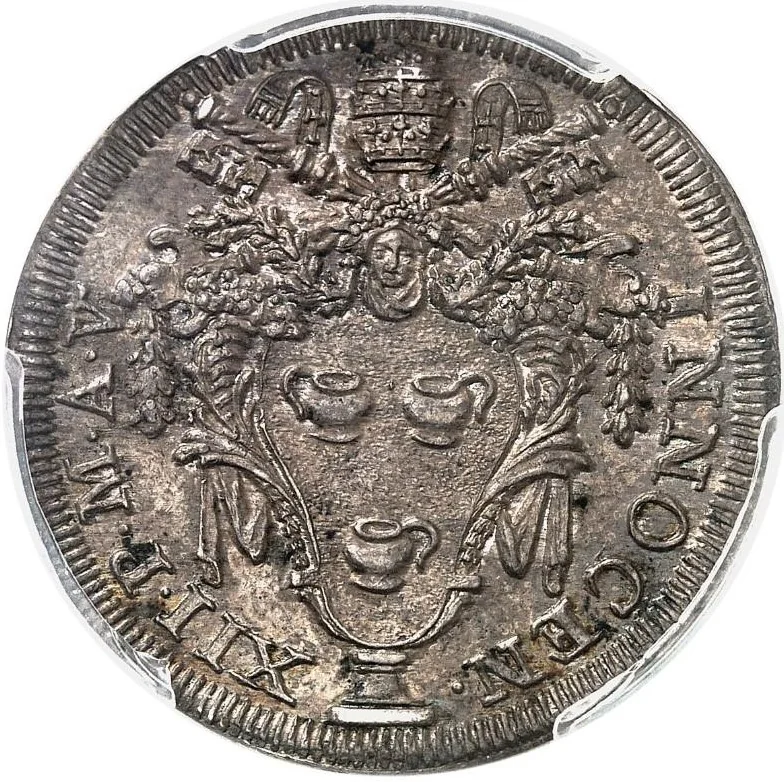
1 teston – Papal States
Add to wishlist
Circulating commemorative coins
Commemoration: Exhortation to the Peace
Vatican City
Context
Year: 1695
Country: Vatican City
Issuer: Papal States
Ruler: Innocent XII
Currency:
(1534—1835)
Demonetized: Yes
Material
References
KM: #
Numista: #268909
Value
Bullion value: $21.27
Obverse
Reverse
Description:
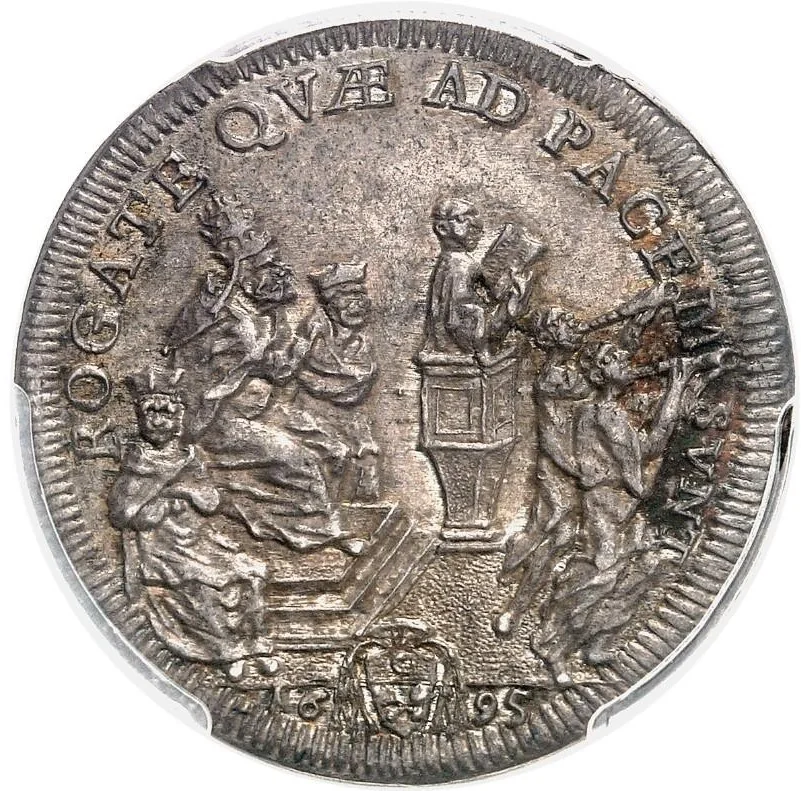
Pope flanked by two cardinals, listening as two trumpeters play.
Inscription:
ROGATE QVAE AD PACEM SVNT
1695
1695
Script: Latin
Edge
Plain
Mints
| Name | Mark |
|---|---|
| Rome | — |
Mintings
| Year | Mint Mark | Mintage | Quality | Collection |
|---|---|---|---|---|
| 1695 | — | — |
Historical background
In 1695, the Papal States under Pope Innocent XII faced a significant monetary crisis rooted in decades of fiscal mismanagement and the debasement of coinage. His predecessors, particularly Innocent XI and Alexander VIII, had resorted to reducing the silver content in coins like the grosso and testone to fund wars, infrastructure, and the lavish Baroque arts. This practice, while providing short-term revenue, led to severe inflation, a loss of public confidence in the currency, and the flight of higher-value coins (a manifestation of Gresham's Law, where "bad money drives out good"). By the 1690s, the monetary system was chaotic, with a confusing mix of old, full-value coins and new, debased ones circulating at fluctuating values, hampering both daily trade and state finances.
The crisis was exacerbated by the Papal States' broader economic stagnation. The state's finances were heavily reliant on taxes, fees from pilgrims, and levies from its extensive lands, but these revenues were often inefficiently collected and insufficient. Furthermore, the lucrative trade in alum (a mineral essential for dyeing textiles) had long since declined, depriving the treasury of a once-steady income. The currency debasement was, in essence, a form of hidden taxation that eroded purchasing power and created widespread economic uncertainty among merchants, bankers, and the populace in Rome and the legations.
Pope Innocent XII, elected in 1691, recognized the need for reform. His pontificate was marked by a drive for austerity and administrative integrity, and by 1695, he was actively working to restore fiscal order. While a comprehensive monetary reform would be formally enacted later in his reign, the year 1695 represents a critical turning point—the nadir of the debasement cycle and the beginning of serious efforts to stabilize the currency. This involved plans to reintroduce coins of proper weight and fineness, a necessary but difficult step to re-establish trust and economic stability within the heart of Catholic Christendom.
The crisis was exacerbated by the Papal States' broader economic stagnation. The state's finances were heavily reliant on taxes, fees from pilgrims, and levies from its extensive lands, but these revenues were often inefficiently collected and insufficient. Furthermore, the lucrative trade in alum (a mineral essential for dyeing textiles) had long since declined, depriving the treasury of a once-steady income. The currency debasement was, in essence, a form of hidden taxation that eroded purchasing power and created widespread economic uncertainty among merchants, bankers, and the populace in Rome and the legations.
Pope Innocent XII, elected in 1691, recognized the need for reform. His pontificate was marked by a drive for austerity and administrative integrity, and by 1695, he was actively working to restore fiscal order. While a comprehensive monetary reform would be formally enacted later in his reign, the year 1695 represents a critical turning point—the nadir of the debasement cycle and the beginning of serious efforts to stabilize the currency. This involved plans to reintroduce coins of proper weight and fineness, a necessary but difficult step to re-establish trust and economic stability within the heart of Catholic Christendom.
✨ Legendary