

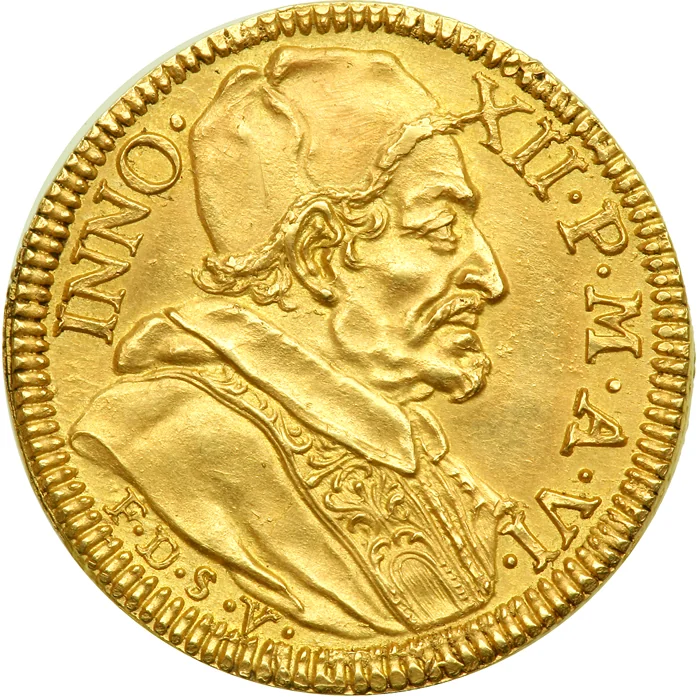
1 Doppia – Papal States
Circulating commemorative coins
Commemoration: Peace of Ryswick
Vatican City
Context
Year: 1697
Country: Vatican City 
Issuer: Papal States
Ruler: Innocent XII
Currency:
(1534—1835)
Demonetized: Yes
References
KM: #Click to copy to clipboard603
Numista: #105920
Value
Bullion value: $1147.51
Obverse
Reverse
Description:
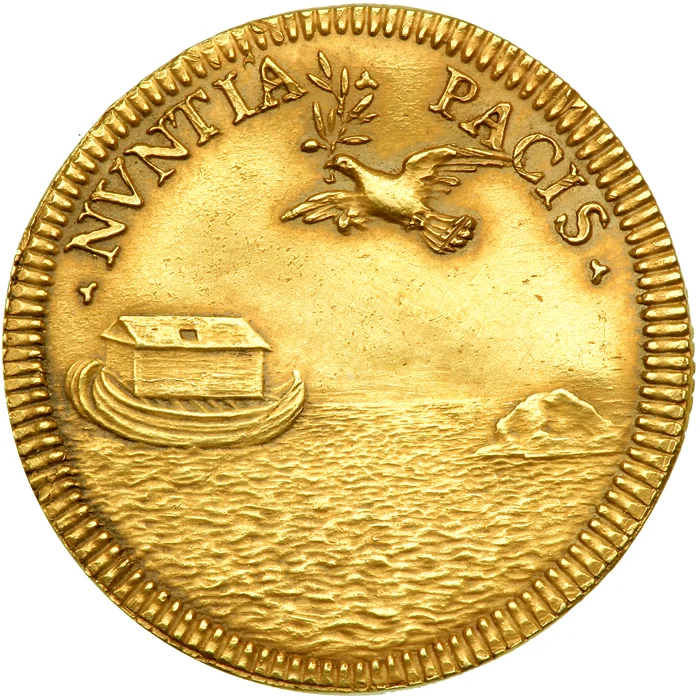
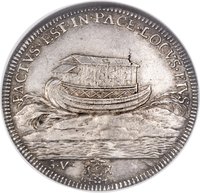
Noah's ark with a dove carrying an olive branch.
Inscription:
NVNTIA PACIS
Script: Latin
Edge
Mintings
| Year | Mint Mark | Mintage | Quality | Collection |
|---|---|---|---|---|
| 1697 | — | — |
Historical background
In 1697, the Papal States, under the pontificate of Pope Innocent XII, were grappling with a complex and debased monetary system typical of many Italian states in the 17th century. The primary currency in circulation was the Papal scudo, a silver coin, but its value and purity were under constant pressure. Decades of financial strain, driven by the costs of administration, monumental building projects in Rome, and the broader economic malaise affecting the Mediterranean, had led to successive devaluations. The monetary landscape was a confusing patchwork of older, higher-value coins, newer debased issues, and a plethora of foreign currencies—especially Spanish silver reales and gold doppie from other Italian states—all circulating simultaneously, with their values fluctuating against the official papal standard.
The root of the problem lay in the practice of reducing the silver content in minted coins to generate seigniorage revenue for the state's coffers, a short-term fix that caused long-term inflation and a loss of public confidence. By 1697, the gap between the official face value of coins and their intrinsic metal value was a source of economic distortion, hindering trade and creating uncertainty. Furthermore, the Papal States' mints, particularly that of Rome, struggled with inefficiency and occasional corruption, failing to produce a sufficient and stable supply of sound currency to unify the monetary space.
While Pope Innocent XII (reigned 1691-1700) was known for his fiscal austerity and moral reforms aimed at curbing nepotism, the entrenched monetary issues proved difficult to resolve within a single pontificate. The year 1697 itself did not mark a major monetary reform, but existed within a period of persistent challenge. The situation would only begin to find a more permanent solution under his successor, Pope Clement XI, who initiated a significant recoinage in 1703, aiming to restore the silver content and stability of the Papal scudo after years of degradation.
The root of the problem lay in the practice of reducing the silver content in minted coins to generate seigniorage revenue for the state's coffers, a short-term fix that caused long-term inflation and a loss of public confidence. By 1697, the gap between the official face value of coins and their intrinsic metal value was a source of economic distortion, hindering trade and creating uncertainty. Furthermore, the Papal States' mints, particularly that of Rome, struggled with inefficiency and occasional corruption, failing to produce a sufficient and stable supply of sound currency to unify the monetary space.
While Pope Innocent XII (reigned 1691-1700) was known for his fiscal austerity and moral reforms aimed at curbing nepotism, the entrenched monetary issues proved difficult to resolve within a single pontificate. The year 1697 itself did not mark a major monetary reform, but existed within a period of persistent challenge. The situation would only begin to find a more permanent solution under his successor, Pope Clement XI, who initiated a significant recoinage in 1703, aiming to restore the silver content and stability of the Papal scudo after years of degradation.
✨ Legendary