Logo Title
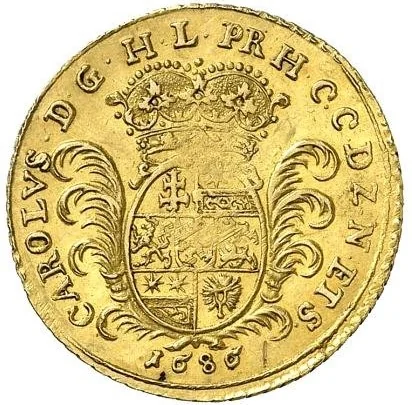
obverse
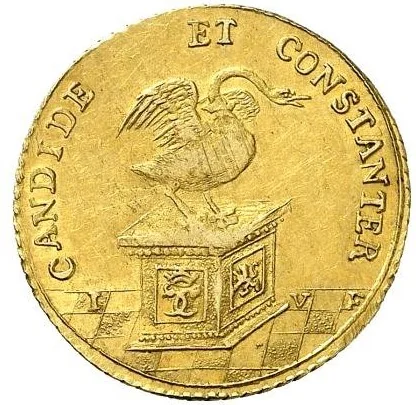
reverse
Fritz Rudolf Künker GmbH & Co. KG, Osnabrück and Lübke & Wiedemann KG, Leonberg

1 Ducat – Landgraviate of Hesse-Cassel

Context
Year: 1686
Ruler: Charles I
Currency:
Demonetized: Yes
Material
Weight: 3.49 g
Gold weight: 3.44 g
Shape: Round
Composition: 98.6% Gold
Magnetic: No
Alignment: Medal alignment
Obverse
OBVERSE ↑
flip
Reverse
REVERSE ↑
References
KM: #Click to copy to clipboard323
Numista: #268247
Value
Bullion value: $573.75

Obverse

Description:
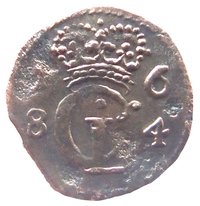
Crowned Hessian arms in oval with date below.
Inscription:
CAROLUS • D • G • H • L • PR • H • C • C • D • Z • N • ET • S

1686
Script: Latin

Reverse

Description:
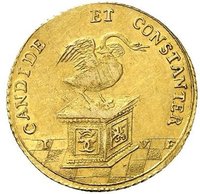
Swan statue
Inscription:
CANDIDE ET CONSTANTER

IVF
Script: Latin

Edge

Categories

Animal> Bird

Mints

NameMark
Kassel

Mintings

YearMint MarkMintageQualityCollection
1686

Historical background

In 1686, the currency situation in the Landgraviate of Hesse-Cassel was characterized by complexity and instability, a common challenge across the fractured Holy Roman Empire. The landgraviate did not have a monopoly on coinage; its monetary system was a confusing mix of locally minted coins, such as the Taler and smaller Kreuzer, alongside a plethora of foreign currencies circulating from neighboring states. This proliferation, combined with the frequent debasement of coinage by various authorities, led to chronic uncertainty in trade and valuation, as the intrinsic silver content of coins often differed from their face value.

The landgrave at the time, Charles I, inherited these monetary troubles, which were exacerbated by the state's significant debts and the immense financial burden of maintaining a large standing army—a policy pioneered by his predecessor, William VII. To generate revenue, the state engaged in the practice of Kipper- und Wipperzeit, or clipping and debasing coins, which provided short-term liquidity but fueled inflation and eroded public trust. Furthermore, Hesse-Cassel's economy was still recovering from the devastation of the Thirty Years' War, which had ended just four decades prior, leaving a legacy of economic fragility that complicated monetary reform.

Consequently, efforts at stabilization were incremental and often reactive. The authorities issued repeated ordinances (Münzordnungen) to fix exchange rates between the various circulating coins and to regulate their acceptance, but these decrees were difficult to enforce. The fundamental issue remained: without a standardized and controlled currency, economic planning and state finance were persistently undermined. This unstable monetary environment would persist until more centralized and forceful reforms were undertaken in the following century, particularly under Landgrave Frederick II.
Legendary