

1 Ducat – Sweden
Sweden
Context
Year: 1796
Issuer: Sweden 
Ruler: Gustav IV Adolf
Currency:
(1719—1798)
Demonetized: Yes
Total mintage: 1,200
Material
References
KM: #Click to copy to clipboard546
Numista: #100527
Value
Bullion value: $571.51
Obverse
Description:
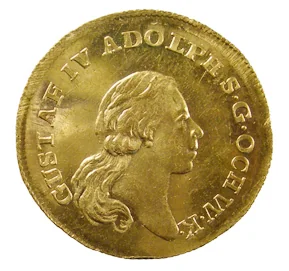
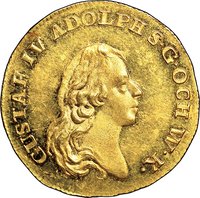
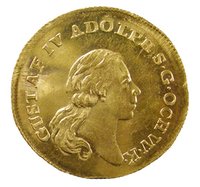
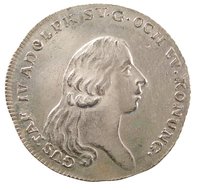
King Gustav IV Adolf facing right, with long hair. Legend encircling.
Inscription:
GUSTAF IV ADOLPH SV • G • OCH W • K •
Script: Latin
Reverse
Description:
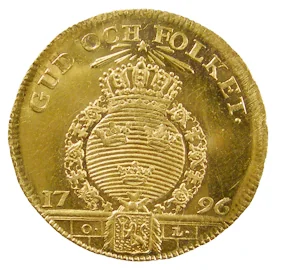
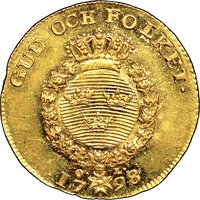
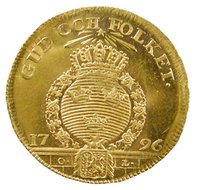
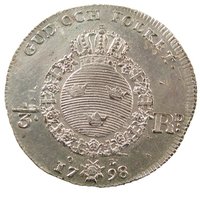
A crowned, lined orb encircled by the Order of Seraphim's chain, featuring Sweden's three crowns. A radiant star and the King's motto are above. The date is flanked by the chain, below which are the Arms of Småland—a rampant lion with a crossbow—on a brick pattern, denoting the gold's origin from Ädelfors mine.
Inscription:
GUD OCH FOLKET •
O• L•
17 96
O• L•
17 96
Script: Latin
Edge
Categories
| Symbols> Coat of Arms |
Mintings
| Year | Mint Mark | Mintage | Quality | Collection |
|---|---|---|---|---|
| 1796 | OL | 1,200 |
Historical background
In 1796, Sweden was operating under a complex and strained monetary system, a legacy of the disastrous Riksdaler currency experiment initiated in 1776. The system was officially bimetallic, based on both silver and copper, but was heavily burdened by the excessive issuance of paper money known as Riksgäldssedlar (government debt notes). These notes, first issued by the Riksens Ständers Bank (precursor to the Riksbank) to finance King Gustav III's war against Russia (1788–1790), were not backed by sufficient precious metal reserves. Consequently, they circulated at a significant and fluctuating discount compared to their face value in silver, creating a de facto dual-currency economy where trusted coin and depreciating paper coexisted uneasily.
The practical effect was severe economic instability. Prices were often quoted in the stable silver Riksdaler Specie, while daily transactions for many were conducted in the depreciating paper Riksdaler Banco, leading to confusion and market distortion. The disparity between the two values acted as a hidden tax on the populace and eroded public trust in financial institutions. This period is part of the larger "Era of Liberty" and Gustavian epoch, where fiscal policy was a central political struggle between the crown and the estates.
Ultimately, the situation in 1796 was unsustainable and presaged a deeper crisis. The mounting state debt and the falling value of the paper currency would culminate just a few years later in 1803 with a major monetary reform. This reform introduced a new silver standard and the Riksdaler Riksmynt, finally retiring the discredited Riksgäldssedlar. Thus, 1796 represents a late point in a prolonged period of monetary weakness, where the financial strains of war and deficit spending had severely compromised the nation's currency.
The practical effect was severe economic instability. Prices were often quoted in the stable silver Riksdaler Specie, while daily transactions for many were conducted in the depreciating paper Riksdaler Banco, leading to confusion and market distortion. The disparity between the two values acted as a hidden tax on the populace and eroded public trust in financial institutions. This period is part of the larger "Era of Liberty" and Gustavian epoch, where fiscal policy was a central political struggle between the crown and the estates.
Ultimately, the situation in 1796 was unsustainable and presaged a deeper crisis. The mounting state debt and the falling value of the paper currency would culminate just a few years later in 1803 with a major monetary reform. This reform introduced a new silver standard and the Riksdaler Riksmynt, finally retiring the discredited Riksgäldssedlar. Thus, 1796 represents a late point in a prolonged period of monetary weakness, where the financial strains of war and deficit spending had severely compromised the nation's currency.
✨ Legendary