

⅓ Riksdaler – Sweden
Sweden
Context
Year: 1798
Issuer: Sweden 
Ruler: Gustav IV Adolf
Currency:
(1719—1798)
Demonetized: Yes
Total mintage: 70,197
Material
References
KM: #Click to copy to clipboard547
Numista: #100865
Value
Bullion value: $24.33
Obverse
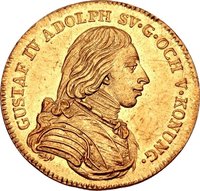
Description:
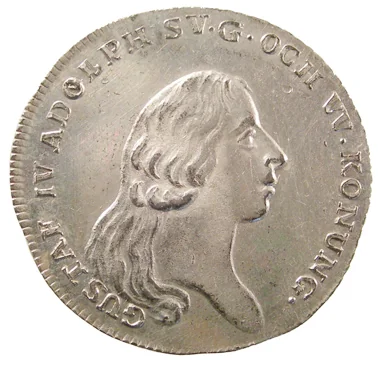
King Gustav IV Adolf facing right, with long hair. Legend encircling.
Inscription:
GUSTAF IV ADOLPH SV • G • OCH W • KONUNG •
Script: Latin
Reverse
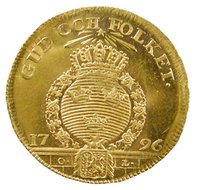
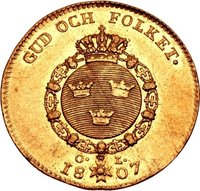
Description:
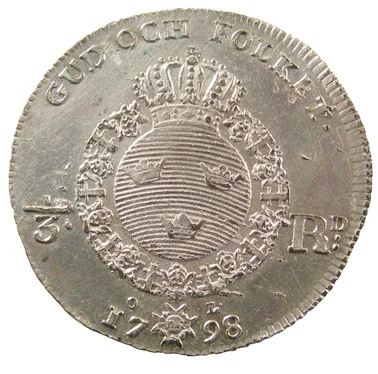
Swedish Three Crowns orb within the Seraphim chain. The pendant divides the date and mintmark; value flanks the orb. The King's motto is above the crown.
Inscription:
GUD OCH FOLKET •
./3• RD:
O• L•
17 98
./3• RD:
O• L•
17 98
Script: Latin
Edge
Categories
| Symbols> Coat of Arms |
Mintings
| Year | Mint Mark | Mintage | Quality | Collection |
|---|---|---|---|---|
| 1798 | OL | 70,197 |
Historical background
In 1798, Sweden was navigating a complex and precarious monetary situation, a legacy of decades of war finance and economic instability. The nation operated on a dual currency system: the Riksdaler Riksmynt (the domestic currency used for everyday transactions) and the Riksdaler Specie (a higher-valued currency tied to silver for international trade). This system, established earlier in the 18th century, was strained by a chronic shortage of silver, leading to a fluctuating and often unfavorable exchange rate between the two. Furthermore, the state's finances were burdened by the heavy debts accrued during the Russo-Swedish War of 1788–1790, exacerbating the scarcity of sound money.
The root of the crisis lay in the overissuance of paper money, known as Riksgälds Sedlar, by the National Debt Office (Riksgäldskontoret). Initially introduced to fund the war, these notes were not fully backed by silver reserves and had begun to depreciate significantly against the Riksdaler Specie. This created a climate of inflation, loss of public confidence, and economic uncertainty. Merchants and the public faced difficulties as the value of the paper money in their hands eroded, disrupting trade and creating a gap between nominal and real prices.
Consequently, the year 1798 fell within a period of intense debate and gradual reform. The government, under the influence of King Gustav IV Adolf and his advisors, recognized the need for stabilization but approached it cautiously. Efforts were focused on restoring confidence by limiting the issuance of new notes and attempting to accumulate silver reserves, setting the stage for more definitive reforms that would culminate in the Currency Act of 1803. This later act aimed to formally stabilize the relationship between the paper money and silver, though the fundamental tensions within the Swedish monetary system would persist into the new century.
The root of the crisis lay in the overissuance of paper money, known as Riksgälds Sedlar, by the National Debt Office (Riksgäldskontoret). Initially introduced to fund the war, these notes were not fully backed by silver reserves and had begun to depreciate significantly against the Riksdaler Specie. This created a climate of inflation, loss of public confidence, and economic uncertainty. Merchants and the public faced difficulties as the value of the paper money in their hands eroded, disrupting trade and creating a gap between nominal and real prices.
Consequently, the year 1798 fell within a period of intense debate and gradual reform. The government, under the influence of King Gustav IV Adolf and his advisors, recognized the need for stabilization but approached it cautiously. Efforts were focused on restoring confidence by limiting the issuance of new notes and attempting to accumulate silver reserves, setting the stage for more definitive reforms that would culminate in the Currency Act of 1803. This later act aimed to formally stabilize the relationship between the paper money and silver, though the fundamental tensions within the Swedish monetary system would persist into the new century.
✨ Legendary