

1 Ducat – Austrian Empire
Austria
Context
Years: 1593–1608
Country: Austria 
Issuer: Austrian Empire
Ruler: Rudolph II
Currency:
(1520—1754)
Demonetized: Yes
Material
References
KM: #Click to copy to clipboard28
Numista: #100437
Value
Bullion value: $574.28
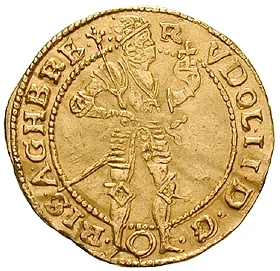
Obverse
Description:
Armoured emperor dividing beaded circle. Mint mark and ring for Lorenz Huebmer (Vienna).
Inscription:
RVDOL II D G // R I S A G H B RE
Script: Latin
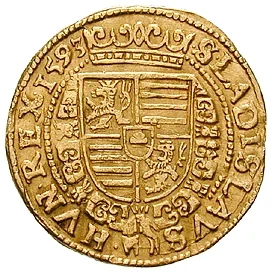
Reverse
Description:
Shield of Bohemia and Hungary crowned, encircled by legend.
Inscription:
S LADISLAVS // HVN REX date
Script: Latin
Edge
Mints
| Name | Mark |
|---|---|
| Münze Österreich | — |
Mintings
| Year | Mint Mark | Mintage | Quality | Collection |
|---|---|---|---|---|
| 1593 | — | — | ||
| 1601 | — | — | ||
| 1602 | — | — | ||
| 1603 | — | — | ||
| 1604 | — | — | ||
| 1605 | — | — | ||
| 1606 | — | — | ||
| 1607 | — | — | ||
| 1608 | — | — |
Historical background
In 1593, the Habsburg-ruled Austrian Empire was not a unified monetary state but a complex mosaic of currencies, reflecting its fragmented political structure. The primary large silver coin was the Reichsthaler (Imperial Thaler), a standard across the Holy Roman Empire, but its actual value and acceptance varied significantly between the Habsburg hereditary lands (like Austria, Bohemia, and parts of Hungary) and the broader Empire. Alongside these, a plethora of regional and local coins circulated, including Kreuzers and Guldens, often minted by individual estates, cities, and archbishoprics, leading to a chaotic system of exchange rates and widespread confusion in commerce.
This monetary fragmentation was exacerbated by the Long Turkish War (1593-1606), which began precisely in that year. The immense cost of financing a large-scale military campaign against the Ottoman Empire placed severe strain on the imperial treasury. To raise funds quickly, the authorities often resorted to debasement—reducing the precious metal content in coins while maintaining their face value. This practice, particularly for smaller denominations like kreuzers, led to inflation, a loss of public trust in the currency, and Gresham’s Law in action, where "bad money" (debased coins) drove "good money" (full-weight thalers) out of circulation as people hoarded the latter.
Consequently, the Austrian economy in 1593 was characterized by monetary instability. Merchants and the populace faced uncertainty in everyday transactions, needing to constantly assess the origin and true metallic worth of coins. While the Reichsthaler provided a theoretical standard, the reality was a messy and inflationary environment, driven by the crown's fiscal desperation and the entrenched privileges of regional minting authorities. This situation would persist and worsen in the coming decades, highlighting the Habsburg monarchy's struggle to impose financial centralization on its diverse territories.
This monetary fragmentation was exacerbated by the Long Turkish War (1593-1606), which began precisely in that year. The immense cost of financing a large-scale military campaign against the Ottoman Empire placed severe strain on the imperial treasury. To raise funds quickly, the authorities often resorted to debasement—reducing the precious metal content in coins while maintaining their face value. This practice, particularly for smaller denominations like kreuzers, led to inflation, a loss of public trust in the currency, and Gresham’s Law in action, where "bad money" (debased coins) drove "good money" (full-weight thalers) out of circulation as people hoarded the latter.
Consequently, the Austrian economy in 1593 was characterized by monetary instability. Merchants and the populace faced uncertainty in everyday transactions, needing to constantly assess the origin and true metallic worth of coins. While the Reichsthaler provided a theoretical standard, the reality was a messy and inflationary environment, driven by the crown's fiscal desperation and the entrenched privileges of regional minting authorities. This situation would persist and worsen in the coming decades, highlighting the Habsburg monarchy's struggle to impose financial centralization on its diverse territories.

✨ Legendary