

3 Kreuzer – Austrian Empire
Austria
Context
Years: 1588–1610
Country: Austria 
Issuer: Austrian Empire
Ruler: Rudolph II
Currency:
(1520—1754)
Demonetized: Yes
References
KM: #Click to copy to clipboard17
Numista: #94501
Value
Bullion value: $5.77
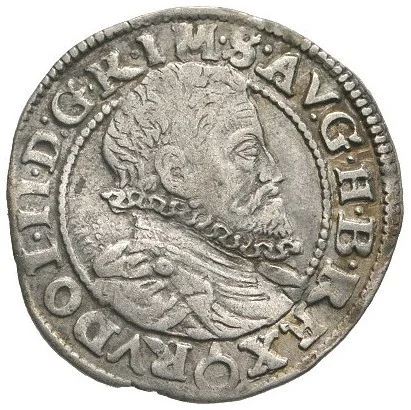
Obverse
Description:
Portrait right, ruffled collar, beaded circle. Legend begins at 6 o'clock.
Inscription:
RVDOL II D G R IM S AV G H B REX
Script: Latin
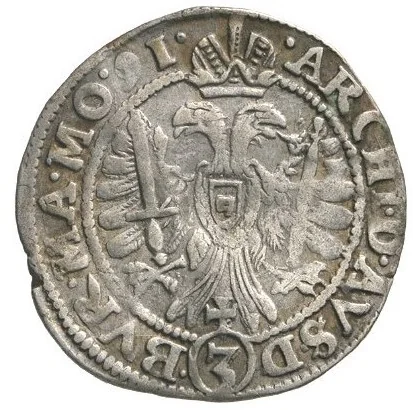
Reverse
Description:
Crowned double-headed imperial eagle, orb below with value splitting legend. Two-digit date at end.
Inscription:
ARCHI D AVS D (3) BVR MA MO 91
Script: Latin
Edge
Mints
| Name | Mark |
|---|---|
| Münze Österreich | — |
Mintings
| Year | Mint Mark | Mintage | Quality | Collection |
|---|---|---|---|---|
| 1588 | — | — | ||
| 1589 | — | — | ||
| 1591 | — | — | ||
| 1592 | — | — | ||
| 1593 | — | — | ||
| 1594 | — | — | ||
| 1601 | — | — | ||
| 1603 | — | — | ||
| 1604 | — | — | ||
| 1606 | — | — | ||
| 1610 | — | — |
Historical background
In 1588, the Habsburg-ruled Austrian Empire was grappling with a severe and multifaceted currency crisis, a direct consequence of the vast silver imports from the Spanish Empire and the New World. This influx, while enriching the Habsburg dynasty, triggered widespread inflation across Europe—a phenomenon later termed the "Price Revolution." Within the Austrian hereditary lands, this devalued the existing silver coinage, particularly the Guldengroschen and Kreuzer, eroding public trust and destabilizing local economies. The situation was exacerbated by the relentless financial demands of the ongoing Long Turkish War (1593-1606), which drained the imperial treasury and forced the government to seek desperate fiscal measures.
The core of the problem lay in currency debasement. To fund military campaigns and cover deficits, the imperial authorities, notably under Emperor Rudolf II, repeatedly reduced the silver content of coins while maintaining their face value. This practice, alongside the circulation of underweight and counterfeit coins, led to a chaotic monetary environment where "bad money drove out good" (Gresham's Law). People hoarded older, purer coins, further reducing the quality of money in daily circulation. The result was a loss of confidence in the currency, price volatility, and hardship for peasants and wage-earners whose incomes did not keep pace with rising costs.
While a centralized solution was needed, the Empire's fragmented political structure complicated response. The Reichstag (Imperial Diet) had issued currency regulations, but enforcement across the diverse territories—from the Austrian archduchies to the Kingdom of Bohemia—was weak. By 1588, the situation was deteriorating toward a point that would necessitate more drastic action, culminating in the major currency reform of 1594. This reform attempted to standardize the Reichsthaler and introduce new, regulated coinage, though with only partial and temporary success against the powerful economic forces of inflation and war finance.
The core of the problem lay in currency debasement. To fund military campaigns and cover deficits, the imperial authorities, notably under Emperor Rudolf II, repeatedly reduced the silver content of coins while maintaining their face value. This practice, alongside the circulation of underweight and counterfeit coins, led to a chaotic monetary environment where "bad money drove out good" (Gresham's Law). People hoarded older, purer coins, further reducing the quality of money in daily circulation. The result was a loss of confidence in the currency, price volatility, and hardship for peasants and wage-earners whose incomes did not keep pace with rising costs.
While a centralized solution was needed, the Empire's fragmented political structure complicated response. The Reichstag (Imperial Diet) had issued currency regulations, but enforcement across the diverse territories—from the Austrian archduchies to the Kingdom of Bohemia—was weak. By 1588, the situation was deteriorating toward a point that would necessitate more drastic action, culminating in the major currency reform of 1594. This reform attempted to standardize the Reichsthaler and introduce new, regulated coinage, though with only partial and temporary success against the powerful economic forces of inflation and war finance.
✨ Legendary