

Switzerland

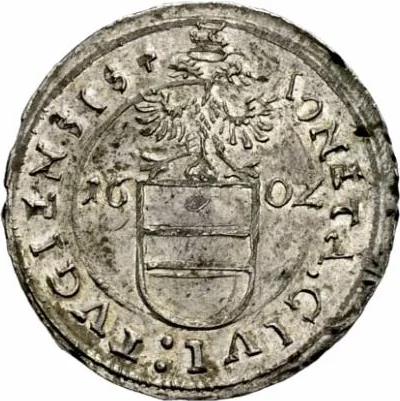
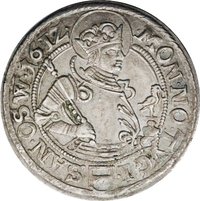
Obverse
Description:
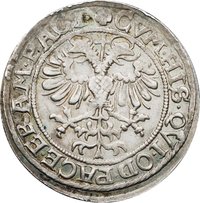
Imperial eagle above arms splits date.
Inscription:
MONETA. CIVI: TVGIENSIS +
16 02
16 02
Script: Latin
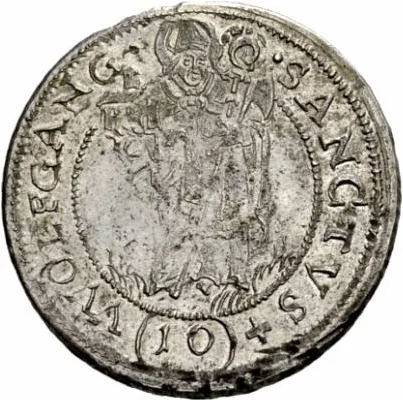
Reverse
Edge
Mintings
| Year | Mint Mark | Mintage | Quality | Collection |
|---|---|---|---|---|
| 1602 | — | — |
Historical background
In 1602, Zug, like other Swiss cantons, operated within a complex and fragmented monetary landscape. It did not mint its own coins but was part of the Swiss Confederation's monetary networks, which were dominated by the powerful coinage of Bern and Zurich. These thalers, batzen, and kreuzers circulated alongside a multitude of foreign currencies, particularly from the Holy Roman Empire, Italy, and France, brought in by trade and mercenary service. This created a constant challenge of valuation and exchange, as the intrinsic silver content and official worth of coins rarely aligned.
The situation was further complicated by the widespread practice of clipping and debasement, which eroded public trust in coinage. Cantonal authorities attempted to regulate this by issuing official exchange rate mandates (Münztaxen), which fixed the value of acceptable currencies within Zug's territory. However, these mandates were difficult to enforce and often lagged behind market realities, leading to Gresham's Law in practice: "bad" debased money drove "good" full-weight coinage out of circulation, hoarded or exported.
For the citizens of Zug, this meant daily economic life was fraught with uncertainty. Merchants, farmers, and tradespeople had to be keen judges of metal, constantly wary of being paid in inferior coin. The instability subtly hindered commerce and credit, as the real value of debts and prices could shift with each new shipment of coin. Thus, in 1602, Zug's currency situation was one of imposed order struggling against a turbulent reality of diverse and deteriorating coins, reflecting the broader monetary disunity of the pre-modern Swiss Confederation.
The situation was further complicated by the widespread practice of clipping and debasement, which eroded public trust in coinage. Cantonal authorities attempted to regulate this by issuing official exchange rate mandates (Münztaxen), which fixed the value of acceptable currencies within Zug's territory. However, these mandates were difficult to enforce and often lagged behind market realities, leading to Gresham's Law in practice: "bad" debased money drove "good" full-weight coinage out of circulation, hoarded or exported.
For the citizens of Zug, this meant daily economic life was fraught with uncertainty. Merchants, farmers, and tradespeople had to be keen judges of metal, constantly wary of being paid in inferior coin. The instability subtly hindered commerce and credit, as the real value of debts and prices could shift with each new shipment of coin. Thus, in 1602, Zug's currency situation was one of imposed order struggling against a turbulent reality of diverse and deteriorating coins, reflecting the broader monetary disunity of the pre-modern Swiss Confederation.
✨ Legendary