

5 yen – Japan
Add to wishlist
Japan
Context
Material
Diameter: 22 mm
Weight: 3.75 g
Thickness: 1.5 mm
Shape: Round with a round hole
Magnetic: No
Technique: Milled
Alignment: Medal alignment
flip
References
Y: #
Numista: #929
Value
Exchange value: 5 JPY
Inflation-adjusted value: 31.61 JPY
Obverse
Description:
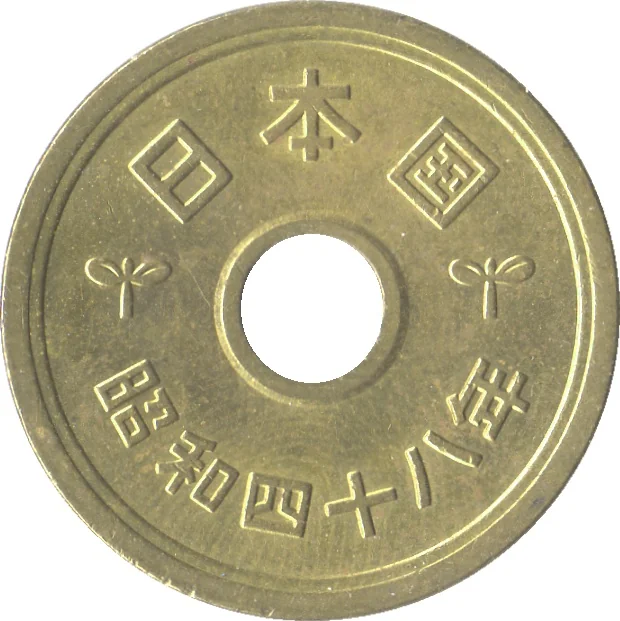
Center hole, seed leaf, authority above, date below.
Inscription:
日 本 国
昭和四十八年
昭和四十八年
Translation:
Japan
48th Year of Showa
48th Year of Showa
Language: Japanese
Reverse
Description:
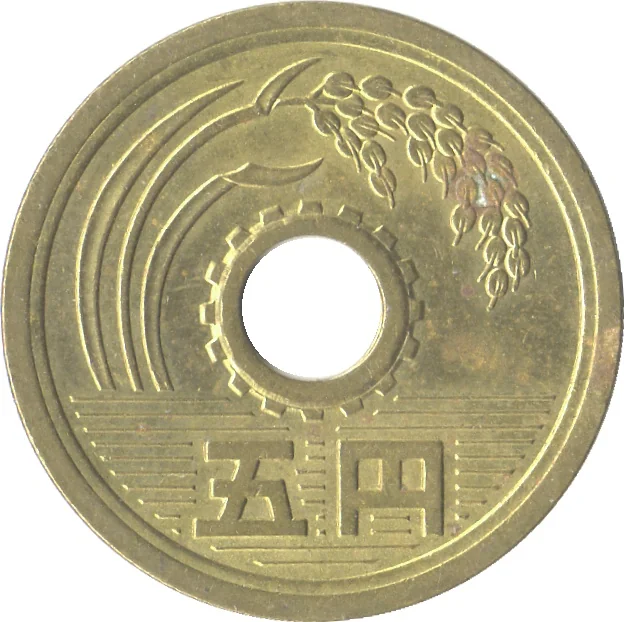
Rice stalk (agriculture) atop, water (fisheries) below, cog teeth (industry) encircling the center.
Inscription:
五円
Translation:
Five Yen
Language: Japanese
Edge
Plain
Mints
| Name | Mark |
|---|---|
| Japan Mint | — |
Mintings
| Year | Mint Mark | Mintage | Quality | Collection |
|---|---|---|---|---|
| 1959 | — | 33,000,000 | ||
| 1960 | — | 34,800,000 | ||
| 1961 | — | 61,000,000 | ||
| 1962 | — | 126,700,000 | ||
| 1963 | — | 171,800,000 | ||
| 1964 | — | 379,700,000 | ||
| 1965 | — | 384,200,000 | ||
| 1966 | — | 163,100,000 | ||
| 1967 | — | 26,000,000 | ||
| 1968 | — | 114,000,000 | ||
| 1969 | — | 240,000,000 | ||
| 1970 | — | 340,000,000 | ||
| 1971 | — | 362,050,000 | ||
| 1972 | — | 562,950,000 | ||
| 1973 | — | 745,000,000 | ||
| 1974 | — | 950,000,000 | ||
| 1975 | — | 970,000,000 | ||
| 1976 | — | 200,000,000 | ||
| 1977 | — | 340,000,000 | ||
| 1978 | — | 318,000,000 | ||
| 1979 | — | 317,000,000 | ||
| 1980 | — | 385,000,000 | ||
| 1981 | — | 95,000,000 | ||
| 1982 | — | 455,000,000 | ||
| 1983 | — | 410,000,000 | ||
| 1984 | — | 202,850,000 | ||
| 1985 | — | 153,150,000 | ||
| 1986 | — | 113,960,000 | ||
| 1987 | — | 631,645,000 | ||
| 1987 | — | 230,000 | Proof | |
| 1988 | — | 368,920,000 | ||
| 1988 | — | 200,000 | Proof | |
| 1989 | — | 67,332,000 |
Historical background
In 1959, Japan's currency system was firmly anchored by the Bank of Japan Law of 1942 and the Foreign Exchange and Foreign Trade Control Law of 1949, which established a framework of strict state management. The yen was pegged to the US dollar under the Bretton Woods system at a fixed rate of 360 yen to 1 dollar, a parity set in 1949 that provided crucial stability for reconstruction and export-led growth. This fixed exchange rate was a cornerstone of Japan's economic policy, shielding its rapidly expanding industries from currency volatility and making its exports—like textiles, cameras, and emerging electronics—highly competitive in international markets.
Domestically, the currency situation reflected a nation in the midst of the "economic miracle." The money supply was growing to fuel industrial investment and consumption, yet inflation was relatively subdued. A key feature was the "overloan" phenomenon, where major city banks lent beyond their deposit bases, relying on constant credit from the Bank of Japan. This system effectively channeled national savings into targeted industries, fueling the heavy industrial and manufacturing boom that defined the era. While the yen itself was stable, access to foreign currency remained tightly controlled, with the government and the Bank of Japan meticulously allocating scarce foreign reserves for the import of essential raw materials and technology.
Looking ahead, the stability of 1959 contained the seeds of future pressure. Japan's rising trade surpluses, particularly with the United States, began to build international momentum for yen revaluation, though this would not become a crisis until the late 1960s. Furthermore, the stringent capital controls created a stark duality: a robust, growing domestic economy operating alongside a virtually non-existent international market for the yen. Thus, 1959 represented the peak of a managed, fixed-rate system that had successfully served post-war recovery but would eventually require fundamental change as Japan's economic power on the global stage intensified.
Domestically, the currency situation reflected a nation in the midst of the "economic miracle." The money supply was growing to fuel industrial investment and consumption, yet inflation was relatively subdued. A key feature was the "overloan" phenomenon, where major city banks lent beyond their deposit bases, relying on constant credit from the Bank of Japan. This system effectively channeled national savings into targeted industries, fueling the heavy industrial and manufacturing boom that defined the era. While the yen itself was stable, access to foreign currency remained tightly controlled, with the government and the Bank of Japan meticulously allocating scarce foreign reserves for the import of essential raw materials and technology.
Looking ahead, the stability of 1959 contained the seeds of future pressure. Japan's rising trade surpluses, particularly with the United States, began to build international momentum for yen revaluation, though this would not become a crisis until the late 1960s. Furthermore, the stringent capital controls created a stark duality: a robust, growing domestic economy operating alongside a virtually non-existent international market for the yen. Thus, 1959 represented the peak of a managed, fixed-rate system that had successfully served post-war recovery but would eventually require fundamental change as Japan's economic power on the global stage intensified.
Series: 1959 Japan circulation coins
🌱 Very Common