

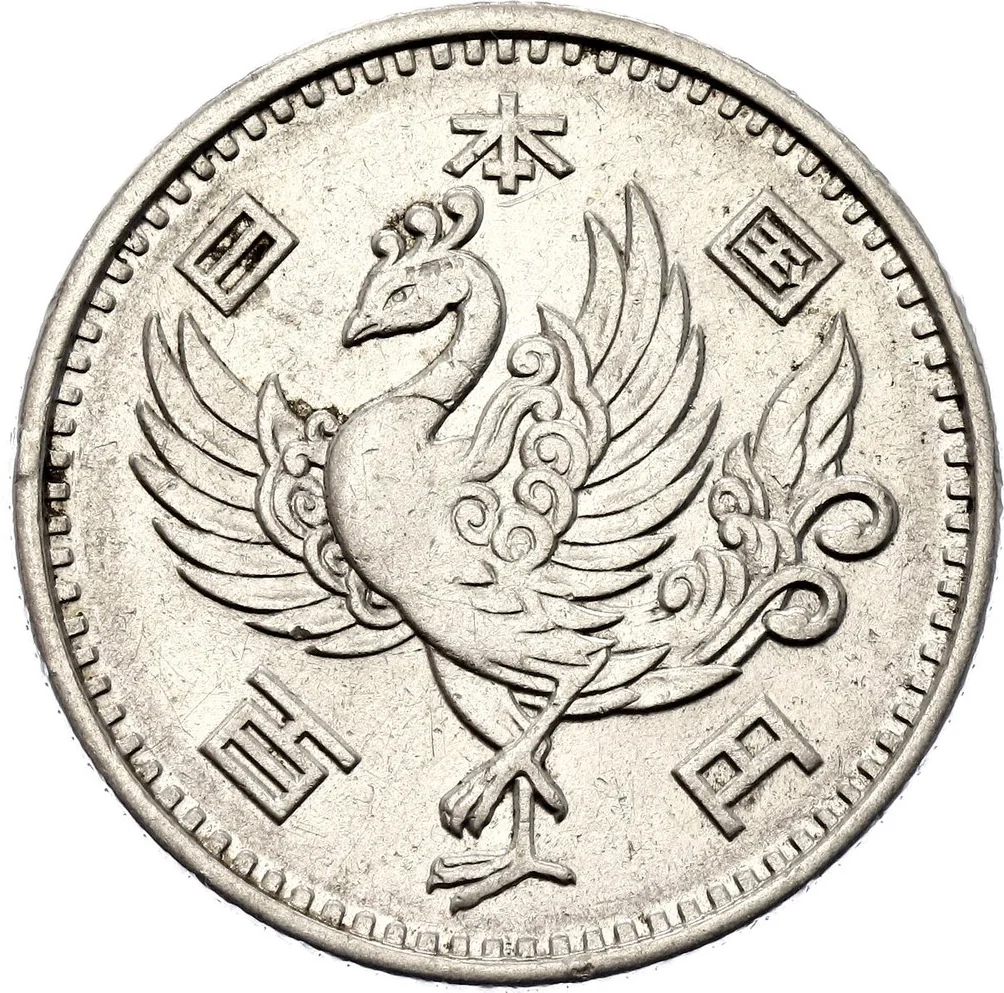
Obverse
Description:
Phoenix: authority above, value below.
Inscription:
日 本 国
百 円
百 円
Translation:
Japan
One Hundred Yen
One Hundred Yen
Language: Japanese
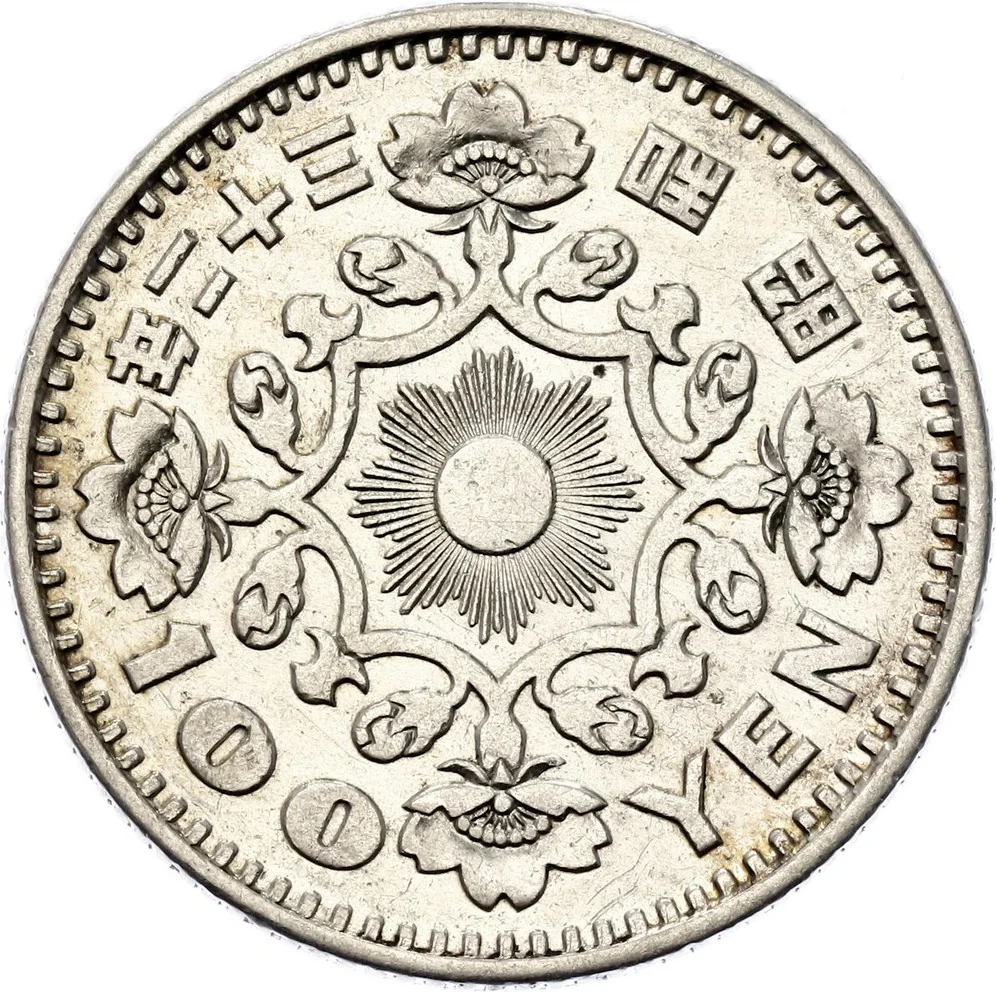
Reverse
Description:
Sun in a sakura wreath, encircled by text.
Inscription:
昭和 三十二年 100 YEN
Translation:
Showa 32nd Year 100 Yen
Language: Japanese
Edge
Reeded
Mints
| Name | Mark |
|---|---|
| Japan Mint | — |
Mintings
| Year | Mint Mark | Mintage | Quality | Collection |
|---|---|---|---|---|
| 1957 | — | 30,000,000 | ||
| 1958 | — | 70,000,000 |
Historical background
In 1957, Japan's currency situation was characterized by stability and controlled growth under the Bretton Woods system, with the yen fixed at 360 yen to the US dollar—a rate established in 1949 that would become a cornerstone of the post-war economic miracle. This fixed exchange rate provided a predictable environment for export-led industries, which were rapidly becoming the engine of Japan's recovery. The Bank of Japan maintained a conservative monetary policy, prioritizing price stability and supporting the government's focus on heavy industrial and technological investment, which fueled double-digit economic growth.
Domestically, the currency was stable, with low inflation after the turbulent early postwar years. However, this period also saw the beginnings of structural tensions. The rapid expansion of the economy, particularly in manufacturing and exports, started to generate persistent trade surpluses with the United States. While not yet a major political issue, this imbalance sowed the seeds for future pressure on the fixed exchange rate regime. Furthermore, the government and the Bank of Japan carefully managed limited capital account convertibility, restricting foreign exchange transactions to prevent speculative flows and maintain control over the value of the yen.
Overall, 1957 represented a period of confident consolidation within a managed international monetary framework. The 360 yen/dollar parity was a symbol of Japan's reintegration into the global economy and a key facilitator of its export strategy. The currency stability provided a crucial platform for the private sector to invest and expand, setting the stage for the high-growth "Income Doubling" policies that would be announced just a few years later, all while underlying trade dynamics quietly built pressures that would eventually challenge the fixed-rate system itself.
Domestically, the currency was stable, with low inflation after the turbulent early postwar years. However, this period also saw the beginnings of structural tensions. The rapid expansion of the economy, particularly in manufacturing and exports, started to generate persistent trade surpluses with the United States. While not yet a major political issue, this imbalance sowed the seeds for future pressure on the fixed exchange rate regime. Furthermore, the government and the Bank of Japan carefully managed limited capital account convertibility, restricting foreign exchange transactions to prevent speculative flows and maintain control over the value of the yen.
Overall, 1957 represented a period of confident consolidation within a managed international monetary framework. The 360 yen/dollar parity was a symbol of Japan's reintegration into the global economy and a key facilitator of its export strategy. The currency stability provided a crucial platform for the private sector to invest and expand, setting the stage for the high-growth "Income Doubling" policies that would be announced just a few years later, all while underlying trade dynamics quietly built pressures that would eventually challenge the fixed-rate system itself.
🌱 Very Common