

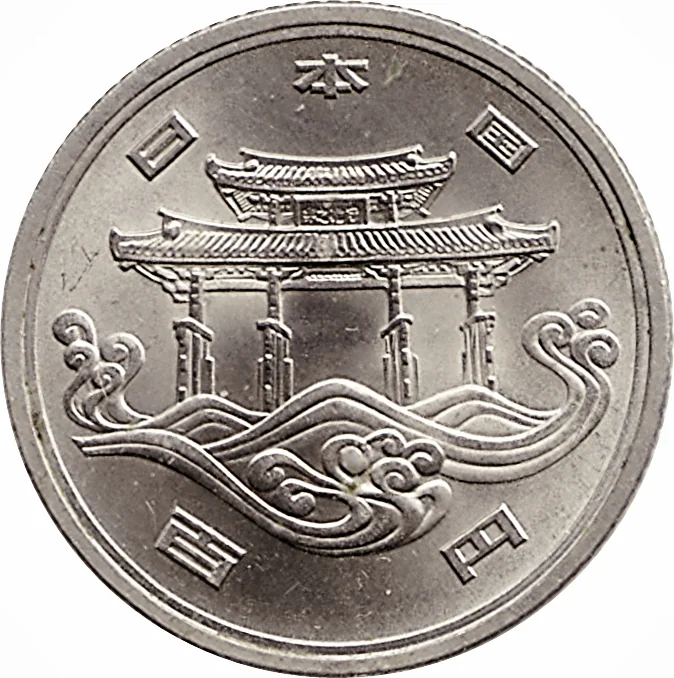
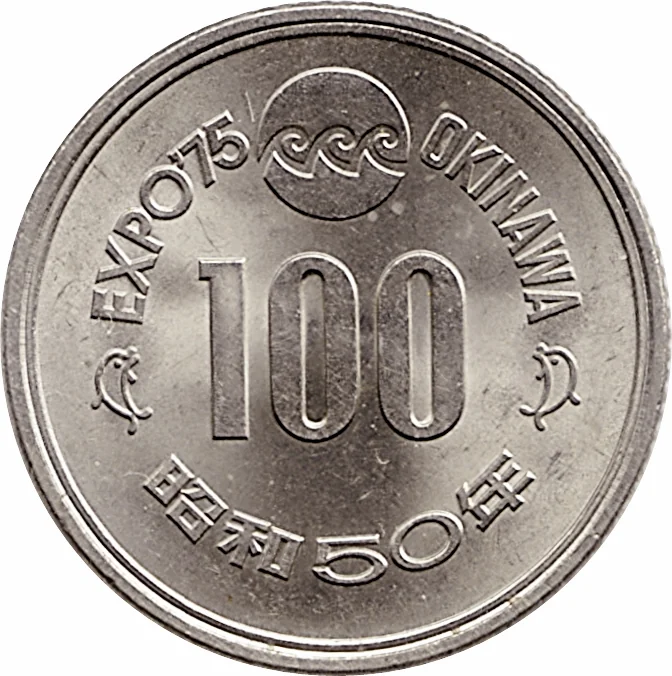
100 yen – Japan
Add to wishlist
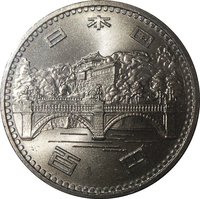
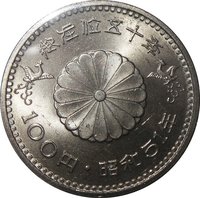
Circulating commemorative coins
Commemoration: 1975 Expo, Okinawa
Japan
Context
Year: 1975
Japanese - Shōwa era Year:: 50
Issuer: Japan
Ruler: Shōwa
Currency:
(since 1871)
Total mintage: 120,000,000
Material

References
Y: #
Numista: #9253
Value
Exchange value: 100 JPY
Inflation-adjusted value: 228.93 JPY
Obverse
Reverse
Edge
Reeded
Mints
| Name | Mark |
|---|---|
| Japan Mint | — |
Mintings
| Year | Mint Mark | Mintage | Quality | Collection |
|---|---|---|---|---|
| 1975 | — | 120,000,000 |
Historical background
In 1975, Japan's currency situation was defined by the turbulent aftermath of the collapse of the Bretton Woods system and the first major oil shock. The fixed exchange rate regime had ended in 1971, leading to the yen's float in 1973. Initially, this resulted in significant appreciation, but the 1973 oil crisis reversed this trend, causing the yen to weaken sharply due to Japan's heavy dependence on imported energy and a resulting severe balance of payments deficit. The year 1975, therefore, found the yen in a state of managed volatility, with the Bank of Japan actively intervening to curb excessive fluctuations while navigating a deep domestic recession—the first major economic downturn of the post-war "miracle" era.
Domestically, the economic landscape was one of "stagflation," with the GNP contracting for the first time since WWII while inflation remained stubbornly high, though decelerating from the double-digit peaks of 1974. This complex environment created a policy dilemma for monetary authorities. The priority was combating inflation and stabilizing the current account, which limited aggressive stimulus. Consequently, the Bank of Japan maintained a relatively tight monetary policy for much of the year, only cautiously easing later as the recession's depth became clearer and inflationary pressures subsided.
The currency dynamics of 1975 set a crucial precedent. The successful navigation of this period, moving from crisis to stability, demonstrated Japan's economic resilience and the effectiveness of its export-oriented model even under a floating exchange rate. It paved the way for a period of yen strength in the latter half of the 1970s, as Japan's competitive exports rebuilt its trade surplus. Thus, 1975 served as a pivotal transition year, marking the end of the initial oil shock turmoil and the beginning of Japan's adaptation to a new global monetary order characterized by flexible exchange rates and external commodity price shocks.
Domestically, the economic landscape was one of "stagflation," with the GNP contracting for the first time since WWII while inflation remained stubbornly high, though decelerating from the double-digit peaks of 1974. This complex environment created a policy dilemma for monetary authorities. The priority was combating inflation and stabilizing the current account, which limited aggressive stimulus. Consequently, the Bank of Japan maintained a relatively tight monetary policy for much of the year, only cautiously easing later as the recession's depth became clearer and inflationary pressures subsided.
The currency dynamics of 1975 set a crucial precedent. The successful navigation of this period, moving from crisis to stability, demonstrated Japan's economic resilience and the effectiveness of its export-oriented model even under a floating exchange rate. It paved the way for a period of yen strength in the latter half of the 1970s, as Japan's competitive exports rebuilt its trade surplus. Thus, 1975 served as a pivotal transition year, marking the end of the initial oil shock turmoil and the beginning of Japan's adaptation to a new global monetary order characterized by flexible exchange rates and external commodity price shocks.
🌱 Common