

100 yen (Hirohito's enthronement) – Japan
Add to wishlist
Circulating commemorative coins
Commemoration: 50th Anniversary of Hirohito's enthronement
Japan
Context
Year: 1976
Japanese - Shōwa era Year:: 51
Issuer: Japan
Ruler: Shōwa
Currency:
(since 1871)
Total mintage: 70,000,000
Material
References
Y: #
Numista: #13962
Value
Exchange value: 100 JPY
Inflation-adjusted value: 204.89 JPY
Obverse
Description:
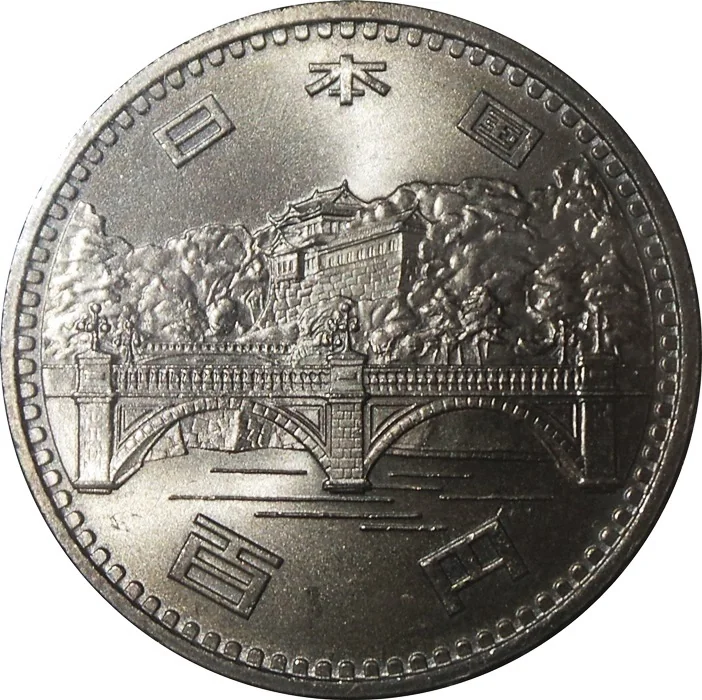
Power above, people below.
Inscription:
日 本 国
百 円
百 円
Translation:
Japan
100 Yen
100 Yen
Language: Japanese
Reverse
Description:
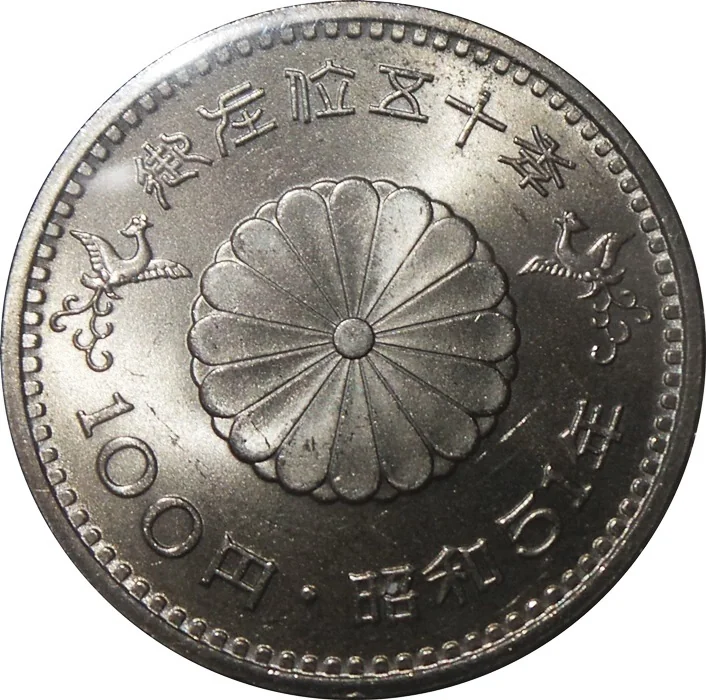
Large central chrysanthemum, phoenixes on sides, seal script legend above, value and date below.
Inscription:
御在位五十年
100 円 • 昭和51年
100 円 • 昭和51年
Translation:
The 50th Year of the Imperial Reign
100 Yen • Showa 51
100 Yen • Showa 51
Language: Japanese
Edge
Reeded
Mints
| Name | Mark |
|---|---|
| Japan Mint | — |
Mintings
| Year | Mint Mark | Mintage | Quality | Collection |
|---|---|---|---|---|
| 1976 | — | 70,000,000 |
Historical background
In 1976, Japan's currency situation was characterized by a managed float of the yen, operating within the new international monetary order established after the collapse of the Bretton Woods system in 1971-1973. The yen had already undergone a significant structural appreciation, most notably with the revaluation following the 1971 Smithsonian Agreement. However, by 1976, the currency's value was being heavily influenced by Japan's burgeoning and persistent trade surpluses, particularly with the United States. These surpluses created constant upward pressure on the yen, which Japanese monetary authorities, namely the Ministry of Finance and the Bank of Japan, actively sought to mitigate through intervention in the foreign exchange markets to prevent excessive strength that could hurt export competitiveness.
Domestically, Japan was recovering from the severe stagflation induced by the 1973 oil crisis. While growth had resumed, it was at a more moderate pace than the high-speed era of the 1960s, and the economy remained export-driven. The yen's value was a critical policy lever. A stronger yen helped curb imported inflation, a lingering concern from the oil shock, but it also threatened the profit margins of key manufacturing industries like automobiles and electronics that were central to Japan's economic success. Consequently, 1976 saw a period of "dirty floating," where the yen was allowed to appreciate gradually but in a controlled manner, with authorities frequently buying dollars to slow its rise.
Internationally, Japan faced growing political pressure, especially from the United States, to allow the yen to appreciate more freely and to stimulate its domestic economy to reduce its large trade imbalances. This tension marked the beginning of a defining era in Japan's financial history, setting the stage for the more dramatic Plaza Accord of 1985. Thus, 1976 represented a transitional and managed phase where the yen was caught between market forces pushing for appreciation and official efforts to maintain stability, all within a global context of increasing scrutiny on Japan's external surpluses.
Domestically, Japan was recovering from the severe stagflation induced by the 1973 oil crisis. While growth had resumed, it was at a more moderate pace than the high-speed era of the 1960s, and the economy remained export-driven. The yen's value was a critical policy lever. A stronger yen helped curb imported inflation, a lingering concern from the oil shock, but it also threatened the profit margins of key manufacturing industries like automobiles and electronics that were central to Japan's economic success. Consequently, 1976 saw a period of "dirty floating," where the yen was allowed to appreciate gradually but in a controlled manner, with authorities frequently buying dollars to slow its rise.
Internationally, Japan faced growing political pressure, especially from the United States, to allow the yen to appreciate more freely and to stimulate its domestic economy to reduce its large trade imbalances. This tension marked the beginning of a defining era in Japan's financial history, setting the stage for the more dramatic Plaza Accord of 1985. Thus, 1976 represented a transitional and managed phase where the yen was caught between market forces pushing for appreciation and official efforts to maintain stability, all within a global context of increasing scrutiny on Japan's external surpluses.
🌱 Common