

50 Yuan – Taiwan
China
Material
Diameter: 24 mm
Weight: 8.25 g
Thickness: 2.33 mm
Shape: Round
Composition: Nickel brass
Magnetic: No
Technique: Milled
Alignment: Medal alignment
flip
References
Y: #Click to copy to clipboard554
Numista: #9175
Value
Exchange value: 50 TWD
Inflation-adjusted value: 157.34 TWD
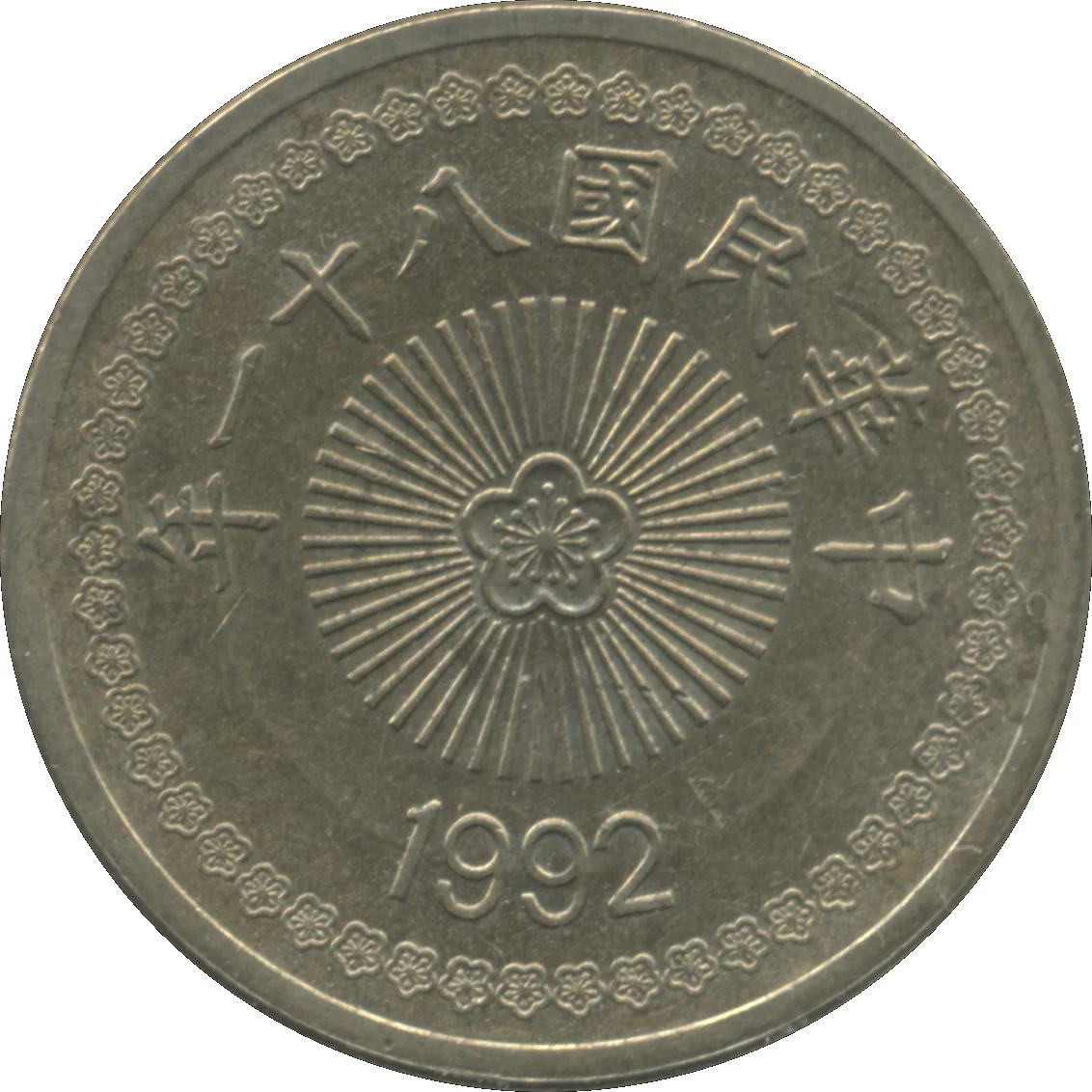
Obverse
Description:
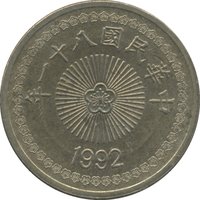
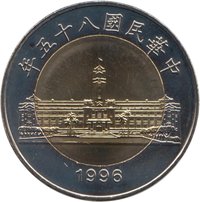
Mei Blossom (Prunus mume) in a radiant circle, with Taiwanese and Western dates above and below.
Inscription:
年一十八國民華中
1992
1992
Translation:
Year 18 of the Republic of China
1992
1992
Scripts: Chinese (traditional, regular script)
Language: Chinese
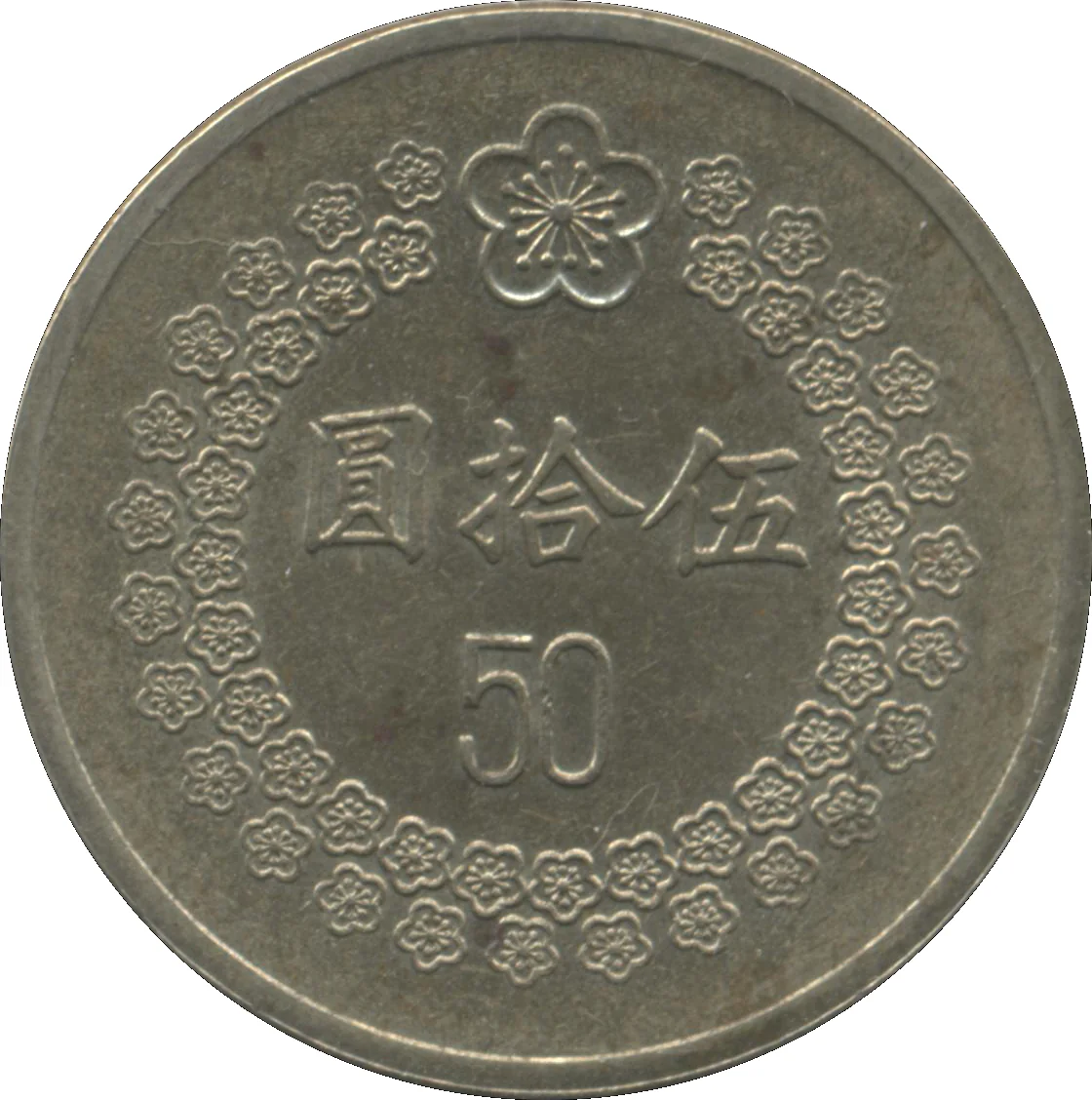
Reverse
Description:
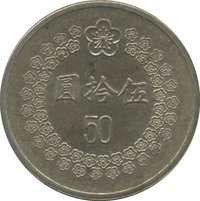
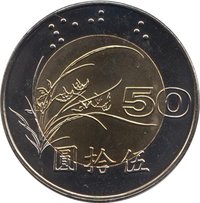
Taiwan's national flower above, denomination within a Mei Blossom wreath below.
Inscription:
圓拾伍
50
50
Translation:
Fifty Yuan
Scripts: Chinese (traditional, regular script)
Language: Chinese
Edge
Reeded with inscription
Legend:
NTS $50 NTS $50 NTS $50
Mintings
| Year | Mint Mark | Mintage | Quality | Collection |
|---|---|---|---|---|
| 1992 | — | — | ||
| 1993 | — | — | ||
| 1993 | — | — | Proof | |
| 1994 | — | — | In sets | |
| 1994 | — | — | Proof | |
| 1995 | — | — | Proof | |
| 1995 | — | — | In sets |
Historical background
In 1992, Taiwan's currency, the New Taiwan Dollar (NTD), was in a period of managed stability and gradual liberalization under the authority of the Central Bank of the Republic of China (Taiwan). Following the dramatic appreciation pressure of the late 1980s—where the NTD had strengthened from around 40 to roughly 25 against the US dollar—the exchange rate regime had settled into a "managed float." The central bank actively intervened in the foreign exchange market to prevent excessive volatility, aiming to maintain export competitiveness while managing inflationary pressures from a large trade surplus and significant foreign exchange reserves.
The domestic financial environment was characterized by ongoing reform. The government continued to relax decades-old capital controls, allowing for greater movement of funds in and out of the island. This period saw the further internationalization of Taipei as a financial center, with growing offshore banking activity. However, monetary policy remained focused on controlling money supply growth to curb asset inflation, particularly in real estate and stock markets, which had experienced a major bubble that burst in 1990.
Politically and economically, Taiwan's currency situation existed in a complex international context. As the island was not a member of the International Monetary Fund (IMF) or the World Bank, its monetary policy was formulated independently. The currency's stability was a cornerstone of Taiwan's export-oriented economic miracle, but its international status was, and remains, constrained by cross-strait relations. All financial operations were conducted under the practical administration of Taiwan's authorities, without explicit recognition from much of the international community, which adhered to the One-China Principle.
The domestic financial environment was characterized by ongoing reform. The government continued to relax decades-old capital controls, allowing for greater movement of funds in and out of the island. This period saw the further internationalization of Taipei as a financial center, with growing offshore banking activity. However, monetary policy remained focused on controlling money supply growth to curb asset inflation, particularly in real estate and stock markets, which had experienced a major bubble that burst in 1990.
Politically and economically, Taiwan's currency situation existed in a complex international context. As the island was not a member of the International Monetary Fund (IMF) or the World Bank, its monetary policy was formulated independently. The currency's stability was a cornerstone of Taiwan's export-oriented economic miracle, but its international status was, and remains, constrained by cross-strait relations. All financial operations were conducted under the practical administration of Taiwan's authorities, without explicit recognition from much of the international community, which adhered to the One-China Principle.
🌱 Common