

50 Yuan – Taiwan
China
Context

Material
References
Y: #Click to copy to clipboard556
Numista: #1586
Value
Exchange value: 50 TWD
Inflation-adjusted value: 88.95 TWD
Obverse
Description:
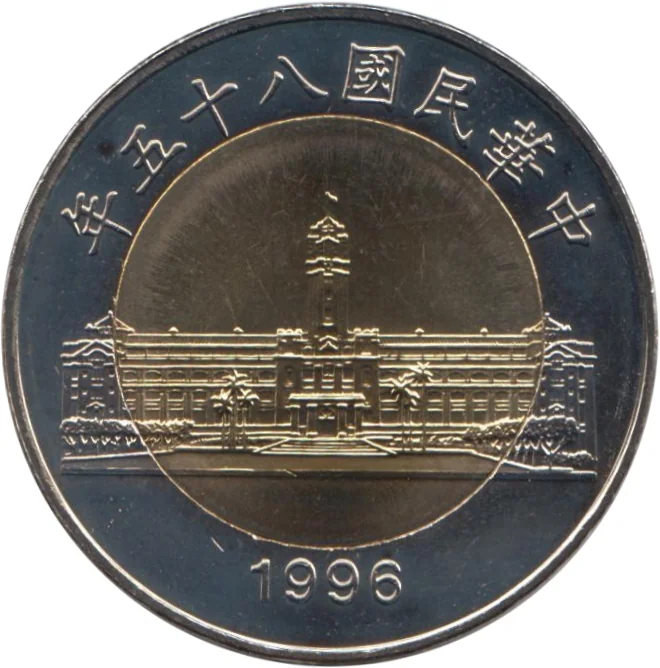
The Presidential Office Building in Taipei, with its construction dates in both Chinese and Gregorian calendars.
Inscription:
年六十八國民華中
1996
1996
Translation:
Sixty-eighth year of the Republic of China
1996
1996
Scripts: Chinese (traditional, regular script)
Language: Chinese
Reverse
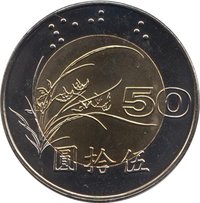
Description:
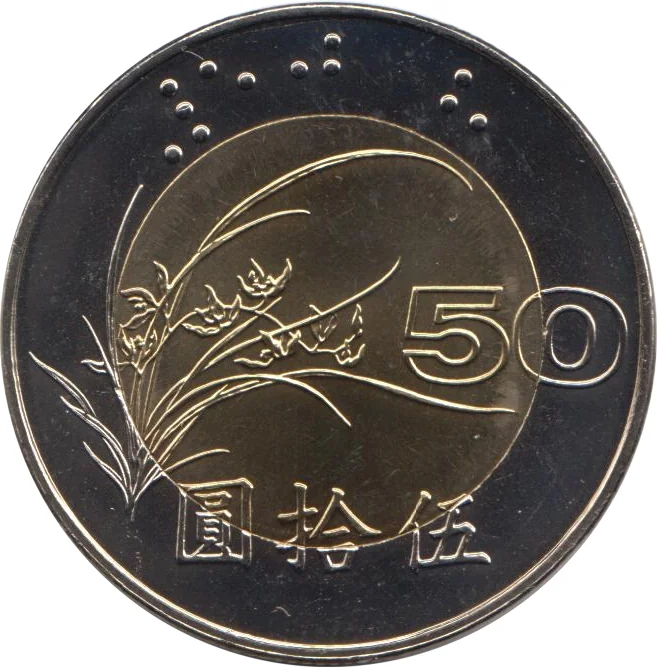
Orchid; value in Chinese, numerals, Braille.
Inscription:
⠼⠑⠚ ⠓
50
圓拾伍
50
圓拾伍
Translation:
FIFTY
YUAN FIFTEEN
YUAN FIFTEEN
Language: Chinese
Edge
5 smooth and 5 reeded segments (14 reeds each).
Mintings
| Year | Mint Mark | Mintage | Quality | Collection |
|---|---|---|---|---|
| 1996 | — | — | ||
| 1996 | — | — | Proof | |
| 1997 | — | — | ||
| 1997 | — | — | Proof | |
| 1998 | — | — | ||
| 1998 | — | — | Proof | |
| 1999 | — | — | In sets | |
| 1999 | — | — | Proof | |
| 2000 | — | — | In sets | |
| 2000 | — | — | Proof | |
| 2001 | — | — | In sets | |
| 2001 | — | — | Proof |
Historical background
In 1996, the currency situation in Taiwan was characterized by stability and strength, underpinned by robust economic fundamentals. The New Taiwan Dollar (NTD) was a managed float, with its value primarily influenced by the Central Bank of the Republic of China (Taiwan). The island was experiencing strong export growth, particularly in its burgeoning technology sector, which generated significant foreign exchange reserves. This economic success provided a solid foundation for the currency, with the central bank actively intervening in the forex market to smooth out excessive volatility and maintain export competitiveness, often preventing the NTD from appreciating too rapidly against the US dollar.
This period of monetary stability occurred against a tense political backdrop. In March 1996, Taiwan held its first direct presidential election, which prompted a major military exercise and missile tests by the People's Republic of China (PRC) in the Taiwan Strait. Despite this significant geopolitical crisis, the financial markets and the NTD remained remarkably resilient. The central bank's substantial reserves, then among the world's largest, acted as a crucial buffer, allowing it to confidently defend the currency and ensure liquidity, thereby preventing any loss of confidence or capital flight.
Consequently, 1996 stands as a testament to the maturity of Taiwan's financial institutions. While the political climate was fraught, the economic and currency management policies proved effective. The NTD did not experience a crisis or devaluation; instead, the year highlighted the central bank's ability to insulate the financial system from external shocks. The episode reinforced the perception of the New Taiwan Dollar as a stable currency, managed prudently within a dynamic, export-oriented economy, even amidst severe cross-strait tensions.
This period of monetary stability occurred against a tense political backdrop. In March 1996, Taiwan held its first direct presidential election, which prompted a major military exercise and missile tests by the People's Republic of China (PRC) in the Taiwan Strait. Despite this significant geopolitical crisis, the financial markets and the NTD remained remarkably resilient. The central bank's substantial reserves, then among the world's largest, acted as a crucial buffer, allowing it to confidently defend the currency and ensure liquidity, thereby preventing any loss of confidence or capital flight.
Consequently, 1996 stands as a testament to the maturity of Taiwan's financial institutions. While the political climate was fraught, the economic and currency management policies proved effective. The NTD did not experience a crisis or devaluation; instead, the year highlighted the central bank's ability to insulate the financial system from external shocks. The episode reinforced the perception of the New Taiwan Dollar as a stable currency, managed prudently within a dynamic, export-oriented economy, even amidst severe cross-strait tensions.
🌱 Common