



Obverse
Description:
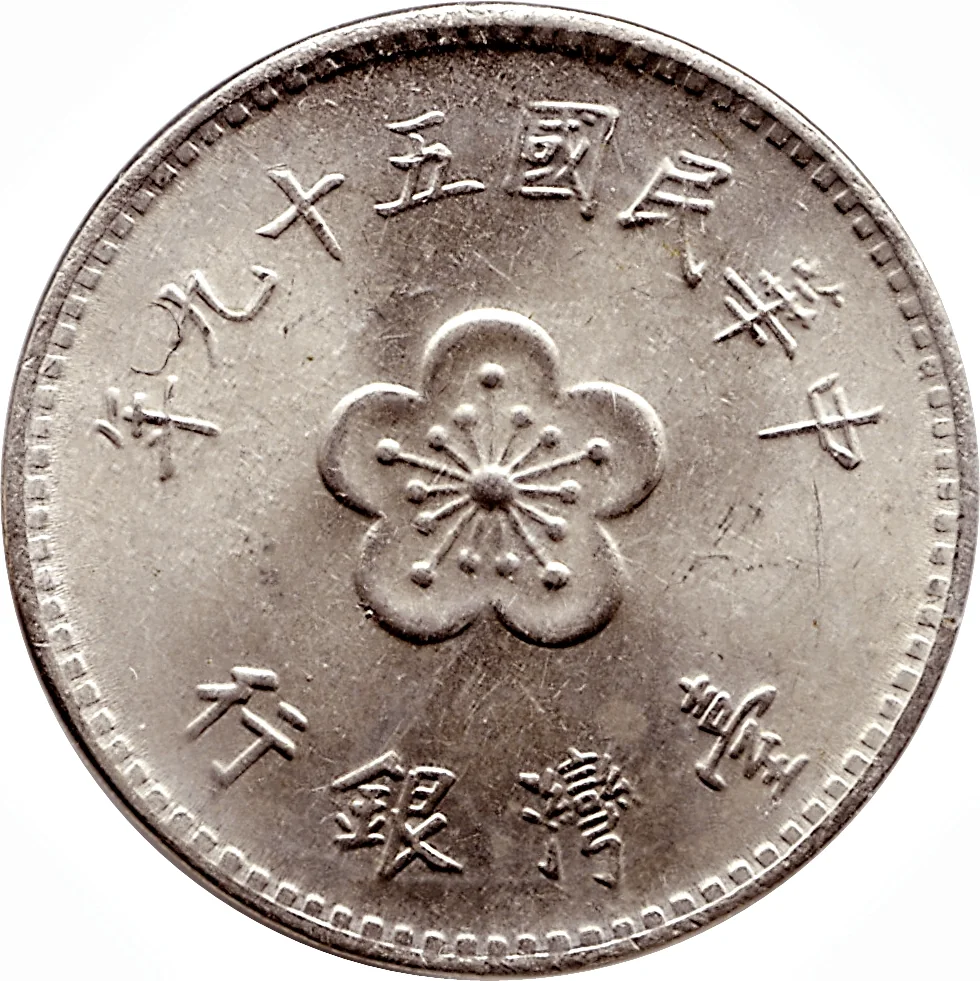
Plum blossom (Prunus mume). Date top, bank name bottom.
Inscription:
年九十五國民華中
行銀灣臺
行銀灣臺
Translation:
Central Trust of China, Taiwan Bank;
Year 95 of the Republic
Year 95 of the Republic
Language: Chinese
Reverse
Edge
Reeded
Mints
| Name | Mark |
|---|---|
| Central Mint of Taiwan | — |
| United States Mint of Denver | — |
Mintings
| Year | Mint Mark | Mintage | Quality | Collection |
|---|---|---|---|---|
| 1960 | — | 321,717,000 | ||
| 1970 | — | 48,800,000 | ||
| 1971 | — | 41,532,000 | ||
| 1972 | — | 105,309,000 | ||
| 1973 | — | 353,924,000 | ||
| 1974 | — | 535,605,000 | ||
| 1975 | — | 456,874,000 | ||
| 1976 | — | 634,497,000 | ||
| 1977 | — | 116,900,000 | ||
| 1978 | — | 104,245,000 | ||
| 1979 | — | — | ||
| 1980 | — | 113,900,000 |
Historical background
In 1960, Taiwan's currency situation was characterized by a period of stabilization and controlled growth under a fixed exchange rate system, following a decade of severe hyperinflation inherited from the Chinese Civil War. The New Taiwan Dollar (NTD), introduced in 1949 to replace the old Taiwan Dollar, was pegged to the U.S. Dollar at a rate of NT$40 to US$1, a parity established in 1958 as part of a critical foreign exchange reform. This reform simplified a complex multi-tiered exchange rate system, unifying rates and moving toward a more market-oriented economy, which was essential for receiving U.S. aid and fostering export-led industrialization.
The island's monetary policy was tightly managed by the Central Bank of China, which had re-established operations in Taipei in 1961, and its precursor, the Bank of Taiwan. The primary goals were to control inflation—which had been tamed to single digits—and to accumulate foreign exchange reserves. This stability was underpinned by substantial U.S. economic aid, which flowed until the mid-1960s, and a growing agricultural and light industrial export sector. Currency issuance was conservative and backed by robust foreign reserves, primarily in U.S. Dollars, which instilled domestic and international confidence in the NTD.
This stable currency regime provided the crucial financial foundation for the early stages of Taiwan's economic "miracle." By anchoring the currency and maintaining fiscal discipline, the government created a predictable environment for both domestic investment and foreign trade. The fixed rate effectively subsidized exports, helping nascent industries like textiles and plastics compete internationally, and set the stage for the rapid industrialization and export-oriented growth that would define Taiwan's economy in the coming decades.
The island's monetary policy was tightly managed by the Central Bank of China, which had re-established operations in Taipei in 1961, and its precursor, the Bank of Taiwan. The primary goals were to control inflation—which had been tamed to single digits—and to accumulate foreign exchange reserves. This stability was underpinned by substantial U.S. economic aid, which flowed until the mid-1960s, and a growing agricultural and light industrial export sector. Currency issuance was conservative and backed by robust foreign reserves, primarily in U.S. Dollars, which instilled domestic and international confidence in the NTD.
This stable currency regime provided the crucial financial foundation for the early stages of Taiwan's economic "miracle." By anchoring the currency and maintaining fiscal discipline, the government created a predictable environment for both domestic investment and foreign trade. The fixed rate effectively subsidized exports, helping nascent industries like textiles and plastics compete internationally, and set the stage for the rapid industrialization and export-oriented growth that would define Taiwan's economy in the coming decades.
🌱 Very Common