

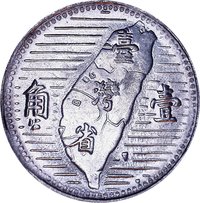
1 Jiao – Taiwan
China
Context
Year: 1955
Chinese republican Year: 44
Country: China 
Issuer: Taiwan 
Period:
(since 1949)
Currency:
(since 1949)
Subdivision: 1 Jiao = 10 Fen
Demonetized: Yes
Total mintage: 583,980,000
Material
References
Y: #Click to copy to clipboard533
Numista: #5648
Value
Exchange value: 0.1 TWD
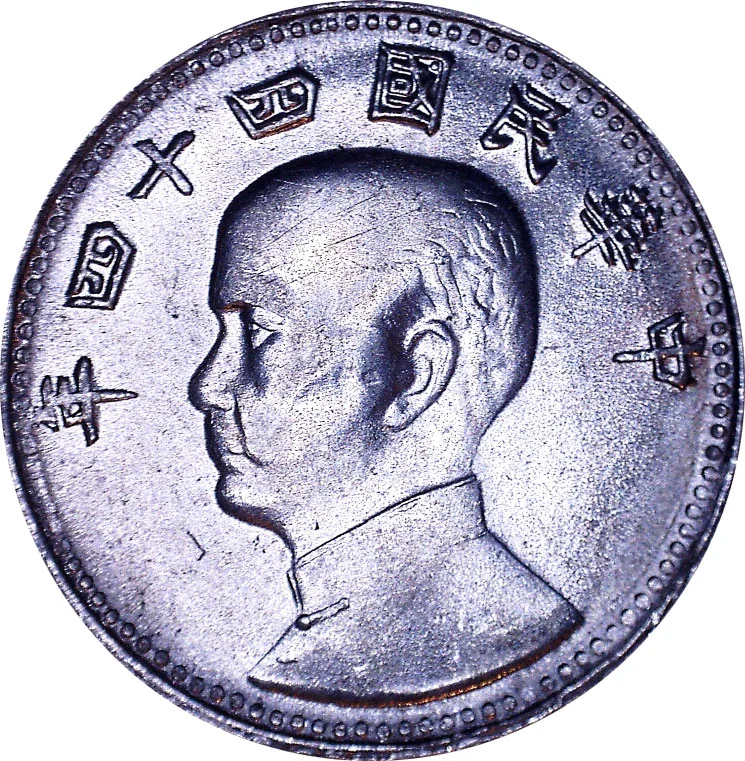
Obverse
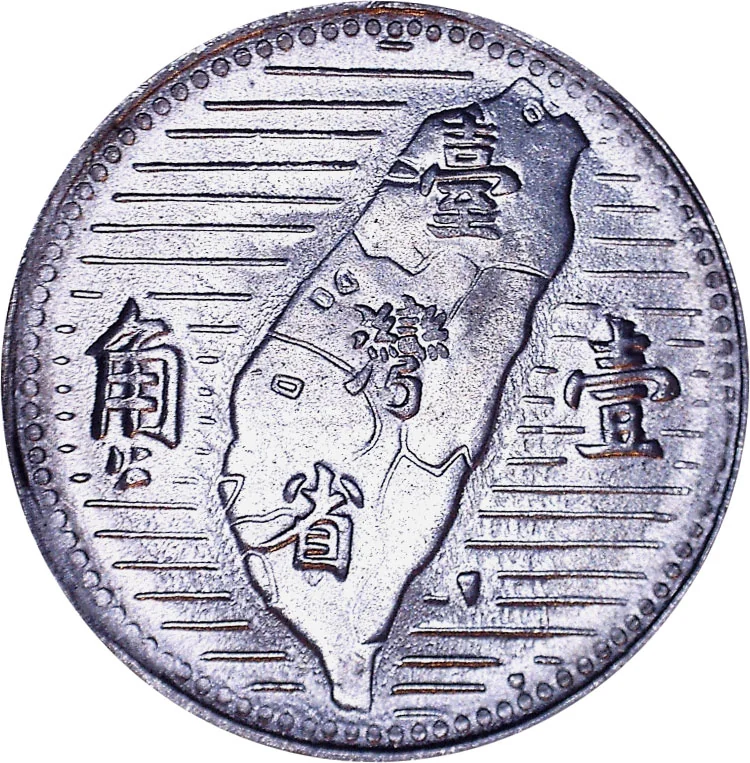
Reverse
Edge
Reeded
Categories
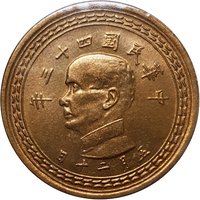
| Person> Politician |
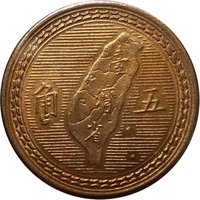
| Map |
Mintings
| Year | Mint Mark | Mintage | Quality | Collection |
|---|---|---|---|---|
| 1955 | — | 583,980,000 |
Historical background
In 1955, the currency situation in Taiwan was one of precarious stabilization following a period of extreme hyperinflation inherited from the final years of the Chinese Civil War. The New Taiwan Dollar (NTD), first issued by the Bank of Taiwan in 1949 to replace the old Taiwan Dollar, had been introduced at a rate of 40,000 old dollars to 1 new dollar. By 1955, this currency reform, overseen by Governor Chen Cheng and with guidance from American advisors, had succeeded in halting the inflationary spiral. This was achieved through strict fiscal discipline, including high interest rates, controls on credit, and a pegged exchange rate supported by substantial U.S. aid, which began flowing after the outbreak of the Korean War.
Despite this success, the economy and its currency in 1955 remained fragile and heavily managed. The official exchange rate was fixed at NT$15.55 to US$1, a rate maintained since 1953, but this peg was artificial and supported by extensive controls. A complex system of foreign exchange certificates and import licensing was in place to conserve scarce foreign reserves and prioritize the import of essential goods and raw materials for strategic industries. The currency was not freely convertible, and its stability was directly underpinned by the massive influx of U.S. economic and military assistance, which averaged over US$100 million annually throughout the 1950s.
Therefore, the currency situation in 1955 reflected a transitional phase. The immediate threat of hyperinflation had been contained, laying a foundational monetary stability for the future "Taiwan Miracle." However, the New Taiwan Dollar existed within a tightly controlled, aid-dependent, and import-substitution economy. True monetary independence and the move toward a market-driven exchange rate would only begin to materialize in the subsequent decades as Taiwan's export-oriented industrialization accelerated and its economic footing grew more secure.
Despite this success, the economy and its currency in 1955 remained fragile and heavily managed. The official exchange rate was fixed at NT$15.55 to US$1, a rate maintained since 1953, but this peg was artificial and supported by extensive controls. A complex system of foreign exchange certificates and import licensing was in place to conserve scarce foreign reserves and prioritize the import of essential goods and raw materials for strategic industries. The currency was not freely convertible, and its stability was directly underpinned by the massive influx of U.S. economic and military assistance, which averaged over US$100 million annually throughout the 1950s.
Therefore, the currency situation in 1955 reflected a transitional phase. The immediate threat of hyperinflation had been contained, laying a foundational monetary stability for the future "Taiwan Miracle." However, the New Taiwan Dollar existed within a tightly controlled, aid-dependent, and import-substitution economy. True monetary independence and the move toward a market-driven exchange rate would only begin to materialize in the subsequent decades as Taiwan's export-oriented industrialization accelerated and its economic footing grew more secure.
🌱 Very Common