

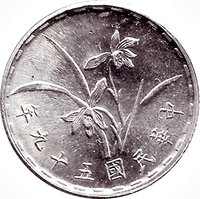
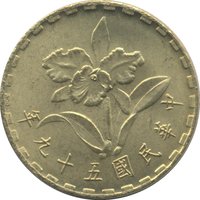
Obverse
Description:
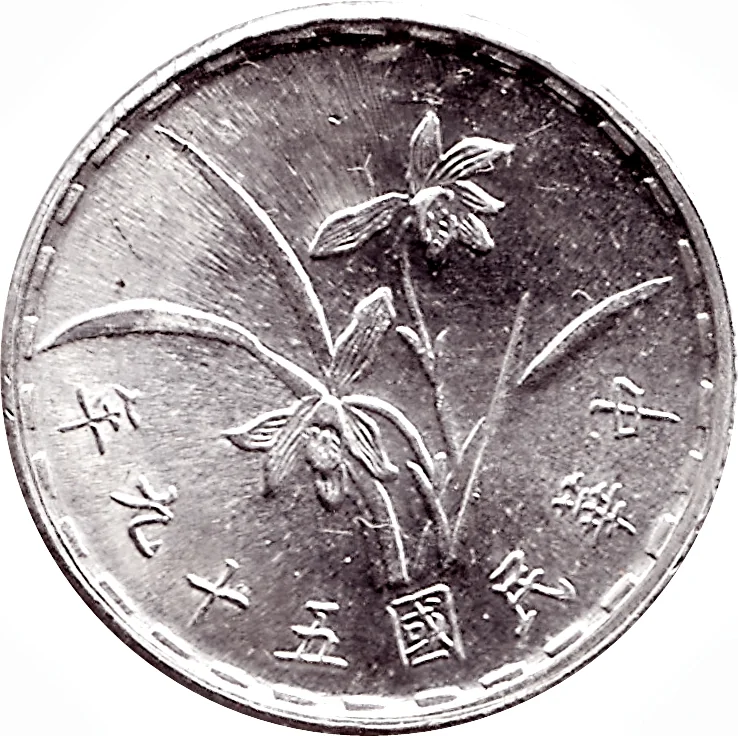
Single-heart orchid, dated.
Inscription:
年九十五國民華中
Translation:
Ninety-fifth Year of the Republic of China
Scripts: Chinese (traditional, regular script)
Language: Chinese
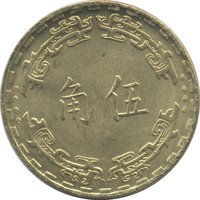
Reverse
Description:
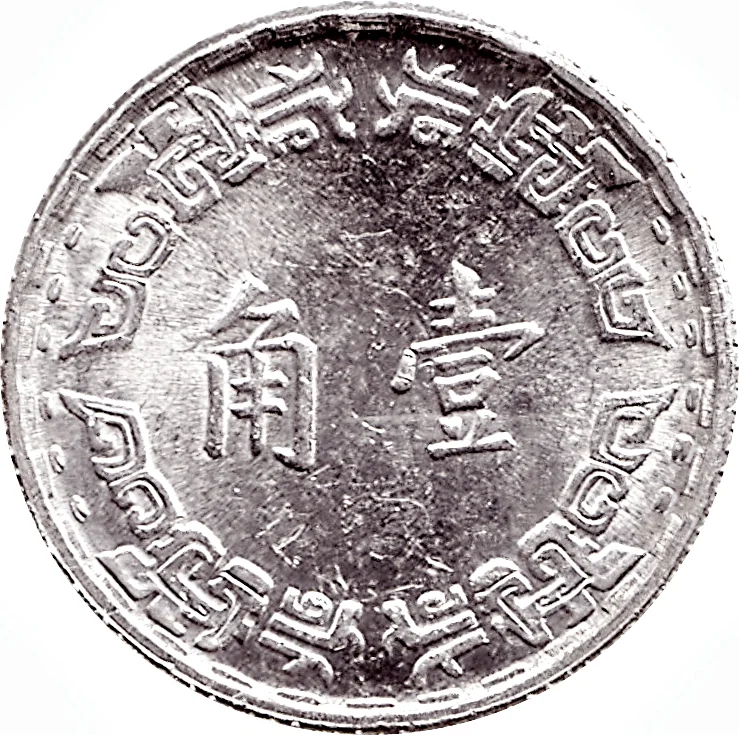
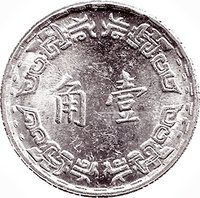
Denomination
Inscription:
角壹
Translation:
Corner One
Scripts: Chinese (traditional, regular script)
Language: Chinese
Edge
Reeded, low and high frequency of grooves for different years
Mints
| Name | Mark |
|---|---|
| Central Mint of Taiwan | — |
Mintings
| Year | Mint Mark | Mintage | Quality | Collection |
|---|---|---|---|---|
| 1967 | — | 89,999,000 | ||
| 1970 | — | 30,000,000 | ||
| 1971 | — | 19,925,000 | ||
| 1972 | — | 11,141,000 | ||
| 1973 | — | 111,400,000 | ||
| 1974 | — | 71,930,000 |
Historical background
In 1967, the currency situation in Taiwan was one of remarkable stability and control, a significant achievement following a period of hyperinflation and economic turmoil after the Chinese Civil War. The New Taiwan Dollar (NTD), introduced in 1949 to replace the Old Taiwan Dollar at a rate of 1:40,000, was firmly managed by the Central Bank of China (re-established in Taipei in 1961). The exchange rate was pegged to the US Dollar at a fixed rate of NT$40 to US$1, a policy that provided a crucial anchor for both trade and investor confidence during the island's export-oriented industrialization drive.
This stability was underpinned by conservative fiscal policies, strict foreign exchange controls, and substantial economic aid from the United States, which had only recently ended in 1965. The government, led by the Kuomintang (KMT), maintained a tight grip on the financial system, directing credit towards strategic industries and limiting capital flight. This environment fostered rapid economic growth, with the economy transitioning from import-substitution to becoming a burgeoning export powerhouse for light industrial goods, setting the stage for the "Taiwan Miracle" of the coming decades.
However, this fixed-rate regime and controlled system also had inherent constraints. The peg, while stabilizing, required significant foreign exchange reserves to maintain and limited monetary policy autonomy. Furthermore, the strict controls on currency exchange and capital flows, though necessary for stability at the time, were not fully conducive to the development of a liberalized financial market. Thus, the currency situation in 1967 represented a successful but tightly managed system, providing the platform for growth while eventually requiring liberalization reforms in the following decades as Taiwan's economy matured and integrated further into the global market.
This stability was underpinned by conservative fiscal policies, strict foreign exchange controls, and substantial economic aid from the United States, which had only recently ended in 1965. The government, led by the Kuomintang (KMT), maintained a tight grip on the financial system, directing credit towards strategic industries and limiting capital flight. This environment fostered rapid economic growth, with the economy transitioning from import-substitution to becoming a burgeoning export powerhouse for light industrial goods, setting the stage for the "Taiwan Miracle" of the coming decades.
However, this fixed-rate regime and controlled system also had inherent constraints. The peg, while stabilizing, required significant foreign exchange reserves to maintain and limited monetary policy autonomy. Furthermore, the strict controls on currency exchange and capital flows, though necessary for stability at the time, were not fully conducive to the development of a liberalized financial market. Thus, the currency situation in 1967 represented a successful but tightly managed system, providing the platform for growth while eventually requiring liberalization reforms in the following decades as Taiwan's economy matured and integrated further into the global market.
🌱 Very Common