

500 yen (Local Autonomy Law) – Japan
Add to wishlist
Circulating commemorative coins
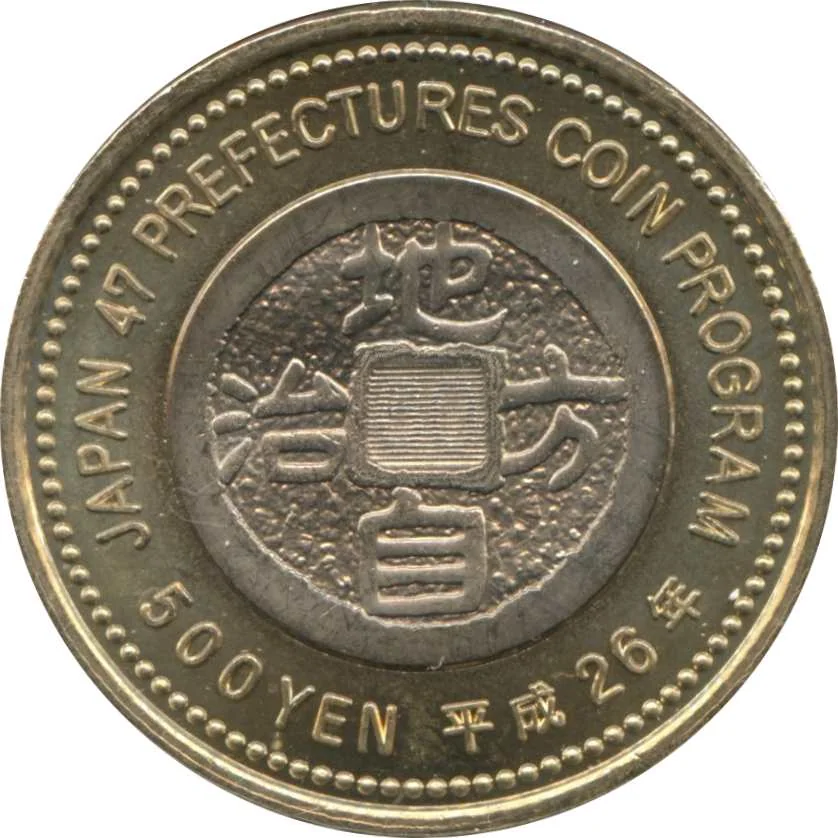
Commemoration: 60th anniversary of Local Autonomy Law
Japan
Context
Year: 2014
Japanese - Heisei era Year:: 26
Issuer: Japan
Ruler: Heisei
Currency:
(since 1871)
Total mintage: 1,780,000
Material
Diameter: 26.5 mm
Weight: 7.1 g
Thickness: 1.8 mm
Shape: Round
Techniques: Latent image, Milled
Alignment: Medal alignment
flip
References
Y: #
Numista: #69309
Value
Exchange value: 500 JPY
Inflation-adjusted value: 573.43 JPY
Obverse
Description:
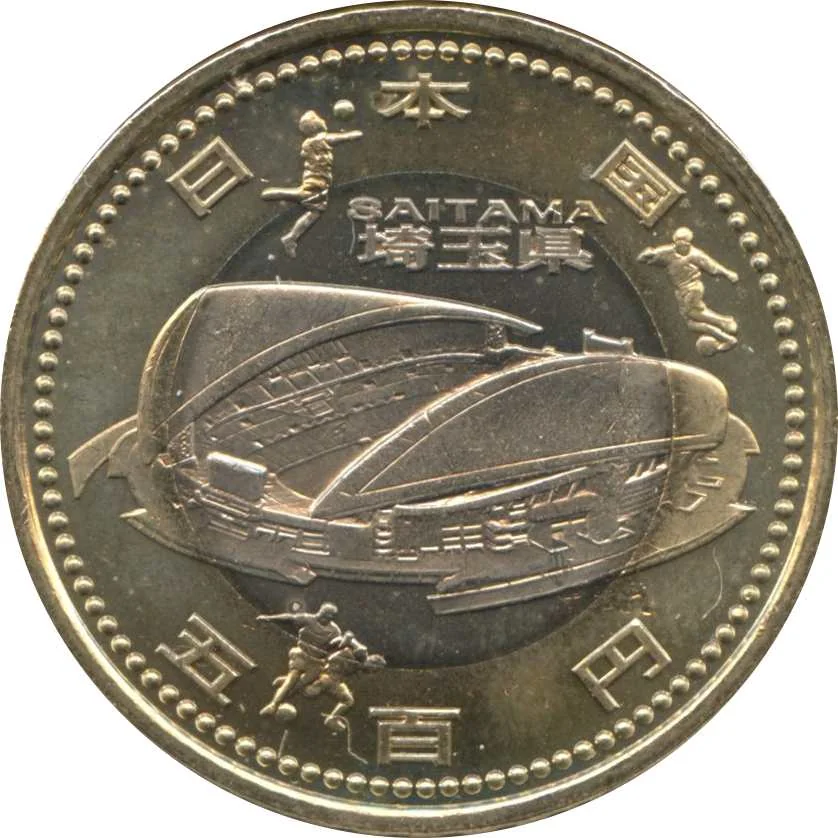
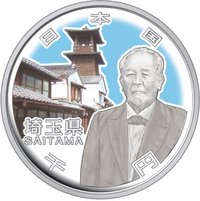
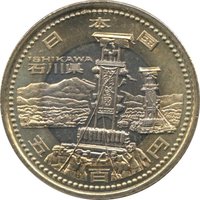
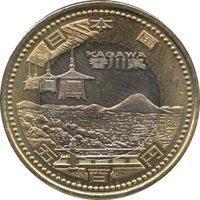
Saitama Stadium 2002 with three players.
Inscription:
日 本 国
SAITAMA
埼玉県
五 百 円
SAITAMA
埼玉県
五 百 円
Translation:
Japan
SAITAMA
Saitama Prefecture
Five Hundred Yen
SAITAMA
Saitama Prefecture
Five Hundred Yen
Language: Japanese
Reverse
Edge
Slanted reeding with two different pitches
Categories
| Sport> Sports venue |
| Currency> Coin depiction |
| Sport> Football |
Mints
| Name | Mark |
|---|---|
| Japan Mint | — |
Mintings
| Year | Mint Mark | Mintage | Quality | Collection |
|---|---|---|---|---|
| 2014 | — | 1,750,000 | ||
| 2014 | — | 30,000 | Proof |
Historical background
In 2014, Japan was in the midst of an unprecedented monetary experiment under Prime Minister Shinzo Abe's "Abenomics" program, with the yen's value being a central focus. The Bank of Japan (BOJ), under Governor Haruhiko Kuroda, had launched an aggressive quantitative and qualitative easing (QQE) program in April 2013, aiming to end decades of deflation by targeting 2% inflation. A core tactic was deliberately weakening the yen to boost exports by making Japanese goods cheaper abroad. This policy succeeded in driving the yen down significantly from its historic highs, trading around 105-120 against the US dollar for much of 2014, which provided a substantial tailwind for major exporters like Toyota and Sony.
However, the currency situation presented a double-edged sword. While a weak yen helped export profits, it sharply increased the cost of imports, particularly energy and raw materials. This was acutely painful because Japan had shut down its nuclear reactors after the 2011 Fukushima disaster, forcing reliance on expensive imported fossil fuels. Consequently, households and smaller businesses faced rising costs, squeezing real incomes and dampening domestic consumption. The weak yen also failed to produce a dramatic surge in export volumes that policymakers had hoped for, as many manufacturers had moved production overseas in previous years.
By the end of 2014, the currency dynamics were further complicated by shifting global monetary policy. The US Federal Reserve was concluding its own quantitative easing, setting the stage for future interest rate hikes, which strengthened the US dollar. This divergence helped sustain the BOJ's desired weak-yen trend without requiring new action from Tokyo. Nevertheless, the primary goal of achieving stable 2% inflation remained elusive, as the boost from the weak yen was largely seen as temporary. This set the stage for the BOJ's decision in October 2014 to expand its already massive stimulus program, doubling down on its commitment to reflate the economy through continued yen depreciation and asset purchases.
However, the currency situation presented a double-edged sword. While a weak yen helped export profits, it sharply increased the cost of imports, particularly energy and raw materials. This was acutely painful because Japan had shut down its nuclear reactors after the 2011 Fukushima disaster, forcing reliance on expensive imported fossil fuels. Consequently, households and smaller businesses faced rising costs, squeezing real incomes and dampening domestic consumption. The weak yen also failed to produce a dramatic surge in export volumes that policymakers had hoped for, as many manufacturers had moved production overseas in previous years.
By the end of 2014, the currency dynamics were further complicated by shifting global monetary policy. The US Federal Reserve was concluding its own quantitative easing, setting the stage for future interest rate hikes, which strengthened the US dollar. This divergence helped sustain the BOJ's desired weak-yen trend without requiring new action from Tokyo. Nevertheless, the primary goal of achieving stable 2% inflation remained elusive, as the boost from the weak yen was largely seen as temporary. This set the stage for the BOJ's decision in October 2014 to expand its already massive stimulus program, doubling down on its commitment to reflate the economy through continued yen depreciation and asset purchases.
🌟 Uncommon