

1000 yen (Local Autonomy Law) – Japan
Add to wishlist
Non-circulating coins
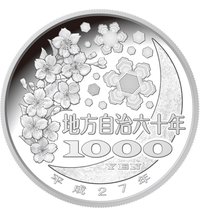
Commemoration: 60th anniversary of Local Autonomy Law
Japan
Context
Year: 2015
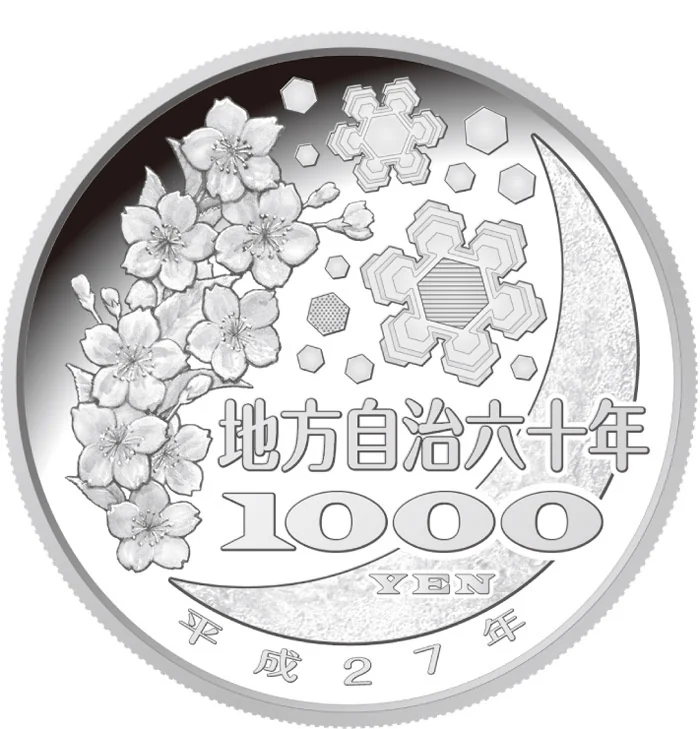
Japanese - Heisei era Year:: 27
Issuer: Japan
Ruler: Heisei
Currency:
(since 1871)
Total mintage: 100,000
Material
Diameter: 40 mm
Weight: 31.1 g
Silver Weight:: 31.07 g
Thickness: 3.5 mm
Shape: Round
Composition: 99.9% Silver
Standard: Silver ounce
Magnetic: No
Alignment: Medal alignment
flip
References
Y: #
Numista: #123696
Value
Exchange value: 1000 JPY
Bullion value: $77.44
Inflation-adjusted value: 1116.06 JPY
Obverse
Description:
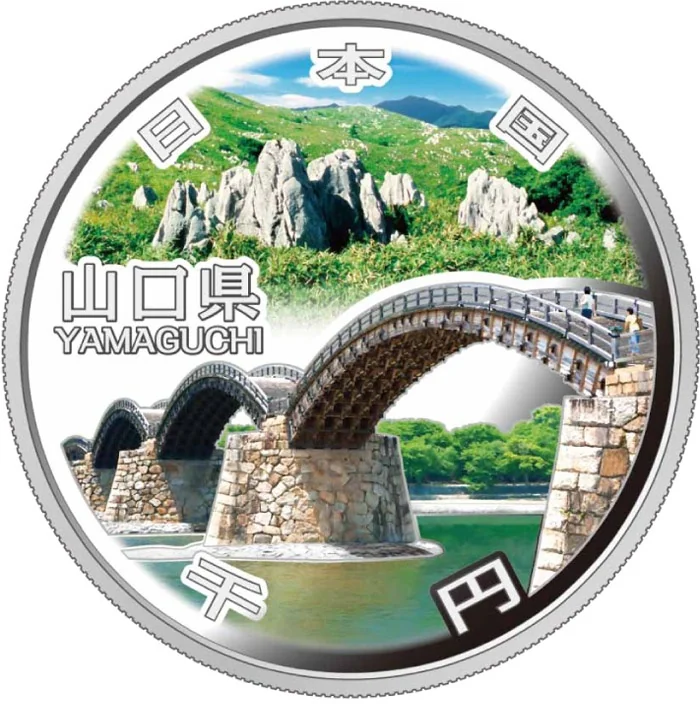
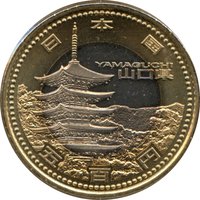
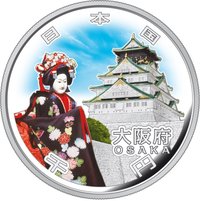
Kintaikyo Bridge and Akiyoshidai Plateau in Color
Inscription:
日 本 国
山口県
YAMAGUCHI
千 円
山口県
YAMAGUCHI
千 円
Translation:
JAPAN
Yamaguchi Prefecture
YAMAGUCHI
One Thousand Yen
Yamaguchi Prefecture
YAMAGUCHI
One Thousand Yen
Language: Japanese
Reverse
Edge
Slanted reeding right
Mints
| Name | Mark |
|---|---|
| Japan Mint | — |
Mintings
| Year | Mint Mark | Mintage | Quality | Collection |
|---|---|---|---|---|
| 2015 | — | 100,000 | Proof |
Historical background
In 2015, Japan's currency situation was dominated by the continued effects of "Abenomics," the aggressive economic policy package championed by Prime Minister Shinzo Abe. A central pillar of this strategy, driven by the Bank of Japan (BOJ) under Governor Haruhiko Kuroda, was unprecedented monetary easing aimed at defeating deflation. This policy deliberately weakened the yen to boost exports and corporate profits, with the USD/JPY rate averaging around 120 for the year, a significant depreciation from the 80-level seen just a few years prior. This weak yen was a double-edged sword: it provided a major tailwind for large exporters like Toyota and Sony, but also increased import costs for energy and food, squeezing household budgets.
The year was also marked by a pivotal policy shift by the BOJ. In late October, the bank announced it would expand its massive asset-purchase program and, for the first time, set a target for 10-year government bond yields to remain at around zero percent. This move to a form of "yield curve control" was an acknowledgment that simply expanding the monetary base was insufficient to sustainably achieve the 2% inflation target. Despite years of stimulus, core inflation (excluding fresh food) hovered near zero for much of 2015, as a sharp fall in global oil prices and sluggish wage growth undermined efforts to reflate the economy.
Internationally, the yen's trajectory was heavily influenced by divergent monetary policies, particularly the expectation of interest rate hikes by the U.S. Federal Reserve. This policy divergence pushed the dollar higher against the yen throughout the year. Furthermore, Japan's currency faced sporadic bouts of strength as a "safe-haven" asset during periods of global market turmoil, such as the Greek debt crisis and the Chinese stock market crash in the summer. These fluctuations highlighted the ongoing tension between the BOJ's deliberate weakening campaign and the yen's traditional role as a refuge during uncertainty, defining a complex currency landscape for the world's third-largest economy.
The year was also marked by a pivotal policy shift by the BOJ. In late October, the bank announced it would expand its massive asset-purchase program and, for the first time, set a target for 10-year government bond yields to remain at around zero percent. This move to a form of "yield curve control" was an acknowledgment that simply expanding the monetary base was insufficient to sustainably achieve the 2% inflation target. Despite years of stimulus, core inflation (excluding fresh food) hovered near zero for much of 2015, as a sharp fall in global oil prices and sluggish wage growth undermined efforts to reflate the economy.
Internationally, the yen's trajectory was heavily influenced by divergent monetary policies, particularly the expectation of interest rate hikes by the U.S. Federal Reserve. This policy divergence pushed the dollar higher against the yen throughout the year. Furthermore, Japan's currency faced sporadic bouts of strength as a "safe-haven" asset during periods of global market turmoil, such as the Greek debt crisis and the Chinese stock market crash in the summer. These fluctuations highlighted the ongoing tension between the BOJ's deliberate weakening campaign and the yen's traditional role as a refuge during uncertainty, defining a complex currency landscape for the world's third-largest economy.
💎 Extremely Rare