

10 fen – Manchurian Provinces
Add to wishlist
China
Context
Year: 1907
Chinese - Guangxu era Year:: 33
Country: China
Issuer: Manchurian Provinces
Ruler: Guangxu
Currency:
(1907—1931)
Demonetized: Yes
Total mintage: 1,079,000
Material
References
Y: #
Numista: #60994
Value
Bullion value: $5.63
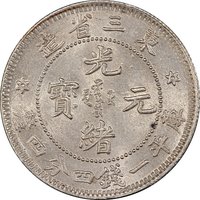
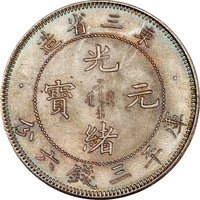
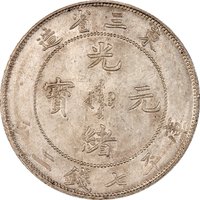
Obverse
Description:
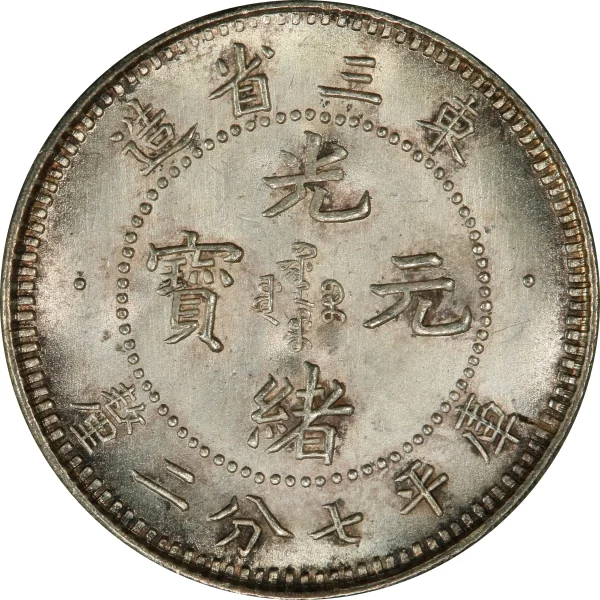
Chinese ideograms read vertically, right to left, with Manchu text in the center, all encircled by more Chinese characters.
Inscription:
造省三東
光
ᠪᠠᡩᠠᡵᠠᠩᡤᠠ
寶 ᠶᡠᠸᠠᠨ ᠪᠣᠣ 元
ᡩᠣᡵᠣ
緒
釐二分七平庫
光
ᠪᠠᡩᠠᡵᠠᠩᡤᠠ
寶 ᠶᡠᠸᠠᠨ ᠪᠣᠣ 元
ᡩᠣᡵᠣ
緒
釐二分七平庫
Translation:
Made at the Three Eastern Provinces Mint
Guangxu
Badarangga
Doro
Yuan Bao
7 Fen 2 Li, Treasury Standard Weight
Guangxu
Badarangga
Doro
Yuan Bao
7 Fen 2 Li, Treasury Standard Weight
Scripts: Chinese, Mongolian / Manchu
Languages: Classical Chinese, Manchu
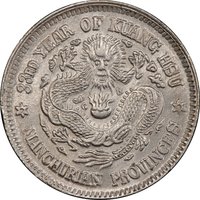
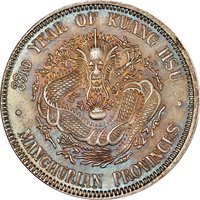
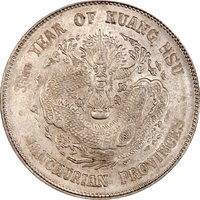
Reverse
Description:
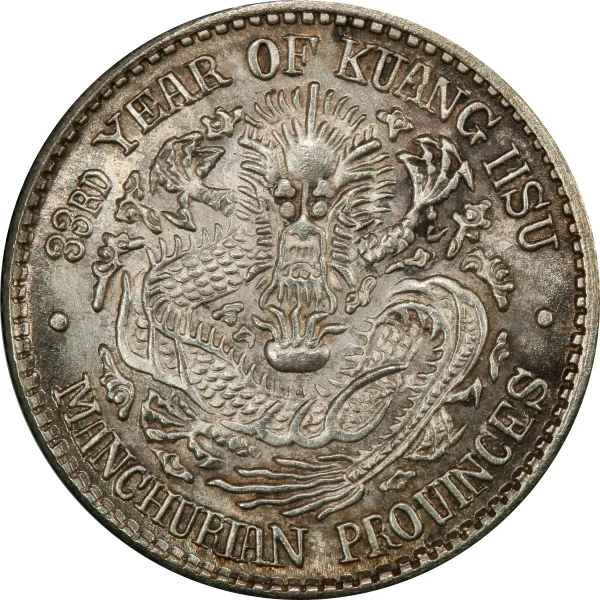
Dragon encircling a pearl, surrounded by English text.
Inscription:
33RD YEAR OF KUANG HSU
MANCHURIAN PROVINCES
MANCHURIAN PROVINCES
Script: Latin
Edge
Reeded.
Categories
| Mythology> Fantastic animal |
Mintings
| Year | Mint Mark | Mintage | Quality | Collection |
|---|---|---|---|---|
| 1907 | — | 1,079,000 |
Historical background
By 1907, the currency situation in China's three northeastern provinces (Manchuria) was a complex and volatile reflection of competing imperial interests and weak central authority. The region was flooded with a bewildering variety of circulating media. The primary Chinese currency was the tiao of fing cash (copper-alloy coins with a square hole), but its value and supply were highly unstable due to rampant counterfeiting and the hoarding of genuine coins. Alongside this, silver circulated by weight in the form of sycee (shoe-shaped ingots) and, increasingly, foreign-minted silver dollars, particularly the Mexican Silver Dollar, which served as a major trade currency.
This monetary chaos was exacerbated by the presence of multiple foreign powers. Following the Russo-Japanese War (1904-05), Japan had replaced Russia as the dominant force in southern Manchuria (the Kwantung Leased Territory and South Manchuria Railway zone). The Russian ruble still circulated in the north, while the Japanese yen, backed by the Yokohama Specie Bank, was aggressively promoted in their sphere of influence. Both powers issued their own banknotes, aiming to tie the regional economy to their respective financial systems and marginalize Chinese currency. This created a patchwork of monetary zones and undermined Qing sovereignty.
Recognizing the economic and strategic danger, Qing authorities, led by the Viceroy of the Three Eastern Provinces, Xu Shichang, and his financial commissioner Tang Shaoyi, initiated urgent currency reforms in 1907. Their central project was the creation of the Bank of the Three Eastern Provinces (Dongsan Sheng Yinhang), founded in Shenyang (Mukden) with capital from the Tianjin-based Board of Revenue Bank. Its key mission was to issue a unified, silver-based provincial currency—the Xiangping tael banknote—to drive out foreign notes and stabilize exchange. Thus, 1907 stands as a pivotal year of attempted financial consolidation by the Qing state, directly contesting Japanese and Russian monetary imperialism in a bid to reassert control over Manchuria's economic future.
This monetary chaos was exacerbated by the presence of multiple foreign powers. Following the Russo-Japanese War (1904-05), Japan had replaced Russia as the dominant force in southern Manchuria (the Kwantung Leased Territory and South Manchuria Railway zone). The Russian ruble still circulated in the north, while the Japanese yen, backed by the Yokohama Specie Bank, was aggressively promoted in their sphere of influence. Both powers issued their own banknotes, aiming to tie the regional economy to their respective financial systems and marginalize Chinese currency. This created a patchwork of monetary zones and undermined Qing sovereignty.
Recognizing the economic and strategic danger, Qing authorities, led by the Viceroy of the Three Eastern Provinces, Xu Shichang, and his financial commissioner Tang Shaoyi, initiated urgent currency reforms in 1907. Their central project was the creation of the Bank of the Three Eastern Provinces (Dongsan Sheng Yinhang), founded in Shenyang (Mukden) with capital from the Tianjin-based Board of Revenue Bank. Its key mission was to issue a unified, silver-based provincial currency—the Xiangping tael banknote—to drive out foreign notes and stabilize exchange. Thus, 1907 stands as a pivotal year of attempted financial consolidation by the Qing state, directly contesting Japanese and Russian monetary imperialism in a bid to reassert control over Manchuria's economic future.
💎 Extremely Rare